




-
- PCB TYPE
- PRINTED CIRCUIT BOARD PROTOTYPE ALUMINUM PRINTED CIRCUIT BOARD R&F PCB FPC HIGH FREQUENCY PCB HIGH-TG PCB HEAVY COPPER PCB HDI PCB PCB FOR LIGHTING METAL CORE PCB


time:May 19. 2026, 10:27:25
The relentless drive toward ultra-thin device profiles, complex form factors, and high-frequency signal processing has pushed rigid circuit boards to their physical limits. In the modern hardware ecosystem—dominated by foldable smartphones, advanced driver-assistance systems (ADAS), high-density medical diagnostics, and wearable IoT arrays—flexible electronics have transitioned from a luxury spacing alternative to a primary architectural requirement.
Designing these next-generation systems is only half the battle. Translating complex, dynamic flexible layouts into highly reproducible, multi-layer physical hardware requires an elite manufacturing partner. As an advanced FPC manufacturer, ApolloPCB delivers the precise engineering frameworks, advanced material science, and high-yield automation necessary to fabricate multi-layer flexible printed circuits that withstand millions of flex cycles without degradation.
By integrating state-of-the-art lamination, registration, and inspection technologies, we provide our global B2B clients with advanced flexible PCB solutions that form the structural and electrical backbone of high-stakes hardware innovations.
Fabricating a multi-layer FPC is radically different from constructing a rigid PCB. In multi-layer rigid manufacturing, fiberglass-reinforced epoxy substrates provide inherent structural stability. Flexible circuits, conversely, rely on thin, ductile polyimide (PI) base films. While polyimide offers exceptional thermal endurance and electrical insulation, its low mechanical modulus means it expands, contracts, and shifts significantly during thermal and chemical processing.
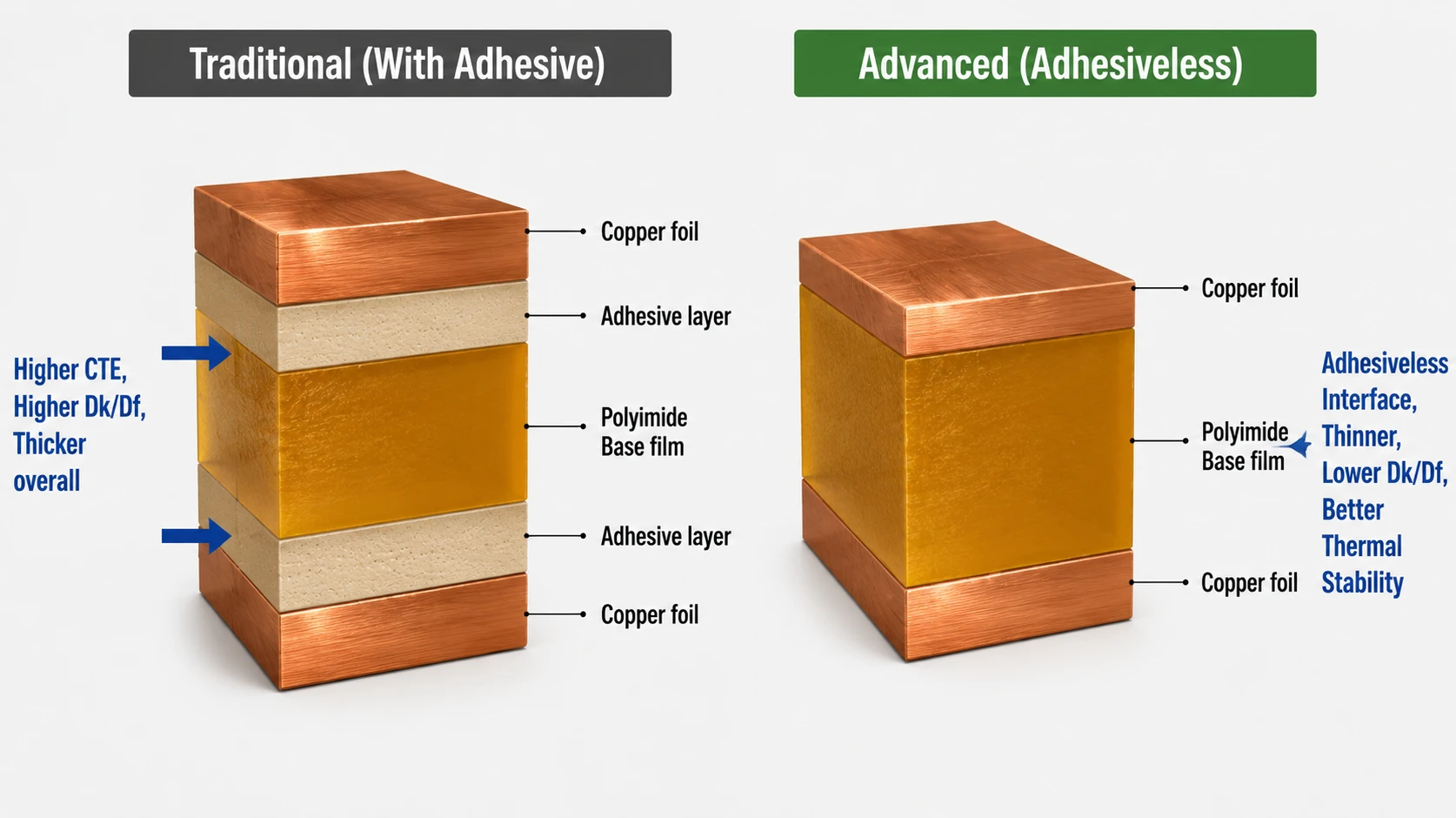
As a highly capable customize FPC manufacturer, ApolloPCB minimizes these structural instabilities by utilizing premium adhesiveless Flexible Copper Clad Laminates (FCCL). Traditional flexible laminates rely on an acrylic or butyral adhesive layer to bond the copper foil to the polyimide core. However, these adhesive layers are the weakest link in high-reliability applications:
Thermal Stress: Adhesives exhibit a much higher coefficient of thermal expansion (CTE) than copper or PI, leading to severe Z-axis expansion during reflow or wave soldering, which can fracture plated through-holes (PTH).
Thickness Disadvantages: Adhesiveless materials yield thinner, more flexible stack-ups, allowing for smaller bend radii in tight enclosures.
Signal Loss: Acrylic adhesives exhibit higher dielectric constants (Dk) and dissipation factors (Df) compared to pure polyimide, causing unacceptable insertion losses in high-frequency circuits.
When building FPCs with 4, 6, or more layers, controlling the dimensional shift between layers is a critical manufacturing variable. Every time a polyimide layer undergoes etching, baking, or lamination, it experiences a micro-scale structural distortion.
To maintain absolute layer-to-layer alignment, ApolloPCB implements computerized optical registration target tracking and advanced pinning systems during the sequential lamination phase. Our automated vacuum hydraulic presses apply precise, non-linear temperature and pressure profiles to ensure the adhesive-backed coverlays or bondplies flow uniformly into the circuit topography without causing voiding, trace shifting, or internal stress traps. This careful management of material physics ensures that the final multi-layer FPC retains its exact shape and electrical performance across its operational lifespan, matching the baseline benchmarks established in our comprehensive framework on custom FPC and HDI flexible PCB foundations.
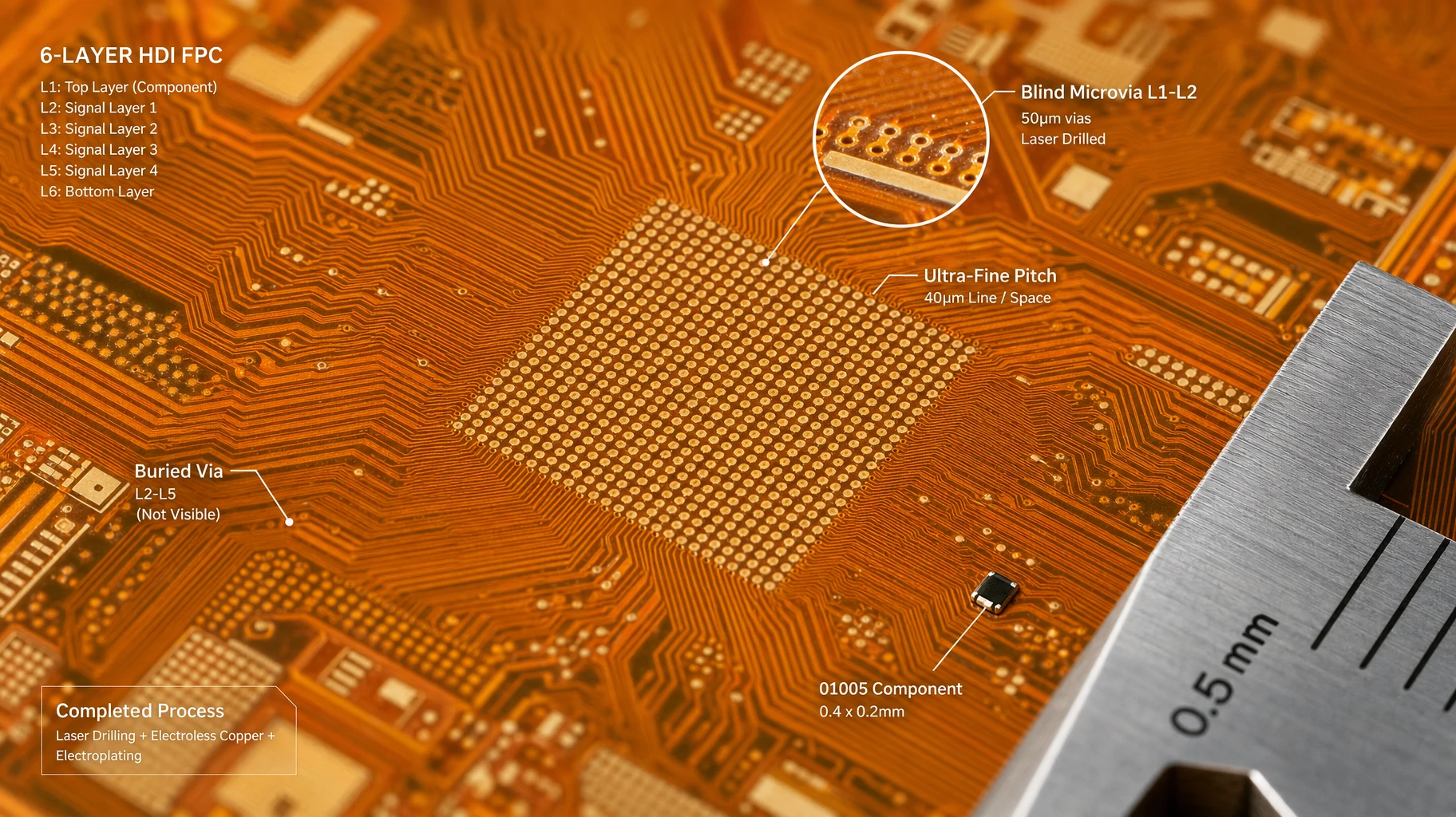
As component pitches shrink on modern microprocessors and chip-scale packages (CSPs), standard mechanical drilling becomes unviable for flexible substrates. Achieving the required routing density within a multi-layer flexible architecture demands High-Density Interconnect (HDI) engineering.
To bridge the gap between sub-millimeter component pads and inner routing layers, our manufacturing line utilizes a highly controlled, multi-stage microvia interconnect pipeline:
| Interconnect Stage | Technical Specifications | Manufacturing & Routing Mechanism |
| Component Lead Alignment | Ultra-Fine Pitch (0.35mm) | Precision SMT placement platform for high-pin count CSPs and micro-BGA packages. |
| Microvia Formation | Laser UV/CO2 Drilled (50μm - 75μm) | High-energy pulse ablation to penetrate copper/polyimide layers with zero peripheral thermal stress. |
| Layer-to-Layer Interconnect | Blind / Buried Via Integration | Sequential copper-plating and lamination enabling direct inner-layer routing while freeing surface area. |
ApolloPCB acts as an authoritative HDI FPC manufacturer, deploying advanced ultraviolet (UV) and carbon dioxide (CO2) dual-source laser drilling systems. UV lasers excel at clean, high-energy ablation of copper foils and polyimide with zero thermal damage to the surrounding organic matrix, allowing us to drill microvias with diameters as small as 50μm.
Following laser ablation, the flexible panels undergo specialized plasma desmear processes. Unlike rigid boards that can tolerate aggressive chemical desmearing, flexible polyimide substrates are prone to chemical swelling. Our low-temperature gas plasma treatment modifies the microvia inner-walls on a molecular level, removing any carbonaceous resin debris and ensuring optimal copper adhesion during subsequent metallization steps.
True spatial optimization in multi-layer flexible circuits is achieved by routing interconnects through internal layers without consuming surface real estate. Operating as a premier blind and buried vias FPC manufacturer, ApolloPCB executes complex sequential lamination schedules to create independent, overlapping via structures:
Buried Vias: Connect internal signal layers (e.g., Layer 2 to Layer 3) and are completely enclosed during lamination, leaving outer surfaces clear for components.
Blind Vias: Link an external surface layer to an inner layer, terminating at a specific depth pad without drilling completely through the FPC.
These microvias are then copper-filled via advanced periodic-reverse pulse electroplating. This process builds up copper uniformly inside the small via cavity while preventing over-plating on the surface traces. Filled microvias can be stacked directly on top of buried vias or utilized as "via-in-pad" structures, giving hardware designers absolute routing freedom and enabling the extreme density profiles that are critical for modern consumer and computing devices.
A premium flexible circuit substrate is only as good as its assembly readiness. Because FPCs are destined for dynamic environments where they are subject to constant twisting, bending, and vibrational harmonic strain, component attachment and surface finishes must meet strict mechanical criteria.
To support fine-pitch Surface Mount Technology (SMT) alongside direct chip-on-flex (COF) integrations, ApolloPCB offers specialized chemical plating options. While Electroless Nickel Immersion Gold (ENIG) is a standard offering, we frequently deploy Electroless Nickel Electroless Palladium Immersion Gold (ENEPIG) for high-performance applications. ENEPIG provides an ultra-flat surface profile that eliminates brittle intermetallic failures ("black pad") and serves as an exceptional platform for FPC gold ball bonding.
In high-density optical modules and localized sensor array packaging, gold wire and ball bonding require a highly ductile, high-purity gold deposit. Our controlled plating lines ensure the gold grain structure is perfectly optimized to accept thermosonic wire bonds, creating low-resistance molecular connections between bare semiconductor dies and the flexible copper traces.
Assembling components onto a flexible sheet requires an entirely different tooling setup than processing rigid boards. Because a multi-layer FPC is flexible, it cannot pass through standard SMT lines without warping, stretching, or vibrating out of alignment.
ApolloPCB utilizes custom-milled aluminum or magnetic carrier fixtures to temporarily hold each flexible circuit panel completely flat during solder paste printing, high-speed pick-and-place, and multi-zone reflow ovens. Our automated optical inspection (AOI) algorithms are custom-tuned to account for the natural reflective variations of polyimide coverlays, ensuring precise solder joint validation. Our specialized FPC High Density Component Assembly workflows encompass:
Stiffener Integration: Precision bonding of localized FR4, polyimide, or stainless steel stiffeners using thermosetting or pressure-sensitive adhesives (PSA) beneath high-pin-count connectors to absorb mechanical mating stresses.
Underfill Application: Dispensing low-viscosity, high-modulus capillary underfills beneath large BGA and CSP components to redistribute thermal-expansion stress away from fragile solder balls.
Moisture Baking Cycles: Mandating pre-assembly vacuum baking routines to purge absorbed atmospheric moisture from the hydroscopic polyimide matrix, preventing delamination and blistering during lead-free reflow cycles (260°C).
An elite production facility must be highly adaptable. The manufacturing parameters required to construct an ultra-thin, high-density smartphone interface are radically different from those used to fabricate a heavy-copper battery management harness.
In the high-volume consumer sector, ApolloPCB serves as a strategic smartphone FPC manufacturer and Dsiplay FPC manufacturer. Mobile and display designs demand line-and-space widths down to 25μm to route high-definition video data, MIPI interfaces, and power lines through narrow mechanical hinges.
Our factory utilizes automated roll-to-roll (R2R) processing for high-volume display runs, ensuring uniform chemical exposure, minimized human handling, and continuous optical alignment. This level of processing control prevents trace fracturing at the display border bonding zone, ensuring flawless frame rates and long-term flexing endurance.
Conversely, serving as an authoritative Batteries FPC manufacturer requires handling thick-copper, multi-layer configurations. Battery Management Systems (BMS) for electric vehicles and large-scale energy storage arrays utilize long FPC harnesses to monitor cell voltages and localized temperatures simultaneously.
Our manufacturing lines are optimized to etch heavy copper foils (up to 3 oz) on flexible substrates while maintaining crisp trace geometries. This allows the boards to carry significant balancing currents without generating hot spots.
For structural human-machine interfaces, our specialized production cells act as a high-yield KeyPads FPC manufacturer and LED Lighting FPC manufacturer. Keypad arrays demand integrated dome-switch plating and high mechanical click endurance, while lighting strips require continuous, long-length lamination (often exceeding 5 meters) without cumulative registration drift. This wide-ranging operational versatility ensures that regardless of whether your hardware demands delicate high-speed signaling or high-current power distribution, ApolloPCB maintains the manufacturing precision required for high-flex automotive FPC performance.
To satisfy the demanding quality requirements of the aerospace, medical, and automotive sectors, ApolloPCB operates under strict IPC-6013 Class 3 guidelines. Because an FPC's internal layers are hidden from view once lamination is complete, structural validation must rely on data-driven, non-destructive and destructive testing methodologies.
Every production batch of multi-layer FPCs at ApolloPCB undergoes a rigorous quality protocol:
Micro-Sectioning and Cross-Section Analysis: Destructive testing of coupons processed alongside production panels to verify inner-layer registration, copper plating thickness inside microvias, and the absence of resin recession or delamination.
Dynamic Flex Testing: Sampling finished boards to undergo mechanical flexing simulations under controlled radii and speeds, tracking real-time resistance modifications to prove fatigue resistance.
High-Pot Testing and Continuity Validation: 100% automated flying probe or dedicated fixture electrical testing to ensure zero micro-shorts or latent open circuits exist within complex HDI FPC manufacturer footprints.
Our comprehensive process control provides international engineering teams with an authoritative layer of operational trust and manufacturing competence. By maintaining strict end-to-end traceability for every material batch, chemical bath, and laser run, we provide the foundational data infrastructure that global procurement teams need to optimize their custom FPC prototyping and OEM supply chains.
A1: Adhesiveless laminates eliminate the acrylic adhesive layer between the copper foil and the polyimide core. This results in a significantly thinner overall profile, improves the minimum bend radius, enhances Z-axis thermal reliability during soldering by reducing expansion stress, and provides superior signal integrity for high-speed digital applications due to a lower and more consistent dielectric loss.
A2: Utilizing advanced UV laser drilling and laser direct imaging (LDI), ApolloPCB can achieve microvia diameters down to 50μm and ultra-fine line/space configurations down to 25μm for specialized applications, such as high-density smartphone display drivers and medical sensor arrays.
A3: We implement a multi-stage thermal stabilization protocol. First, all flexible panels undergo a controlled vacuum baking cycle to eliminate absorbed atmospheric moisture. During assembly, the FPCs are locked into custom-engineered, rigid aluminum or magnetic carrier plates that hold the substrate completely flat, ensuring uniform thermal absorption and preventing component shifting or board warpage inside lead-free reflow ovens.
The performance of an advanced flexible electronic product depends entirely on the capability of its manufacturer. Micro-scale registration errors, inadequate desmearing, or poor material selection can result in latent field failures that damage a brand's reputation.
Consolidating your production with an experienced, technologically advanced FPC manufacturer like ApolloPCB mitigates these structural risks. We blend material science expertise, advanced laser processing, and rigorous quality validation to transform complex, multi-layer flexible circuit concepts into high-yielding, rugged physical realities.
Ready to secure elite multi-layer flexible fabrication for your next high-density hardware project? Request a custom FPC technical quote from the ApolloPCB engineering team today and experience factory-floor precision designed to scale with your innovation.
Custom FPC Manufacturer: HDI & Flexible PCB Solutions | ApolloPCB
Smartphone FPC Manufacturer | High-Density HDI & Multi-layer Flex PCB
Durable Keypad FPC Manufacturer: High-Cycle & Reliable Flex Solutions

Got project ready to assembly? Contact us: info@apollopcb.com



 Whatsapp 0086 755 29438407
 Mail info@apollopcb.com
 Tel 0086 755 29438407


ABOUT US

PRODUCTS
TECHNOLOGY
KNOWLEDGE CENTRE
CULTURE
NEWS
We're not around but we still want to hear from you! Leave us a note:

Leave Message to APOLLOPCB
