




-
- PCB TYPE
- PRINTED CIRCUIT BOARD PROTOTYPE ALUMINUM PRINTED CIRCUIT BOARD R&F PCB FPC HIGH FREQUENCY PCB HIGH-TG PCB HEAVY COPPER PCB HDI PCB PCB FOR LIGHTING METAL CORE PCB


time:Mar 13. 2026, 11:52:59
In the rapidly evolving landscape of electronics, the journey from a brilliant conceptual design to a market-ready product is fraught with technical hurdles. For industrial clients and hardware startups alike, the most critical phase is the transition from a low-volume prototype to high-volume manufacturing. Choosing the right pcb manufacturer is not just about finding a vendor; it is about securing a strategic partner capable of scaling your vision without compromising on quality or signal integrity.
As a top chinese pcb manufacturer, ApolloPCB specializes in bridging this gap. Whether you are developing complex industrial controllers or flexible wearables, understanding the nuances of the pcb manufacturing process is essential for a smooth market entry.
In the high-stakes world of industrial electronics, the leap from a functional prototype to a market-ready product is often the most treacherous phase of development. While many procurement managers searching for pcb manufacturing are initially lured by the lowest per-unit price, seasoned industrial buyers understand that true cost-efficiency is rooted in reliability and manufacturing yield.
A china-based pcb giant like ApolloPCB offers far more than just the raw economies of scale associated with high-volume output; they provide the indispensable engineering depth required to refine a raw design for global mass-market success.
The fundamental challenge lies in the shifting objectives between development stages. Prototyping is primarily an exercise in validation—it is the stage where engineers prove that the "proof of concept" works under controlled lab conditions. However, mass production is an entirely different discipline centered on yield and consistency.
A prototype that functions perfectly on a benchtop may harbor hidden "manufacturability" flaws—such as trace clearances that are too tight for high-speed etching or via placements that invite solder bridging. Without a partner who understands these nuances, a project can suffer from a "low yield" nightmare, where 20% or more of the manufactured boards end up as scrap, effectively evaporating any initial price savings.
This is where the intervention of a professional pcb fabrication manufacturer becomes a strategic asset. During the critical DFM (Design for Manufacturing) phase, a technical-driven manufacturer acts as a final gatekeeper. By deploying advanced CAM (Computer-Aided Manufacturing) tools and drawing on a decade of industrial experience, they identify potential design flaws before a single sheet of copper is etched.
Thermal Relief Optimization: Ensuring that heat is distributed evenly during reflow soldering to prevent component tombstoning.
Signal Integrity Refinement: Adjusting stack-ups to maintain precise impedance control across thousands of units.
Mechanical Precision: Verifying that mounting holes and board outlines account for material shrinkage and expansion during the lamination process.
By partnering with a manufacturer that prioritizes these technical details, you ensure that a board which works in a lab environment can be replicated by the thousands in an automated facility with 100% repeatability. In the industrial sector, where downtime or field failures can lead to massive liabilities, choosing a reliable pcb manufacturer is not just a purchasing decision—it is a risk management strategy that protects your brand’s reputation.
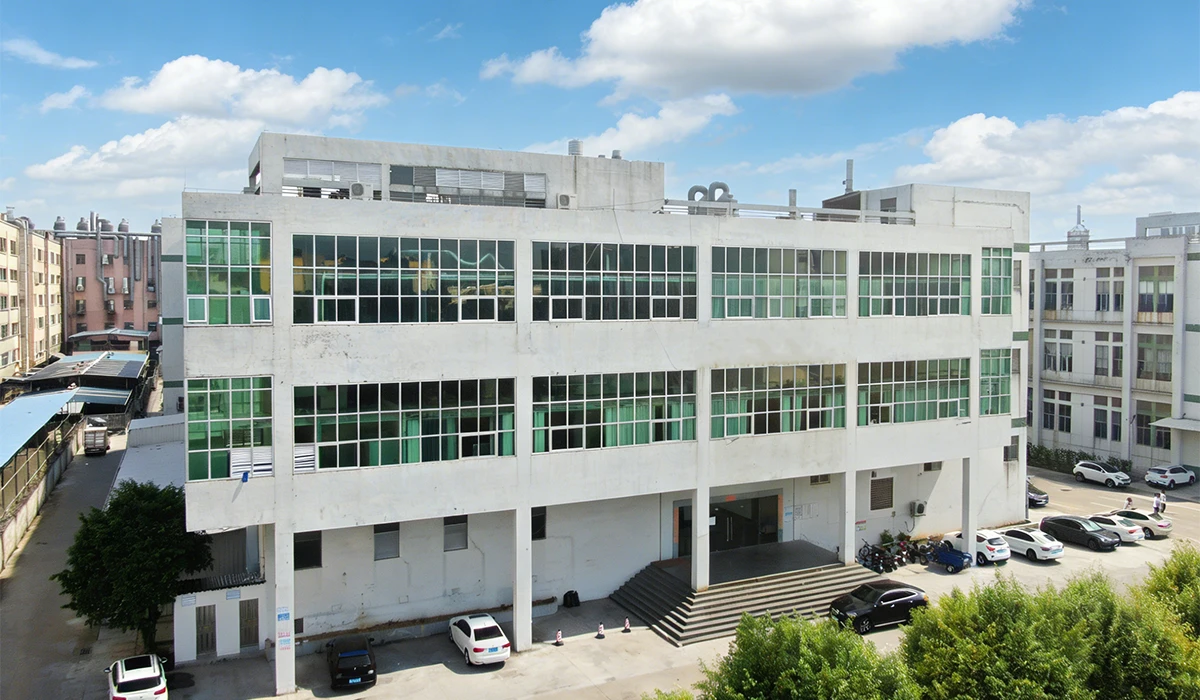
In an era of rapid technological disruption, keeping an eye on pcb manufacturing news is no longer a peripheral task—it is vital for any procurement manager or lead engineer aiming to maintain a competitive edge. The global electronics industry is currently undergoing a seismic shift toward higher functional integration and extreme miniaturization. As consumer demand for smaller, more powerful devices grows, the techniques once reserved for niche aerospace projects are now becoming the standard for mainstream commercial success.
One of the most significant trends highlighted in recent industry reports is the transition of advanced fabrication methods from "luxury options" to "baseline requirements." For instance, partnering with a specialized blind and buried vias pcb manufacturer is now a prerequisite for developing 5G infrastructure and IoT hardware.
Standard through-hole technology often consumes too much valuable "real estate" on a high-density board. By utilizing blind vias (connecting an outer layer to an inner layer) and buried vias (connecting internal layers only), designers can reduce layer counts and board size while significantly improving signal integrity. Furthermore, the integration of high-frequency materials (such as Rogers or PTFE-based substrates) is essential to minimize signal loss in the millimeter-wave spectrum required for 5G connectivity.
By following the latest industrial pcb manufacturing news, you also gain insight into how the factory floor is becoming both more sustainable and exponentially more precise. The industry is moving away from traditional film-based imaging toward Laser Direct Imaging (LDI). LDI technology allows for the direct transfer of the circuit pattern from a digital file to the board, eliminating the distortion associated with physical film and allowing for tighter trace widths and spaces (down to 2 mil or less).
Coupled with LDI is the evolution of Automated Optical Inspection (AOI). Modern AOI systems utilize AI-driven algorithms to scan boards in 3D, catching microscopic defects that the human eye would miss. These innovations have significantly reduced the margin of error, ensuring that multilayer pcb manufacturing—which involves complex registration of up to 32 or more layers—is consistently reliable and cost-effective.
Furthermore, the news cycle reflects a growing emphasis on "Green Manufacturing." Leading china-based pcb giants are investing heavily in closed-loop water recycling systems and lead-free, halogen-free materials to comply with global RoHS and REACH standards. For the procurement manager, staying informed on these news trends ensures that your supply chain is not only technologically advanced but also ethically compliant, protecting your brand from future regulatory hurdles and environmental liabilities.
In the world of electronics, there is a profound "reliability gap" between consumer-grade devices and industrial-grade systems. Industrial PCB manufacturing is an entirely different discipline, where the cost of failure is not just a frustrated user, but potentially massive downtime, equipment damage, or safety risks. While a smartphone board is designed for a lifespan of 2–3 years in a climate-controlled pocket, an industrial PCB must survive 10–15 years of continuous operation in the most punishing conditions imaginable.
At its core, industrial-grade circuitry must be built to withstand extreme temperatures, relentless mechanical vibrations, and intense electromagnetic interference (EMI). As a premier pcb manufacture in China with over a decade of technical experience, ApolloPCB recognizes that "standard" materials simply won't suffice for these applications.
To combat thermal stress, we utilize high-Tg (Glass Transition Temperature) materials (typically Tg170 or Tg180). These specialized laminates maintain their mechanical integrity and dimensional stability even when the ambient temperature fluctuates wildly, preventing the board from warping or delaminating. Furthermore, for high-power industrial controllers or motor drives, we implement heavy copper layers (ranging from 3oz to 10oz). This "thick copper" approach is essential for efficient power dissipation and carrying high currents without overheating the traces.
For industrial applications, the mechanical robustness of the board is often just as critical as its electrical performance. Industrial PCBs are frequently mounted inside heavy-duty enclosures, exposed to constant mechanical shocks or high-frequency vibrations from factory machinery. This is where the importance of working with a specialized Countersink Holes PCB manufacturer becomes clear.
Standard drilling is often insufficient for secure industrial mounting. By utilizing Countersink and Counterbore holes, we allow heavy-duty fasteners and screws to sit flush with or below the surface of the PCB.
Countersink Holes: These conical holes allow flat-head screws to sit flush, providing a smooth surface that prevents mechanical interference with other components or the enclosure lid.
Counterbore Holes: These cylindrical, flat-bottomed holes allow socket-head cap screws to be recessed, providing a much stronger mechanical "bite" and preventing the screw from loosening under intense vibration.
This attention to mechanical detail ensures that the electrical connections remain secure and the board stays firmly anchored, even in the most volatile "harsh environments." By integrating EMI shielding layers and robust mechanical mounting solutions, our industrial pcb manufacturing process delivers a final product that is not just a circuit, but a ruggedized engine capable of driving industrial innovation.
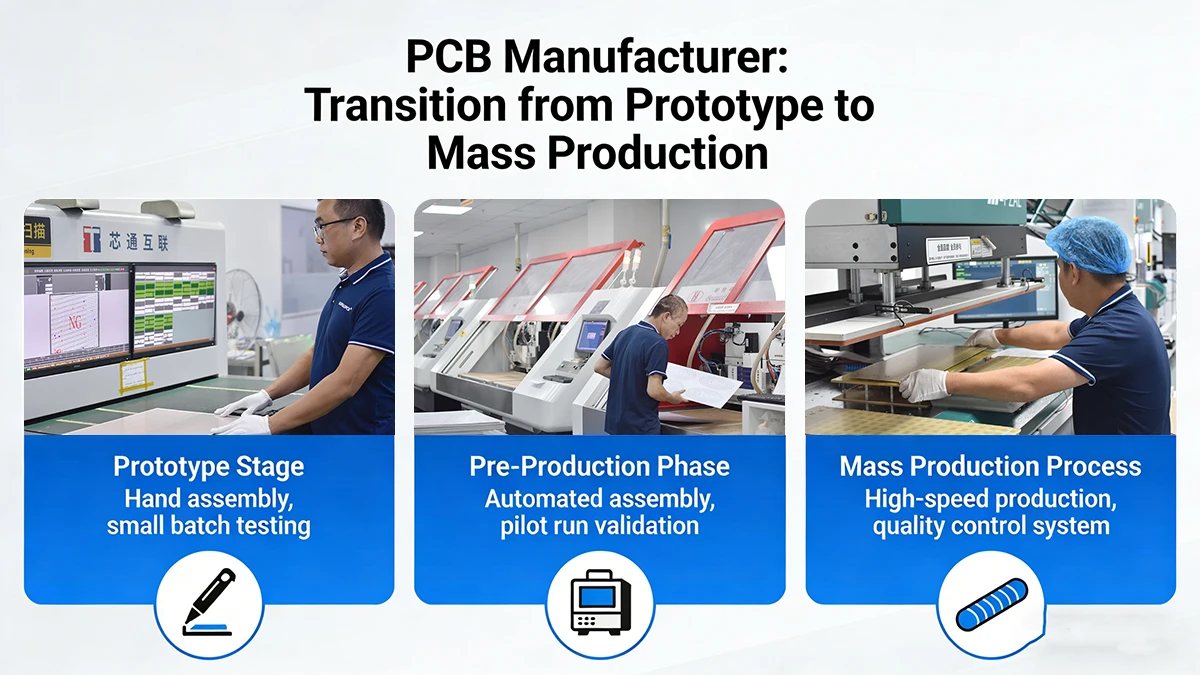
The pcb manufacturing process is a symphony of chemistry, physics, and mechanical engineering. To successfully transition to mass production, one must understand how each step affects the final output.
The process begins with your Gerber files. A top chinese pcb manufacturer will perform a rigorous DFM check to ensure that the trace spacing, hole diameters, and stack-up are optimized for high-yield production.
For multilayer boards, the inner layers are processed first. This involves coating the core with photoresist and using UV light to define the circuitry. China's multilayer pcb manufacturer expertise shines here, where precision is measured in microns.
Layers are bonded together under high pressure and heat. Then, high-speed CNC machines drill the holes. If your design is high-density, you will need a blind and buried vias pcb manufacturer. Blind vias connect an outer layer to an inner layer, while buried vias connect two inner layers, saving valuable surface real estate.
Copper is chemically deposited into the drilled holes to create electrical connections between layers. The outer layer circuit is then formed using a similar imaging and etching process.
When moving to mass production, the pcb manufacturing steps become more automated. Consistency is maintained through standardized chemical baths and robotic handling.
Solder Mask Application: This green (or custom color) layer protects the copper from oxidation and prevents solder bridges.
Surface Finish: Options like ENIG (Immersion Gold), OSP, or Lead-Free HASL are applied. For industrial longevity, ENIG is often the preferred pcb solution.
Silkscreen: Important labels and component identifiers are printed.
Electrical Testing: Every single board in a mass production run must pass a flying probe or bed-of-nails test to ensure there are no shorts or opens.
The traditional paradigm of electronics design—where components are housed in rigid, rectangular boxes—is being rapidly dismantled. In its place, a new era of "organic" and ergonomically integrated electronics has emerged. The demand for a high-tier flex pcb manufacturer or flexible pcb manufacturer has reached an all-time high, driven primarily by the explosion of the wearable technology market, medical diagnostics, and the revolutionary shift toward foldable smartphones and aerospace instrumentation.
The fundamental difference lies in the substrate. While a standard pcb manufacturer relies on FR4 (a rigid epoxy-reinforced glass cloth), a specialized flexible pcb manufacturer utilizes Polyimide (PI). Polyimide is a high-performance polymer that offers an extraordinary combination of thermal stability, chemical resistance, and, most importantly, mechanical flexibility.
This material allows the circuit to bend, twist, and even fold 180 degrees, enabling engineers to "wrap" the electronics around the internal contours of a device. This capability is the "magic" behind the ultra-slim profiles of modern smartwatches and the seamless interconnects found in high-end DSLR cameras and automotive sensor arrays.
However, the path to a high-yield flexible circuit is far more complex than that of a rigid board. Manufacturing flex circuits requires a level of specialized handling and environmental control that standard facilities simply cannot provide. Because the PI base material is extremely thin—often only 25 to 50 microns thick—it is highly susceptible to "dimensional instability."
During the pcb manufacturing process, the material can stretch, shrink, or warp when exposed to the heat of lamination or the chemicals of etching. To combat this, a professional flexible pcb manufacturer employs:
Specialized Tension Control: Automated handling systems that maintain precise tension to prevent registration errors between layers.
Adhesiveless Laminates: Utilizing advanced copper-clad laminates that do not require an adhesive layer, resulting in even thinner, more flexible, and more heat-resistant boards.
Dynamic Flex Testing: For applications like foldable hinges, we perform millions of bending cycle tests to ensure the copper traces do not suffer from fatigue cracking.
The rise of the flex pcb manufacturer is not just about bending; it is about efficiency. FPCBs (Flexible Printed Circuit Boards) can reduce the weight and space consumption of an interconnect system by up to 75% compared to traditional wire harnesses and rigid connectors. By integrating the functionality of several rigid boards and cables into a single, continuous flexible unit, we eliminate "connector failure points," significantly increasing the overall system reliability for our industrial and aerospace B2B partners.
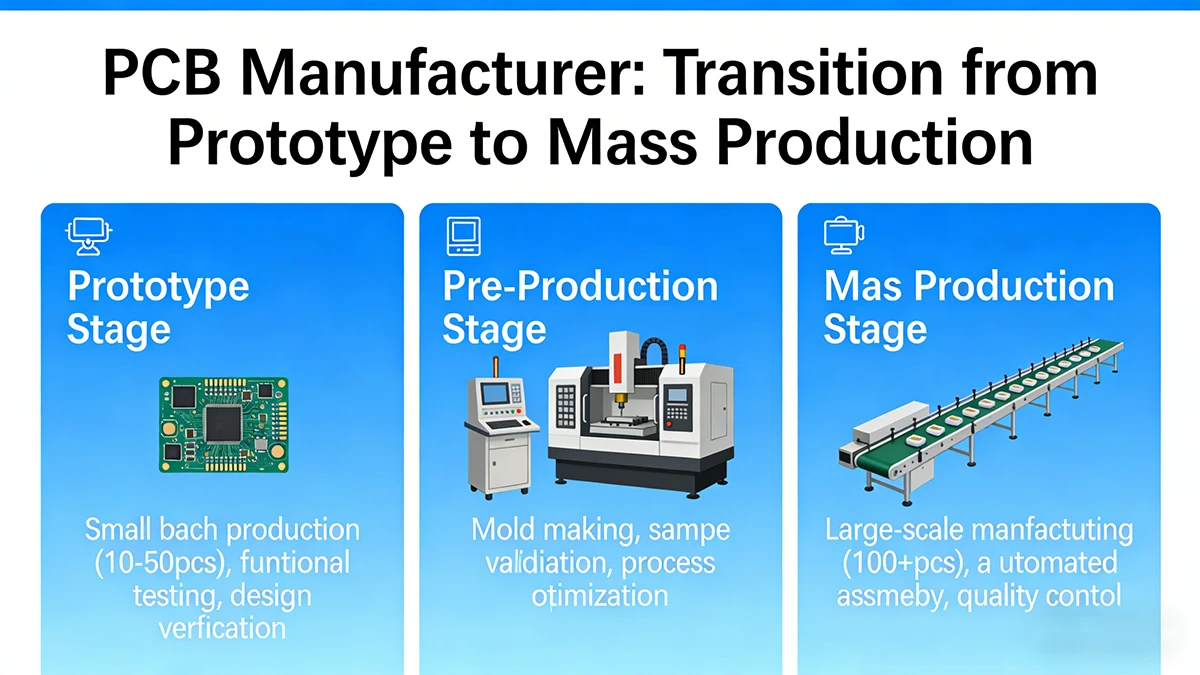
Selecting a pcb manufacture in china gives you access to the world’s most robust supply chain. ApolloPCB stands out as a top chinese pcb manufacturer by offering:
Seamless Scalability: We handle your 5-piece prototype with the same engineering rigor as a 50,000-piece mass production order.
Advanced Capabilities: As a blind and buried vias pcb manufacturer, we support high-density interconnect (HDI) designs that other shops refuse.
Mechanical Precision: Being a specialized Countersink Holes PCB manufacturer, we ensure your boards fit perfectly into their housings every time.
Quick Turnaround: We understand that time-to-market is the ultimate competitive advantage.
The transition from prototype to mass production is the "valley of death" for many hardware projects. By partnering with a dedicated pcb manufacturer like ApolloPCB, you mitigate risks through expert DFM, advanced fabrication techniques, and rigorous quality control. From the initial pcb manufacturing steps to the final electrical test, we provide the pcb solution that industrial giants and innovators trust.
PCB manufacturing involves a series of steps including material preparation, inner layer imaging, lamination, drilling (including blind/buried vias), plating, outer layer imaging, solder mask application, surface finish, and electrical testing.
PCB manufacturing is the process of fabricating a physical printed circuit board based on a digital design. It involves transforming raw materials like copper-clad laminates into a functional board that supports and connects electronic components.
The manufacturing follows a subtractive process where unwanted copper is etched away to leave behind the intended circuit traces. Complex boards involve laminating multiple layers together and using specialized drilling and plating to create vertical connections.
Look for a pcb manufacturer that offers in-house fabrication and assembly. ApolloPCB provides quick-turn services by utilizing advanced LDI and automated testing, ensuring that prototypes are delivered in as little as 24-48 hours without sacrificing mass production quality.
[Contact ApolloPCB Today for a Free Review and Precision Quote]
Related Articles
Precision Countersink Hole PCB Manufacturer: 90° & 120° Custom Drills | ApolloPCB
CEM3 PCB Manufacturer for Cost-Effective Industrial Electronics
Top 5 China PCB Manufacturers: 2026 Ranking & Sourcing Guide

Got project ready to assembly? Contact us: info@apollopcb.com



 Whatsapp 0086 755 29438407
 Mail info@apollopcb.com
 Tel 0086 755 29438407


ABOUT US

PRODUCTS
TECHNOLOGY
KNOWLEDGE CENTRE
CULTURE
NEWS
We're not around but we still want to hear from you! Leave us a note:

Leave Message to APOLLOPCB
