




-
- PCB TYPE
- PRINTED CIRCUIT BOARD PROTOTYPE ALUMINUM PRINTED CIRCUIT BOARD R&F PCB FPC HIGH FREQUENCY PCB HIGH-TG PCB HEAVY COPPER PCB HDI PCB PCB FOR LIGHTING METAL CORE PCB


time:May 23. 2026, 10:55:02
The automotive industry is undergoing its most radical transformation since the invention of the assembly line. The rapid shift toward Electric Vehicles (EVs), Connected Autonomous Vehicles (CAVs), and advanced ADAS architectures has turned modern cars into supercomputers on wheels. Within these rigorous vehicular environments, hardware must endure severe vibrations, extreme thermal cycles, and strict spatial constraints over an operational lifespan often exceeding fifteen years.
Traditional rigid cabling and bulky wire harnesses are no longer capable of supporting these complex, space-constrained electronic systems. They add weight, present high failure rates at connector joints, and are incredibly difficult to route through tight vehicle geometries. To address these limitations, automotive Tier-1 suppliers and OEMs are transitioning to high-flex flexible printed circuits (FPCs).
However, sourcing hardware for automotive applications presents unique challenges. Unlike consumer electronics, vehicular components must adhere to uncompromising zero-defect parameters. Partnering with a highly qualified FPC manufacturer capable of balancing peak mechanical flexibility with robust electrical performance is essential.
At ApolloPCB, we engineer advanced flexible substrates tailored precisely to the severe environmental demands of automotive hardware. By executing precision design for manufacturing (DFM) and leveraging elite material science, we provide robust advanced flexible PCB solutions that serve as the nervous system for next-generation transportation tech.
Automotive electronics do not operate in climate-controlled server rooms. Components located under the hood, near braking assemblies, or packed tightly within battery enclosures must maintain flawless continuity while subjected to extreme mechanical and thermal stress profiles.
When configuring flexible circuitry for automotive applications, standard commercial-grade polyimide film and adhesives are prone to accelerated degradation. To prevent latent field failures, an expert customize FPC manufacturer must rigorously evaluate three foundational environmental threats:
The temperature envelope within a vehicle engine bay or power inverter module can fluctuate wildly, ranging from -40°C during harsh winters up to +125°C or +150°C under peak operational load. Standard flexible laminates utilizing acrylic adhesives exhibit a high coefficient of thermal expansion (CTE) along the Z-axis. When cycled continuously across extreme temperatures, this adhesive layer expands and contracts at a different rate than the adjacent copper traces, creating devastating shear stresses that fracture plated through-holes (PTH).
To mitigate this risk, ApolloPCB utilizes specialized automotive-grade adhesiveless Flexible Copper Clad Laminates (FCCL). By eliminating the adhesive layer entirely, we substantially reduce the total profile thickness, minimize moisture absorption within the hydroscopic polyimide matrix, and double the thermal cycling lifespan of the interconnects. This material durability prevents internal delamination and trace cracking, guaranteeing long-term system stability even under continuous thermal shock conditions.
Flexible circuits deployed in steering column interfaces, active suspension systems, side mirrors, and infotainment hinges are subject to continuous dynamic bending. Over the life of a vehicle, an FPC may experience millions of micro-flexing cycles.
To withstand this fatigue, the copper grain structure must be meticulously specified. While electro-deposited (ED) copper is acceptable for static bend applications, dynamic automotive circuits require high-ductility Rolled Annealed (RA) copper. ApolloPCB applies RA copper with the grain direction oriented parallel to the primary bend axis, dramatically retarding micro-fissure propagation and ensuring long-term mechanical survival.
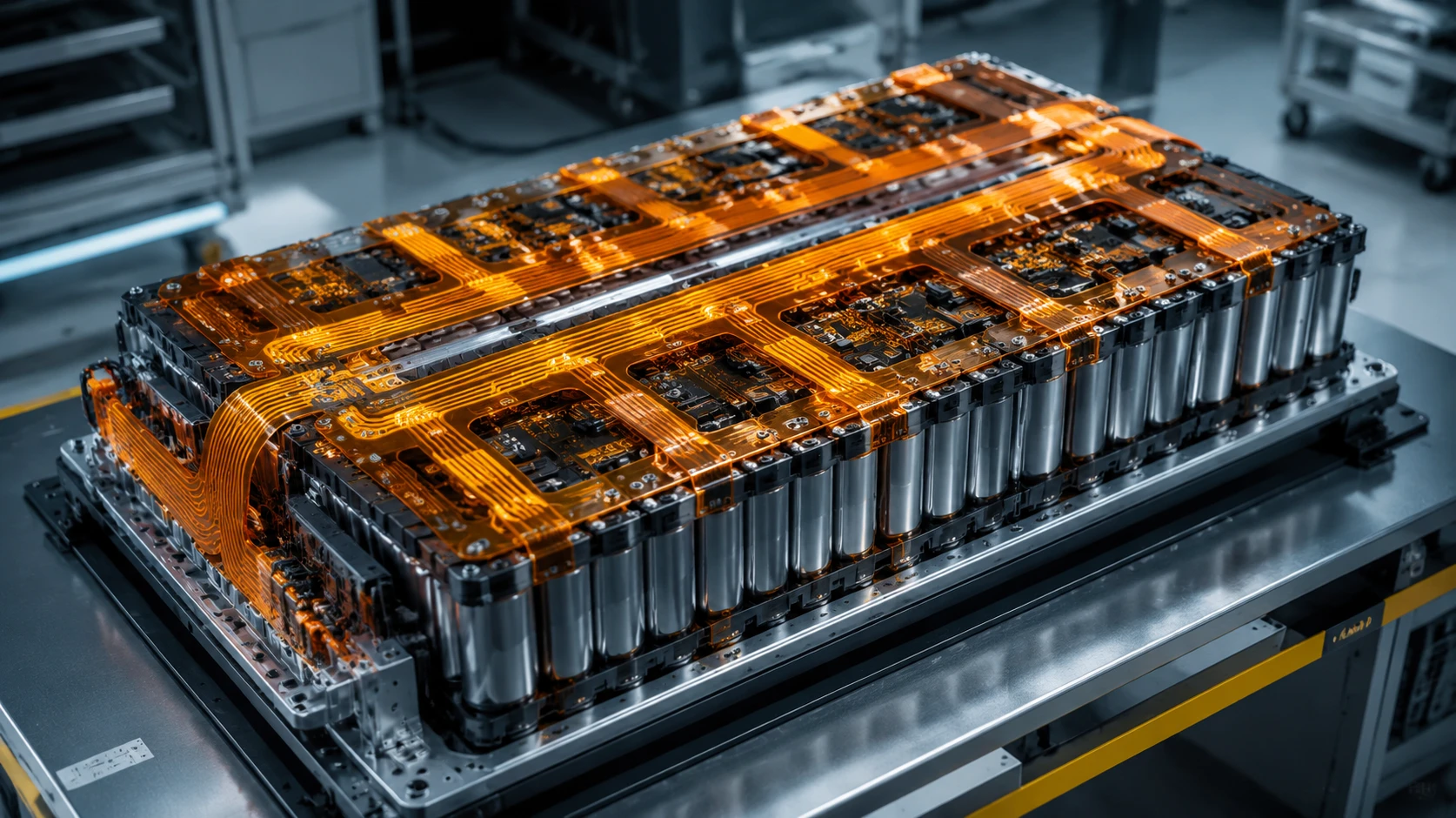
The most critical growth vector for automotive flexible circuitry is within Electric Vehicle Battery Management Systems (BMS). A standard EV battery pack consists of hundreds or thousands of individual lithium-ion cells clustered into modules. To manage safety, efficiency, and charging cycles, the BMS must monitor the voltage and temperature of every cell cluster simultaneously.
[Battery Cell Modules] ---> Integrated Voltage/Temperature Sensors
                                  │
                                  ▼
[Heavy-Copper Multi-Layer FPC] -> Replaces Bulkier Traditional Wire Harnesses
                                  │
                                  ▼
[Central BMS Controller] ------> Real-time Thermal & Electrical Optimization
Historically, this required a highly complex, manually routed wire harness filled with dozens of discrete wires, connectors, and fusion joints. This traditional setup presented major manufacturing challenges:
Weight and Volume: Standard copper wiring bundles add massive parasitic weight to the vehicle, directly reducing its driving range.
Assembly Error Rates: Manually pinning dozens of wires into multi-pin connectors introduces significant human error and contact point resistance variance.
Vibrational Wear: Continuous chassis vibrations can cause individual wire insulation to rub against metallic structures, leading to catastrophic short circuits.
By partnering with a specialized Batteries FPC manufacturer, automotive designers can consolidate this entire tracking network into a single, continuous, multi-layer flexible assembly. ApolloPCB manufactures ultra-long battery harness FPCs—often exceeding 1 to 1.5 meters—capable of integrating voltage lines and temperature-sensing traces into a flat, lightweight ribbon.
Our factory processes heavy copper foils (up to 3 oz) onto polyimide substrates, enabling these flex harnesses to safely handle balancing currents without generating localized hotspots. Replacing a traditional harness with a single consolidated flexible assembly compresses the required routing volume by up to 70%, strips away kilograms of dead weight, and completely eliminates the assembly errors associated with manual wiring.
Beyond the high-power powertrain environment, vehicles are incorporating increasingly complex sensor suites to drive Advanced Driver-Assistance Systems (ADAS), autonomous lane centering, and interactive cabin environments.
Modern vehicles utilize an array of high-resolution cameras, ultrasonic sensors, and LIDAR units to construct a 3D map of their surroundings. These sensors are frequently located in exterior mirrors, bumper assemblies, and behind the front windshield—areas where packaging space is miniscule.
To route these high-frequency data streams within tight enclosures, ApolloPCB operates as an expert HDI FPC manufacturer. We leverage High-Density Interconnect techniques, such as laser-drilling microvias down to 50μm and applying fine-line etching, to pack maximum routing density into sub-millimeter footprints.
Operating as a specialized blind and buried vias FPC manufacturer, we execute sequential lamination steps to create multi-layer flex circuits that route critical high-speed data without consuming surface real estate. This allows ADAS radar units to process gigabits of raw data locally before transmitting it to the vehicle's central computing unit. These ultra-dense routing strategies match the advanced material configurations detailed in our benchmark article on advanced multi-layer FPC factory manufacturing capabilities.
Inside the cabin, the user experience is defined by sleek, curved displays and capacitive touch control surfaces. Traditional mechanical switches are being replaced by lightweight, multi-functional trim elements.
ApolloPCB works closely with Tier-1 cabin suppliers as an elite Dsiplay FPC manufacturer and KeyPads FPC manufacturer. Display connections demand line-and-space widths down to 25μm to drive sharp frame rates across curved screens, while keypad flex circuits integrate dome-switch contacts directly onto the polyimide sheet. For ambient and functional indicator lighting, our production setup functions as a high-yield LED Lighting FPC manufacturer, delivering reliable, long-length flex circuits that seamlessly trace the interior contours of doors, dashboards, and headliners.
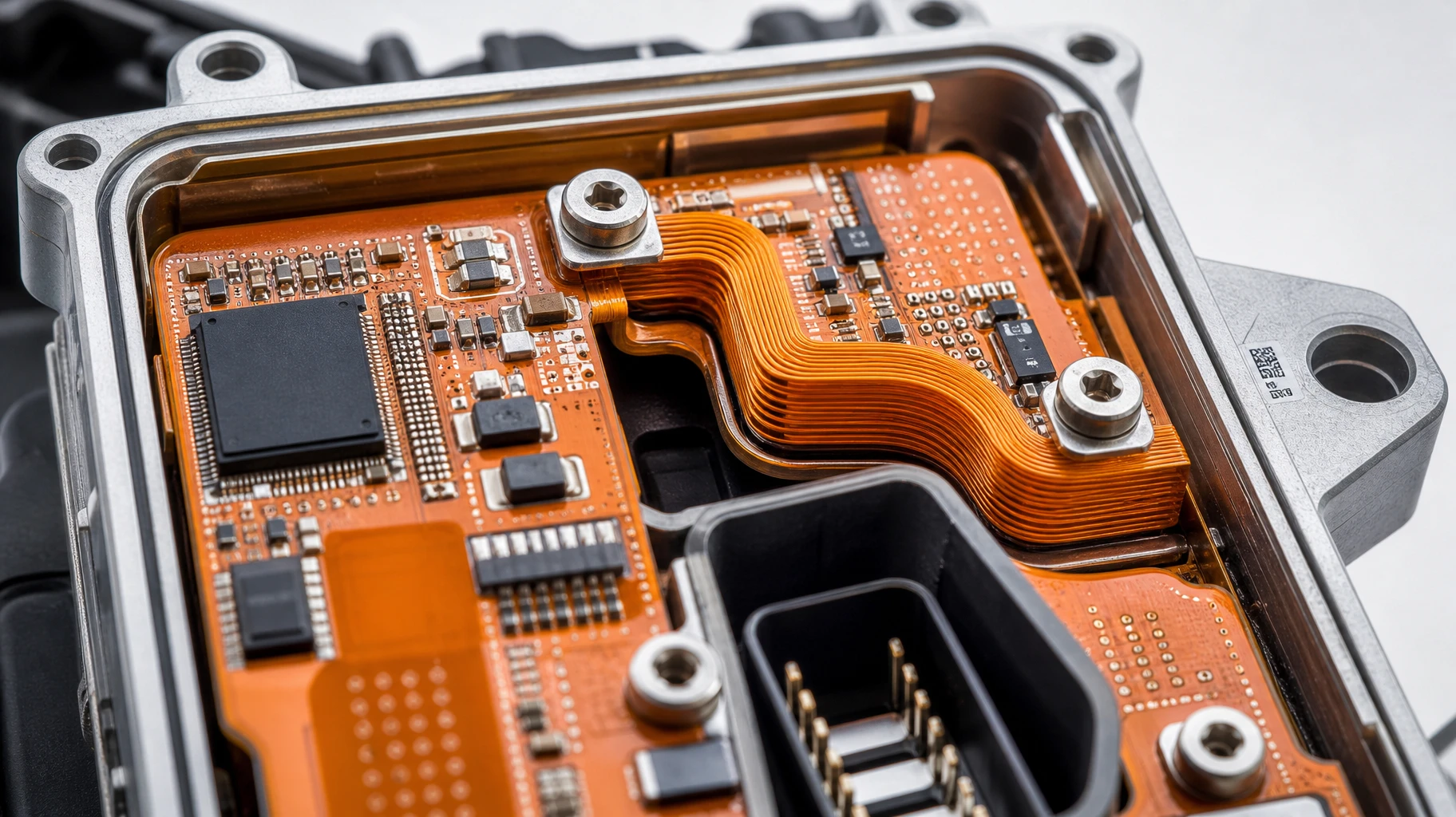
A flexible substrate engineered for the automotive market must be built to support high-reliability component assembly. Because an automotive FPC is subject to thermal shifts and structural vibration, the bonding interface between electronic components and flexible copper pads must be exceptionally robust.
To eliminate intermetallic failures and ensure uniform solder joints across fine-pitch components, ApolloPCB provides specialized surface processing options:
| Surface Finish Type | Industrial Application | Key Performance Characteristics |
| ENIG (Electroless Nickel Immersion Gold) | Standard SMT Assemblies / Sensor Leads | Excellent flatness, long shelf life, robust solderability for standard automotive sensors. |
| ENEPIG (Electroless Nickel Electroless Palladium Immersion Gold) | High-Stress SMT / Dual-Bonding Architectures | Completely eliminates "black pad" brittle fractures; ideal for severe vibration control modules. |
| Pure Immersion Gold | Direct Chip-on-Flex (COF) Modules | Optimized grain matrix to accept thermosonic FPC gold ball bonding with minimal resistance. |
Our specialized plating lines ensure that when an application demands direct chip-on-flex wire bonding, the gold layer possesses the ductility required to forge an unbreakable molecular bond, ensuring absolute electrical continuity across years of service.
Populating components onto a flexible polyimide substrate is a specialized discipline that requires strict thermal and mechanical tooling controls. ApolloPCB executes FPC High Density Component Assembly utilizing custom-machined carrier fixtures that lock the flexible panel flat during solder paste printing and component placement.
Because polyimide is a hydroscopic material that naturally absorbs atmospheric moisture, running a raw FPC through a lead-free reflow oven can cause trapped water molecules to vaporize instantly, resulting in catastrophic delamination or micro-blistering. To prevent this, ApolloPCB enforces strict pre-assembly vacuum baking cycles to completely dehydrate the material.
Furthermore, we utilize automated solder paste inspection (SPI) and 3D automated optical inspection (AOI) custom-calibrated for the reflective variations of flexible coverlays. This ensures that every solder fillet conforms perfectly to IPC Class 3 high-reliability criteria, matching the rigid quality baselines established in our foundational guide on custom FPC and HDI flexible PCB solutions.
In the automotive sector, component failure can directly compromise passenger safety. Therefore, a premier manufacturer must back its hardware with rigorous data-driven quality validation. ApolloPCB operates under strict IATF 16949 compliant frameworks, ensuring that every design undergoes comprehensive testing prior to delivery.
Our automotive quality protocol includes:
Dynamic Flex Profiling: Testing production samples on dynamic flexing rigs under specified bend radii to monitor real-time resistance changes and prove fatigue resistance.
Thermal Shock Validation: Submitting completed boards to rapid temperature transitions (-40°C to +125°C) for hundreds of cycles to verify plated through-hole and microvia structural survival.
Micro-Sectioning Verification: Destructive cross-sectional analysis of manufacturing coupons to measure exact copper plating thicknesses inside microvias and ensure the total absence of voiding or internal trace shifting.
This comprehensive operational control ensures that global hardware engineers and procurement teams receive high-yielding, zero-defect hardware. Our robust data infrastructure provides the process traceability that global supply chain leads require to streamline their custom FPC prototyping and OEM logistics.

A1: RA copper undergoes a rolling manufacturing process that creates an elongated, horizontal grain structure parallel to the foil surface. This horizontal grain makes the copper highly ductile, allowing it to withstand millions of dynamic bending cycles without fracturing. Electro-deposited (ED) copper, by contrast, has a vertical, crystalline grain structure that is highly prone to micro-cracking under repetitive mechanical stress.
A2: Traditional flexible laminates use acrylic or butyral adhesives to bond copper foil to the polyimide core. These adhesives possess a high coefficient of thermal expansion (CTE). Under extreme temperature changes, the adhesive layer expands aggressively along the Z-axis, tearing copper plating out of microvias and plated through-holes. Adhesiveless laminates eliminate this weak layer, drastically improving thermal cycling endurance.
A3: FPCs replace heavy, complex, hand-assembled traditional wire harnesses with a single, flat, lightweight ribbon. They automate the connection of voltage and temperature sensors across cell modules, eliminate the risk of manual wiring errors, compress the required packaging volume by up to 70%, and dramatically reduce parasitic vehicle weight to extend EV driving range.
The automotive landscape will continue to demand higher processing speeds, denser component footprints, and lower failure thresholds. Sourcing circuit hardware for these high-stakes systems requires moving past transactional suppliers and partnering with a technically advanced manufacturer.
ApolloPCB bridges the gap between advanced material science, complex multi-layer fabrication, and strict automotive quality protocols. From engineering high-current battery management harnesses to processing ultra-dense ADAS sensor lines, we ensure your flexible circuitry delivers absolute operational reliability under the harshest real-world road conditions.
Ready to secure elite, high-flex performance for your next automotive hardware initiative? Request an automotive FPC technical quote from the ApolloPCB engineering team today, and discover how our advanced manufacturing can drive value for your vehicle platform.
Custom FPC Manufacturer: HDI & Flexible PCB Solutions | ApolloPCB
Smartphone FPC Manufacturer | High-Density HDI & Multi-layer Flex PCB
Durable Keypad FPC Manufacturer: High-Cycle & Reliable Flex Solutions

Got project ready to assembly? Contact us: info@apollopcb.com



 Whatsapp 0086 755 29438407
 Mail info@apollopcb.com
 Tel 0086 755 29438407


ABOUT US

PRODUCTS
TECHNOLOGY
KNOWLEDGE CENTRE
CULTURE
NEWS
We're not around but we still want to hear from you! Leave us a note:

Leave Message to APOLLOPCB
