




-
- PCB TYPE
- PRINTED CIRCUIT BOARD PROTOTYPE ALUMINUM PRINTED CIRCUIT BOARD R&F PCB FPC HIGH FREQUENCY PCB HIGH-TG PCB HEAVY COPPER PCB HDI PCB PCB FOR LIGHTING METAL CORE PCB


time:Aug 04. 2026, 17:34:50
Industrial power supply developers, automotive lighting designers, and high-bay LED fixture OEMs face strict thermal constraints. Standard FR-4 substrates quickly reach thermal saturation when driven at high currents, leading to thermal throttling, LED chromaticity shifts, and early component degradation. Managing intense heat dissipation requires switching from traditional epoxy-glass laminates to high-performance Metal Core PCBs (MCPCB).
A strategic partnership with a certified custom aluminum pcb fabrication supplier resolves these thermal management challenges. By bonding thin copper foil to a rigid aluminum substrate through a highly thermally conductive dielectric layer, custom aluminum circuit boards dissipate heat up to 10 times faster than conventional FR-4.
This comprehensive technical guide breaks down every critical phase of high-performance aluminum circuit board production. We analyze thermal conductivity ratings, dielectric insulation choices, mechanical scoring, single versus multi-layer stackups, and targeted DFM guidelines to help global factory OEMs maximize yield, ensure IPC Class 3 quality, and accelerate time-to-market.
Metal Core Printed Circuit Board (MCPCB) manufacturing requires specialized fabrication controls compared to standard FR-4 processing. At its core, an aluminum-clad laminate consists of three distinct functional layers engineered to balance heat transfer and electrical insulation:
              ALUMINUM PCB THREE-LAYER ARCHITECTURE

┌─────────────────────────────────────────────────────────────┐
│ 1. Circuit Foil Layer (1oz - 6oz Heavy Copper)              │
├─────────────────────────────────────────────────────────────┤
│ 2. Thermally Conductive Dielectric (1.0 - 8.0 W/m·K)        │
├─────────────────────────────────────────────────────────────┤
│ 3. Aluminum Base Substrate (1000 / 5000 / 6000 Series Alloy) │
└─────────────────────────────────────────────────────────────┘
The Circuit Layer (Copper Foil): Electro-deposited copper ranging from 1 oz (35 µm) to heavy 6 oz (210 µm) foil configurations, designed to handle high-amperage current draw without excessive trace heating.
The Polymer Dielectric Layer: A ceramic-filled epoxy polymer matrix that delivers high thermal conductivity while maintaining breakdown voltage strength up to 6 kV DC.
The Base Metal Substrate: A high-rigidity aluminum alloy plate (typically 0.8 mm to 3.0 mm thick) serving as a structural backing and high-efficiency heat sink interface.
Extended Component Operating Lifespan: Reducing junction temperatures ($T_j$) by just 10°C doubles the Mean Time Between Failures (MTBF) for high-power transistors and LEDs.
Exceptional Dimensional Stability: Aluminum exhibits superior mechanical stiffness and dimensional stability under extreme mechanical vibration and thermal cycling compared to flexible FR-4 substrates.
Integrated Structural Heat Sinking: Eliminates the need for bulky external copper heat sinks, reducing enclosure volume, overall assembly weight, and total Bill of Materials (BOM) costs.
To explore how advanced metal core technology handles extreme operational environments, read our in-depth report on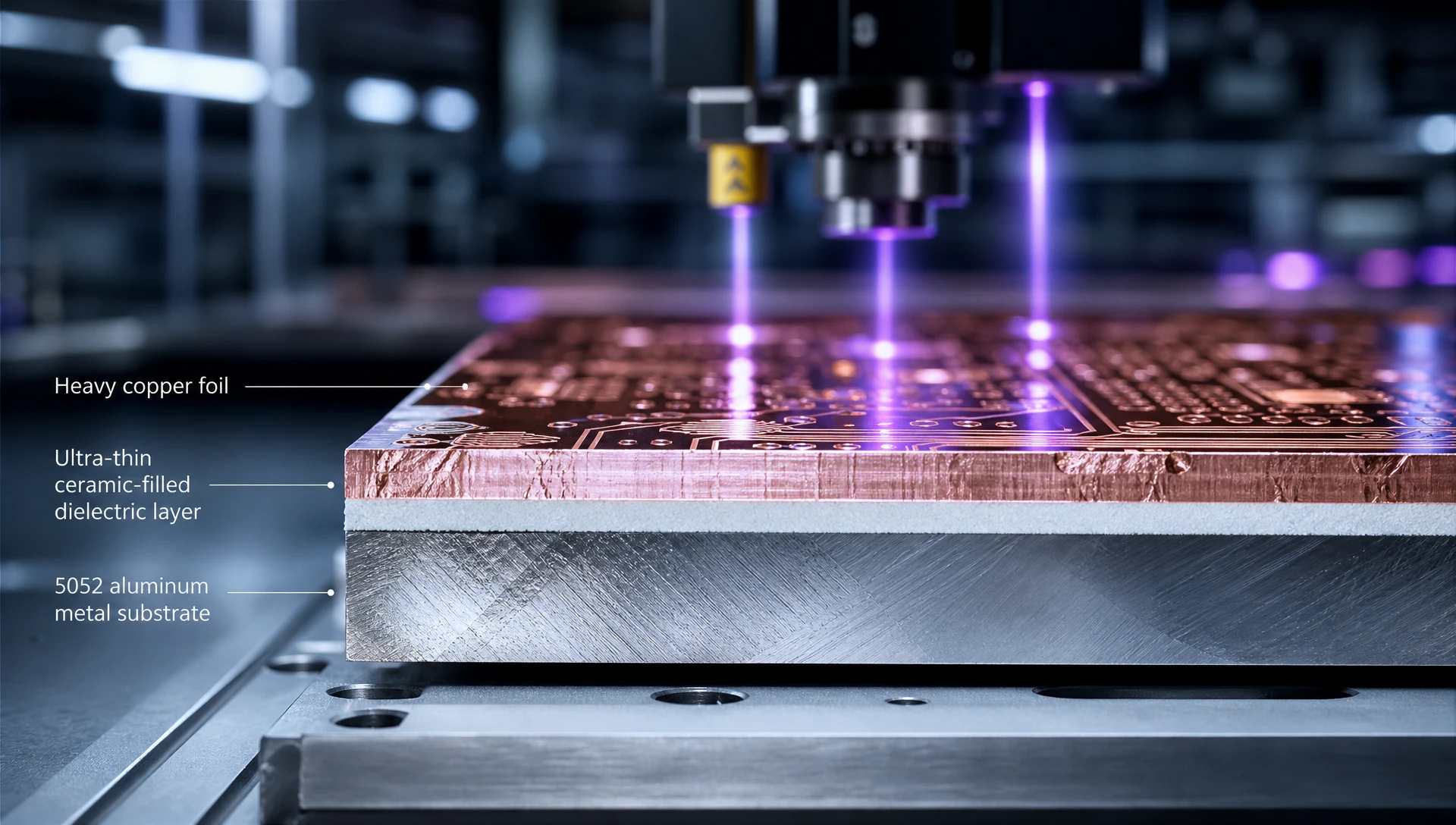
Selecting the right raw material stackup dictates the long-term reliability and thermal throughput of high-power industrial products.
1100 Series (Pure Aluminum): Offers maximum thermal conductivity and flexibility, making it ideal for low-stress designs requiring simple mechanical punching and light bending.
5052-H32 Series (Magnesium Alloy): The industry standard for high-reliability industrial automation and automotive applications. Delivers high mechanical strength, excellent corrosion resistance, and clean V-scoring characteristics.
6061-T6 Series (Silicon-Magnesium Alloy): Designed for heavy-duty structural applications requiring precision CNC milling, complex routing, complex countersink holes, and high tensile strength.
The dielectric layer represents the central engineering bottleneck in metal-core construction. Standard commercial grades provide thermal conductivity ratings of 1.0 W/m·K to 2.0 W/m·K. High-power industrial motor drives, solar inverters, and automotive EV chargers require specialized ceramic-filled polymer dielectrics yielding 3.0 W/m·K to 8.0 W/m·K.
| Material Property | Commercial Grade Dielectric | Industrial Grade Dielectric | Automotive/Aerospace Grade |
| Thermal Conductivity | 1.0 - 1.5 W/m·K | 2.0 - 3.0 W/m·K | 4.0 - 8.0 W/m·K |
| Dielectric Breakdown Voltage | > 3 kV AC | > 4 kV AC | > 6 kV AC |
| Thermal Impedance | 0.85 °C·in²/W | 0.45 °C·in²/W | 0.18 °C·in²/W |
| Glass Transition Temp (Tg) | 130°C | 150°C | 170°C+ |
| Flammability Rating | UL 94 V-0 | UL 94 V-0 | UL 94 V-0 |
Factory engineers evaluating heavy-duty automotive and outdoor lighting builds should review our operational guide on
Understanding the distinction between single-sided, double-sided, and multi-layer aluminum stackups ensures optimal routing density without incurring unnecessary fabrication costs.
The standard choice for architectural LED fixtures, high-bay spotlights, and automotive rear lighting. Components are surface-mounted (SMT) exclusively on the top copper foil, leaving the flat aluminum back face open for direct mechanical contact with external heatsinks or enclosures.
For dense power electronics—such as industrial variable frequency drives (VFDs) and medical imaging controls—designers require multi-layer routing.
Double-Sided MCPCB: Features copper circuit layers on both sides of an internal insulated aluminum core, using insulated blind vias to bridge signal connections.
Multi-Layer Thermally Coupled Substrates: Combines an FR-4 multi-layer signal core laminated onto an aluminum backing plate using high-conductivity prepreg materials. Heat from internal layers travels down through copper thermal microvias directly into the aluminum base plate.
Fabricating high-yield metal core circuit boards demands specialized production equipment capable of handling rigid metal substrates alongside delicate circuit copper.
Standard carbide routing bits dull quickly against hard aluminum alloys. Specialized custom aluminum pcb fabrication requires diamond-coated router bits, controlled feed rates, and continuous vacuum debris removal to prevent burrs on panel edges.
V-Scoring Angle Precision: Maintaining precise 30° or 45° V-score blade depths leaves a thin, uniform web (typically 0.33 mm ± 0.05 mm) that allows smooth manual or automated panel singulation post-SMT assembly without stress-cracking solder joints.
Countersink and Hole Insulation: When structural mounting screws pass directly through the metal base, precision CNC countersinks are drilled and insulated to prevent short-circuit bridging between power fasteners and trace layers.
Hasl & ENIG Options: Electroless Nickel Immersion Gold (ENIG) delivers an exceptionally flat planar surface, providing optimal solderability for fine-pitch QFNs, power MOSFETs, and high-density ICs.
Super-White Reflective Solder Masks: LED lighting boards utilize specialized ceramic-pigmented white solder masks that deliver up to 88% to 92% light reflectivity, preventing UV discoloration and degradation over long operating cycles.
For a complete breakdown of raw board capability options, layer stackups, and base material tolerances, explore our full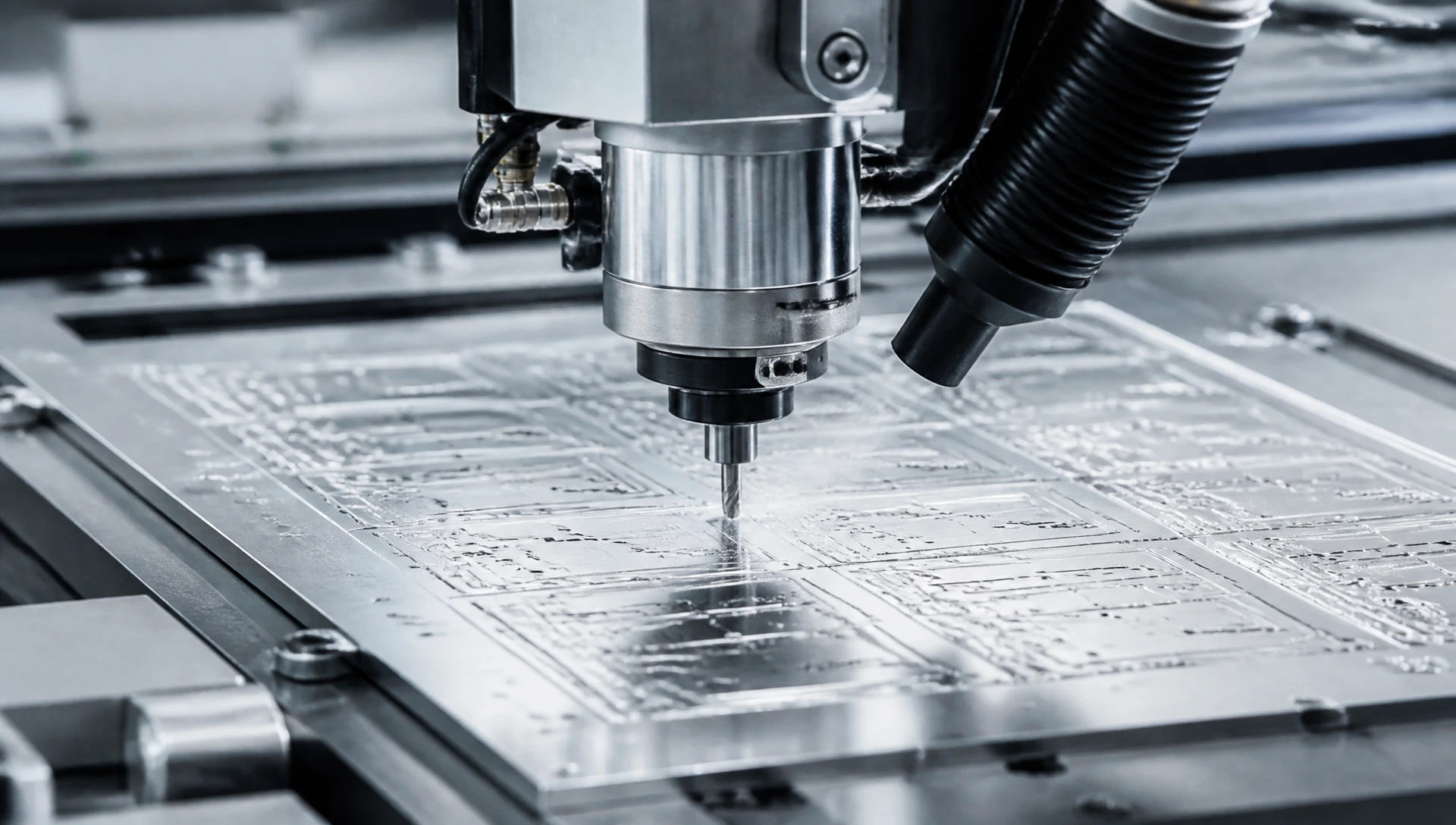
Incorporate these proven DFM parameters during the initial layout phase to eliminate engineering change orders (ECOs), optimize unit costs, and prevent panel-level line stoppage during automated SMT placement.
                  KEY DFM DESIGN RULES FOR ALUMINUM PCBs

    Trace-to-Edge Margin               Creepage & Clearance Distance
 ┌──────────────────────┐             ┌───────┐         ┌───────┐
 │ [Traces]             │             │ High  │ ◄─────► │ Low   │
 │   ◄─── Min 0.8mm ──► │             │ Volt  │  Min    │ Volt  │
 ├──────────────────────┤             │ Pad   │  3.0mm  │ Pad   │
 │ Aluminum Base Edge   │             └───────┘         └───────┘
 └──────────────────────┘
Trace-to-Edge Clearance: Maintain a minimum distance of $0.80\text{ mm}$ ($31.5\text{ mils}$) between trace copper and the outer routed panel edge. Placing copper too close to the perimeter risks exposed copper burrs or short-circuiting to the conductive aluminum base plate during mechanical V-scoring or punch-routing.
Minimum Thermal Via Diameters: For double-sided metal core designs, use thermal vias with finished hole diameters between $0.20\text{ mm}$ and $0.30\text{ mm}$ plugged with thermally conductive epoxy resin to eliminate solder wicking during reflow.
High-Voltage Creepage Margins: Industrial power converters operating at voltages above 300V DC require enlarged pad-to-substrate clearances ($>3.0\text{ mm}$) to meet international UL 60950 and IEC 61010 safety isolation standards.
Choosing an experienced EMS and fabrication partner is essential for maintaining supply chain stability, component authenticity, and reliable product quality.
Comprehensive Quality Certifications: Ensure the manufacturing facility holds active ISO 9001:2015, ISO 13485 (medical), and IATF 16949 (automotive) quality management accreditations.
Dedicated Hi-Pot Insulation Testing: Verify that 100% of manufactured production panels undergo High Potential (Hi-Pot) electrical breakdown testing—applying $2000\text{V AC}$ to $3000\text{V AC}$ for 1 second between the copper layer and aluminum base to guarantee zero dielectric breakdown defects.
Traceable Material Procurement: Partner with fabricators that source original copper-clad aluminum laminates directly from top-tier material foundries (e.g., Bergquist, Thermagon, Ventec, Polystrata) with full lot traceability certificates.
To review our engineering credentials, custom dielectric option matrix, and specialized manufacturing solutions, visit our
Achieving zero-defect circuit board production requires an experienced, technology-driven partner. As a global manufacturing leader in custom aluminum pcb fabrication, ApolloPCB provides complete turn-key solutions for industrial automation, automotive electronics, and commercial lighting factories worldwide.
Our modern manufacturing facilities feature advanced high-speed CNC metal routers, diamond V-scoring machinery, automated LDI pattern exposure lines, and dedicated high-voltage insulation testing equipment. From quick-turn prototypes to high-volume production, ApolloPCB guarantees IPC Class 2 and Class 3 compliance across every batch.
We support complete raw laminate selection, custom stackup modeling, and comprehensive DFM/DFA engineering reviews to ensure your power products operate reliably in harsh, high-temperature environments.
Streamline your supply chain, optimize thermal performance, and scale your production yields with confidence. Contact our technical team today to submit your design files.
ApolloPCB provides dielectric options ranging from standard commercial grades (1.0 W/m·K to 1.5 W/m·K ) up to ultra-high thermal conductivity formulations (3.0 W/m·K to 8.0 W/m·K) tailored for heavy industrial power electronics and high-output automotive lighting setups.
Yes. ApolloPCB specializes in single-sided, double-sided, and complex multi-layer metal core boards. Our advanced production lines process insulated thermal vias, blind/buried via structures, and hybrid FR-4-to-aluminum laminations under strict IPC Class 3 quality controls.
Every aluminum PCB panel manufactured by ApolloPCB undergoes 100% automated flying probe testing along with high-voltage High Potential (Hi-Pot) dielectric testing. This ensures zero leakage current between the copper circuit traces and the underlying aluminum substrate before shipping.

Got project ready to assembly? Contact us: info@apollopcb.com



 Whatsapp 0086 755 29438407
 Mail info@apollopcb.com
 Tel 0086 755 29438407


ABOUT US

PRODUCTS
TECHNOLOGY
KNOWLEDGE CENTRE
CULTURE
NEWS
We're not around but we still want to hear from you! Leave us a note:

Leave Message to APOLLOPCB
