




-
- PCB TYPE
- PRINTED CIRCUIT BOARD PROTOTYPE ALUMINUM PRINTED CIRCUIT BOARD R&F PCB FPC HIGH FREQUENCY PCB HIGH-TG PCB HEAVY COPPER PCB HDI PCB PCB FOR LIGHTING METAL CORE PCB


time:Jun 29. 2026, 11:52:15
The global industrial electronics market demands continuous improvements in power density, packaging efficiency, and thermal reliability. As original equipment manufacturers (OEMs), automotive hardware designers, and industrial power infrastructure engineers scale up their product portfolios, managing localized heat generation is a critical obstacle to long-term system survivability. When traditional FR4 fiberglass laminates face high-amperage current loops or ultra-bright optical configurations, their low thermal conductivity causes severe heat concentration. This issue results in localized thermal degradation, structural warping, and early component failure. To resolve these thermal bottlenecks, modern engineering teams specify a custom aluminum pcb as their primary metal core substrate solution.
Also known as Metal Core PCBs (MCPCBs), these specialized copper-clad laminates utilize a solid metal base plate to serve as an integrated heat sink. Moving a highly specialized metal substrate layout from initial computer-aided design (CAD) files to error-free volume production requires an accurate, data-driven analysis of raw material boundaries, dielectric isolation performance, mechanical machining limits, and automated assembly profiles. This technical guide outlines the engineering specifications, stackup structures, and process controls necessary to successfully manufacture high-reliability aluminum core circuit platforms.
The foundation of any customized aluminum pcb is the raw metal base layer. The selection of the underlying metal alloy determines the structural rigidity, weight, mechanical machinability, and thermal dissipation efficiency of the entire multi-layer assembly. Industrial fabricators rely on specific aluminum alloy series to match distinct mechanical loads and environmental operating spaces. The physical performance metrics of the base substrate depend heavily on two main industrial alloys: the 5052 series and the 6061 series.
The 5052 aluminum alloy series serves as the industry standard for the majority of high-volume metal core applications. Composed primarily of aluminum alloyed with magnesium, 5052 provides excellent structural formability, high corrosion resistance, and stable mechanical strength. From an assembly standpoint, 5052 expands uniformly under thermal stress, minimizing internal shearing forces between the copper traces and the metal base. Its excellent ductility makes it the ideal candidate for applications requiring mechanical scoring, post-fabrication bending, or complex outer perimeter punching without risking internal micro-fissures.
For complex systems subjected to severe mechanical shock, high-vibration structural frames, or multi-axis fastening brackets, engineers specify the 6061 aluminum alloy series. Enhanced with silicon and magnesium, 6061 undergoes structural heat treatments to achieve significantly higher tensile strength and hardness than the 5052 series. This mechanical rigidity makes 6061 highly effective for complex multi-tier enclosures where the circuit board acts as a load-bearing chassis component. However, its increased hardness requires specialized, low-speed carbide cutting tools during factory drilling and shaping processes to ensure clean cuts and avoid tool wear.
To select the ideal material composition for your specific power requirements, engineering teams must cross-reference mechanical and thermal thresholds. The matrix below outlines the critical distinctions across common metal core substrate configurations.
| Material Alloy Class | Thermal Conductivity (W/m-K) | Tensile Strength (MPa) | Dielectric Breakdown (kV) | Coefficient of Thermal Expansion (ppm/°C) | Primary Sourcing Application |
| Standard 5052 Class | 138 | 220 | 3.0 to 4.5 | 23.0 | Automotive LED clusters, indoor lighting tracks |
| Premium 5052 Class | 138 | 220 | 5.0 to 6.5 | 23.0 | Commercial power supplies, motor driver matrices |
| High-Rigidity 6061 Class | 167 | 310 | 4.0 to 6.0 | 23.6 | Aerospace actuators, heavy industrial enclosures |
| Ultra-Thermal 6061 Class | 167 | 310 | 6.5 to 8.0 | 23.6 | EV powertrain converters, base station amplifiers |
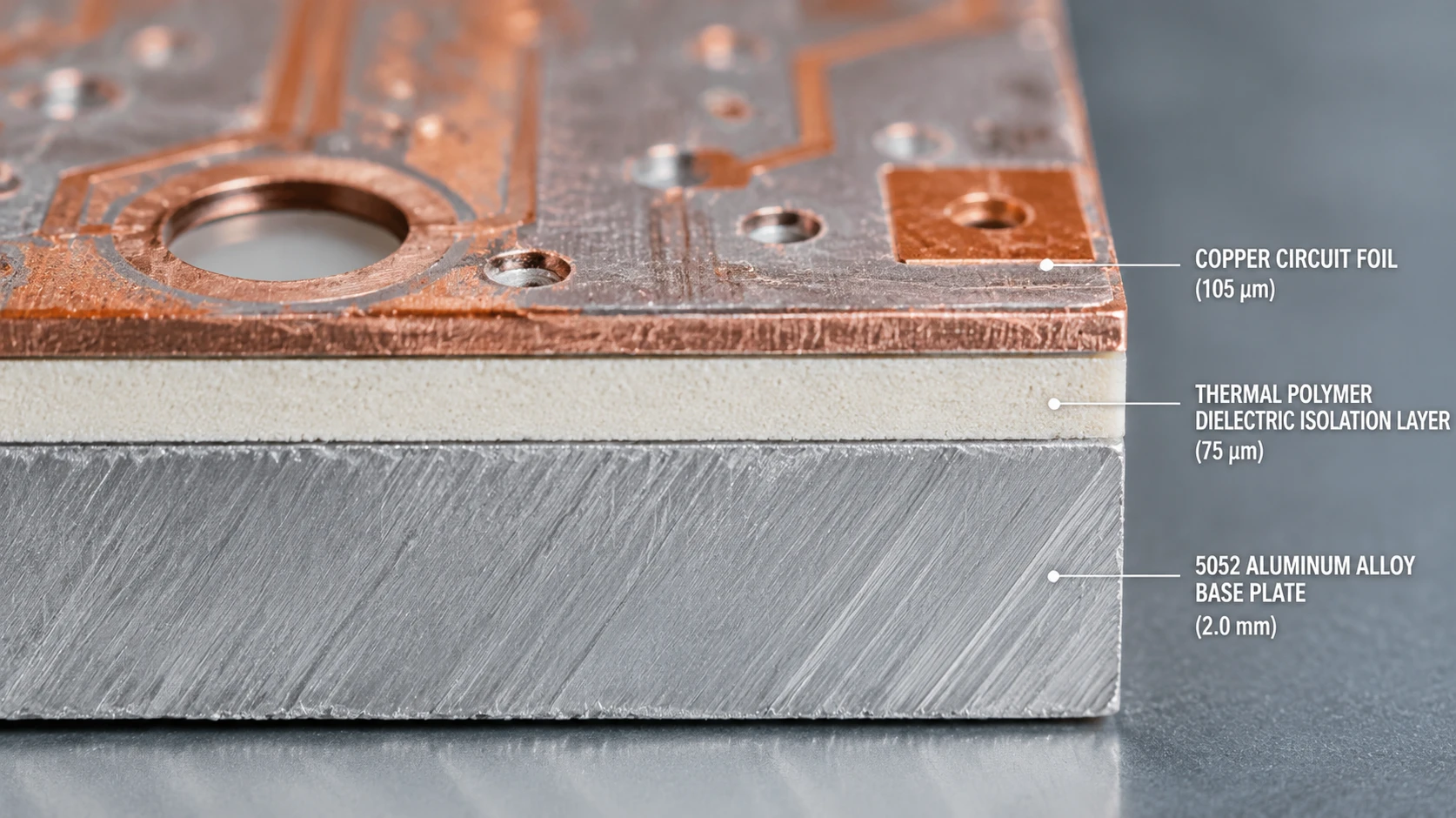
The performance of an aluminum core circuit board does not rely solely on the thickness of the metal base; it depends heavily on the properties of the thin dielectric isolation layer sandwiched between the top copper trace and the aluminum plate. This layer must manage a difficult balance: it must provide absolute electrical insulation to prevent high-voltage shorts while maintaining low thermal impedance to allow heat to pass downward into the metal core. Optimizing this multi-layered layout requires implementing a precise
The top conductive layer consists of a high-purity electrodeposited copper foil, with thicknesses ranging from standard 1 oz up to heavy 5 oz profiles. High-power industrial power supplies, motor controllers, and automated EV charging networks generate significant current densities, requiring thick copper traces to prevent excessive trace heating. The width and thickness of these traces must be calculated alongside the dielectric layer properties to handle operational current spikes safely.
The dielectric layer is the primary thermal bottleneck within the entire stackup matrix. Standard FR4 prepreg exhibits a poor thermal conductivity rating of only 0.25 W/m-K. In contrast, advanced metal core substrates use a specialized polymer resin enriched with thermally conductive ceramic fillers. Depending on your design requirements, these advanced interfaces provide thermal conductivity ratings ranging from 1.0 W/m-K up to 8.0 W/m-K or higher. Choosing a thin, high-performance dielectric layer minimizes the overall thermal resistance path, allowing heat to flow efficiently into the metal plate while maintaining a high dielectric breakdown voltage rating to isolate the circuit from the chassis ground.
The solid aluminum backplate typically spans thicknesses from 0.8 mm to 3.0 mm, with 1.6 mm serving as the baseline for standard industrial enclosures. The thickness of this metal plate dictates the total thermal mass available to absorb transient heat spikes and determines the physical flatness of the panel during high-temperature surface-mount reflow cycles.
Processing a metal plate bonded to a fine-line copper circuit introduces unique manufacturing challenges that traditional fiberglass processing lines are not equipped to handle. Fabricating these hybrid panels requires specialized tooling, customized chemical etching systems, and automated mechanical finishing cells. To deliver defect-free boards that slide perfectly into industrial product housings, production lines must maintain tight control over mechanical profile fabrication and specialized contoured milling steps.
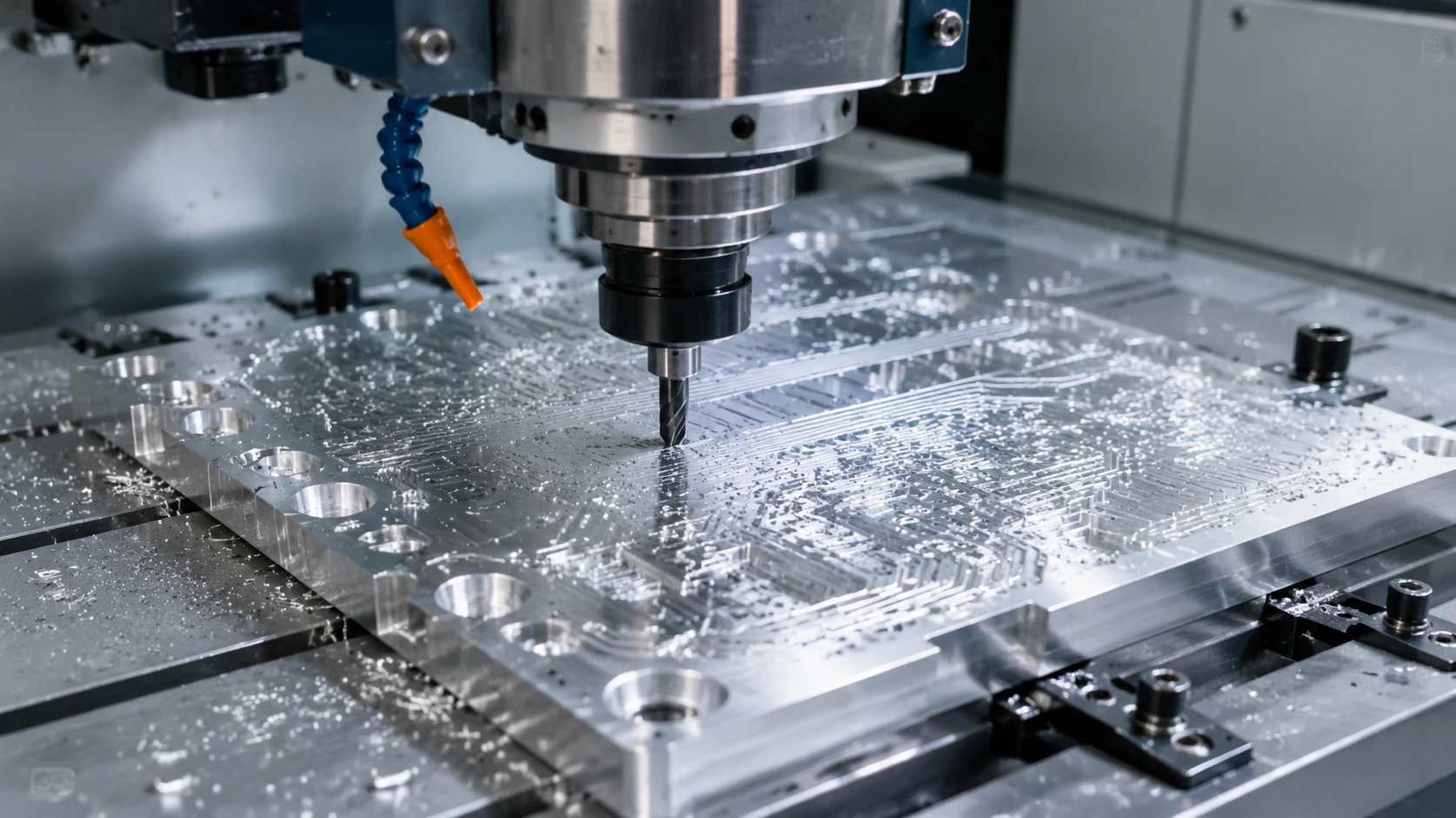
Shaping the metal core requires specialized tooling through advanced aluminum pcb electrical circuit board custom machining workflows. Standard PCB routers will dull instantly and tear the underlying metal when processing thick aluminum substrates. Instead, production lines utilize high-torque CNC milling systems equipped with specialized solid-carbide cutting bits. These automated milling systems cut perimeter paths, internal isolation slots, and complex mounting patterns with high precision. Tool feed speeds and cooling fluid delivery are monitored closely to prevent the aluminum from melting, gumming up the cutters, or generating burrs along the edges of the panel.
When a product design requires high-torque fasteners or power transistors to mount directly to the metal backing for maximum grounding efficiency, factories execute a precise custom aluminum milled pcb plate workflow. Advanced multi-axis CNC machines mill away localized areas of the circuit layer and dielectric insulation, creating flat-bottomed counterbores, blind pockets, or threaded mounting configurations directly within the raw aluminum backing. This mechanical processing enables power components to sit directly against the metal core, utilizing high-performance thermal paste to bypass the dielectric layer completely and achieve minimal thermal resistance. Enterprise procurement managers can browse our
Populating components onto an aluminum-backed board introduces distinct challenges during the automated surface-mount technology (SMT) reflow stage. In traditional assembly runs, the fiberglass substrate acts as a thermal insulator, allowing the components and solder paste to heat up quickly under infrared lamps or convection air currents. However, because an aluminum core board is designed to absorb and dissipate heat efficiently, the entire board acts as a massive heat sink inside the reflow oven, drawing thermal energy away from the solder joints during processing. Managing this thermal mass without damaging delicate silicon components requires optimizing every stage of the customized aluminum pcb assembly pipeline.
To counteract the high thermal dissipation of the metal core, assembly lines utilize long, multi-zone forced-convection reflow ovens filled with pure nitrogen gas. The reflow thermal profile must be carefully adjusted to feature an extended soak phase. This step allows the thick aluminum base to heat up uniformly to the target stabilization temperature before reaching the liquidus reflow stage. If the soak phase is too short, the metal base will pull heat away from the surface pads during peak reflow, resulting in cold solder joints, irregular wetting, or brittle mechanical connections. Conversely, if the oven temperature is raised too aggressively, the top copper traces can overheat and delaminate from the expanding polymer dielectric beneath.
Optoelectronic designs require high precision during component placement, particularly when constructing high-density customized aluminum pcb for led arrays. High-power LEDs operate at elevated current densities and feature compact surface pads. Stencil apertures must be engineered using advanced laser-cutting techniques to apply the precise volume of lead-free solder paste required. Depositing too much paste can cause components to float or bridge during reflow, while insufficient paste creates thin, weak joints prone to cracking under repetitive thermal cycling. Assembly systems utilize specialized soft-tipped vacuum nozzles and vision alignment cameras to place components accurately onto the solder paste without scratching delicate optical surfaces or protective silicone lenses.
In high-reliability industrial automation, aerospace power conversion, and mission-critical automotive infrastructure, component failure can lead to significant warranty liabilities, factory downtime, or safety hazards. Therefore, a premier global contract manufacturer must back its volume production runs with rigorous testing protocols and verifiable quality metrics. Every production batch should be processed under strict adherence to IPC Class 3 and ISO 9001 quality management guidelines to ensure consistent field performance. To learn how integrated quality controls protect your hardware investment, engineering teams can review our
Our automated quality assurance centers subject every metal core production batch to a rigorous, multi-stage verification workflow before final packaging. High-precision inline optical scanners check paste deposition heights and alignment across all surface pads, catching printing anomalies before components are mounted. Following reflow, high-resolution multi-angle camera networks scan the populated panels to verify component alignment, correct polarity markings, and solder joint geometry.
Because metal core boards operate near high voltages with ground connections running through the chassis, completed assemblies undergo mandatory High-Potential insulation testing. This process applies a high-voltage pulse between the electrical circuit layer and the aluminum backing to confirm the dielectric isolation layer is free of pinholes or micro-cracks. Finally, sample coupons from each batch undergo rapid thermal cycling tests, moving between extreme cold and heat limits to confirm the internal layer bonds can withstand repetitive expansion without delamination or trace cracking.
The raw aluminum base material possesses inherently high thermal conductivity. However, the thin polymer dielectric layer acts as a natural resistor. If the polymer lacks adequate ceramic fillers, it blocks heat transfer regardless of how thick the aluminum plate is. Specifying a high-conductivity dielectric layer ensures immediate thermal transmission down to the core.
ApolloPCB utilizes CTE-matched dielectric polymers whose expansion behavior aligns with the aluminum base. Furthermore, our SMT lines implement customized multi-zone preheating and gradual cooling ramp profiles, ensuring the entire substrate profile absorbs and releases heat evenly to maintain absolute board flatness.
Yes. While standard aluminum cores support surface-mount components, ApolloPCB utilizes specialized mechanical drilling processes to support mixed assemblies. We drill oversized holes into the aluminum base, fill them with high-isolation epoxy resins, and re-drill the cores to allow through-hole pins to pass through safely without electrical shorting.
As modern industrial electronics shrink into more compact enclosures and operate under higher electrical loads, choosing a reliable manufacturing partner is critical to long-term project success. Securing a stable market position requires moving past transactional brokers and partnering with an integrated manufacturer capable of executing advanced material science, complex multi-axis machining, and high-precision automated assembly under one roof.
ApolloPCB combines deep process engineering, advanced cleanroom assets, and strict quality controls to streamline your sourcing pipeline and protect your hardware investment from early prototype validation through large-scale automated delivery. Ready to eliminate field failures, reduce hidden logistical overhead, and compress your product development timeline? Please contact our international engineering department and

Got project ready to assembly? Contact us: info@apollopcb.com



 Whatsapp 0086 755 29438407
 Mail info@apollopcb.com
 Tel 0086 755 29438407


ABOUT US

PRODUCTS
TECHNOLOGY
KNOWLEDGE CENTRE
CULTURE
NEWS
We're not around but we still want to hear from you! Leave us a note:

Leave Message to APOLLOPCB
