




-
- PCB TYPE
- PRINTED CIRCUIT BOARD PROTOTYPE ALUMINUM PRINTED CIRCUIT BOARD R&F PCB FPC HIGH FREQUENCY PCB HIGH-TG PCB HEAVY COPPER PCB HDI PCB PCB FOR LIGHTING METAL CORE PCB


time:Jun 25. 2026, 09:12:12
The modern industrial solid-state lighting and electronics landscape is defined by continuous miniaturization and escalating power density requirements. As original equipment manufacturers (OEMs), electronic product architects, and procurement managers design next-generation hardware—such as high-density LED luminaire arrays, automotive dashboard displays, commercial signal matrices, and compact consumer electronics—selecting the optimal chip architecture becomes a critical choice. The success of an optoelectronic system depends heavily on matching your design criteria with the precise physical, electrical, and thermal boundaries of different surface-mount device packages.
For industrial engineering teams, analyzing an smd led size is not merely a matter of checking casing footprints; it is an essential engineering calculation that directly dictates automated pick-and-place assembly speeds, thermal dissipation paths, stencil layout design, and overall manufacturing yield. Utilizing the wrong component footprint can lead to severe structural flaws, including solder bridging, thermal bottlenecks, and premature component degradation in the field. This engineering guide provides a detailed breakdown of industrial parameters, package dimensions, and assembly workflows to help you optimize your solid-state lighting platforms.
To properly navigate a technical product specification sheet, design teams must understand the coding systems used to designate chip footprints. Surface-mount component packaging typically uses a four-digit numerical code to identify length and width dimensions. However, the global supply chain often switches between imperial and metric units depending on the specific type and power rating of the chip configuration.
Understanding how these measurements are applied helps clarify the differences between standard low-power indicators and high-brightness lighting configurations:
For small, low-power indication circuits and compact signal arrays, chip packages generally follow standard imperial configurations. For instance, common package designations like 0603, 0805, and 1206 are based on inches. An imperial 0603 package measures approximately 0.06 inches in length by 0.03 inches in width. These packages are ideal for tight status-indicator arrays where minimal board space is available and operational currents remain low.
Conversely, high-brightness illumination and commercial power lighting arrays almost exclusively use metric naming conventions. When analyzing prominent lighting profiles like 2835, 3528, or 5050, the numerical codes indicate physical measurements expressed in millimeters. For example, a 2835 package measures exactly 2.8 mm in length by 3.5 mm in width, while a 5050 package measures 5.0 mm by 5.0 mm.
Concurrently, confusing an imperial package code with a metric designation can lead to major layout errors on the factory floor. Engineers can review the structural differences between these packaging environments by examining our
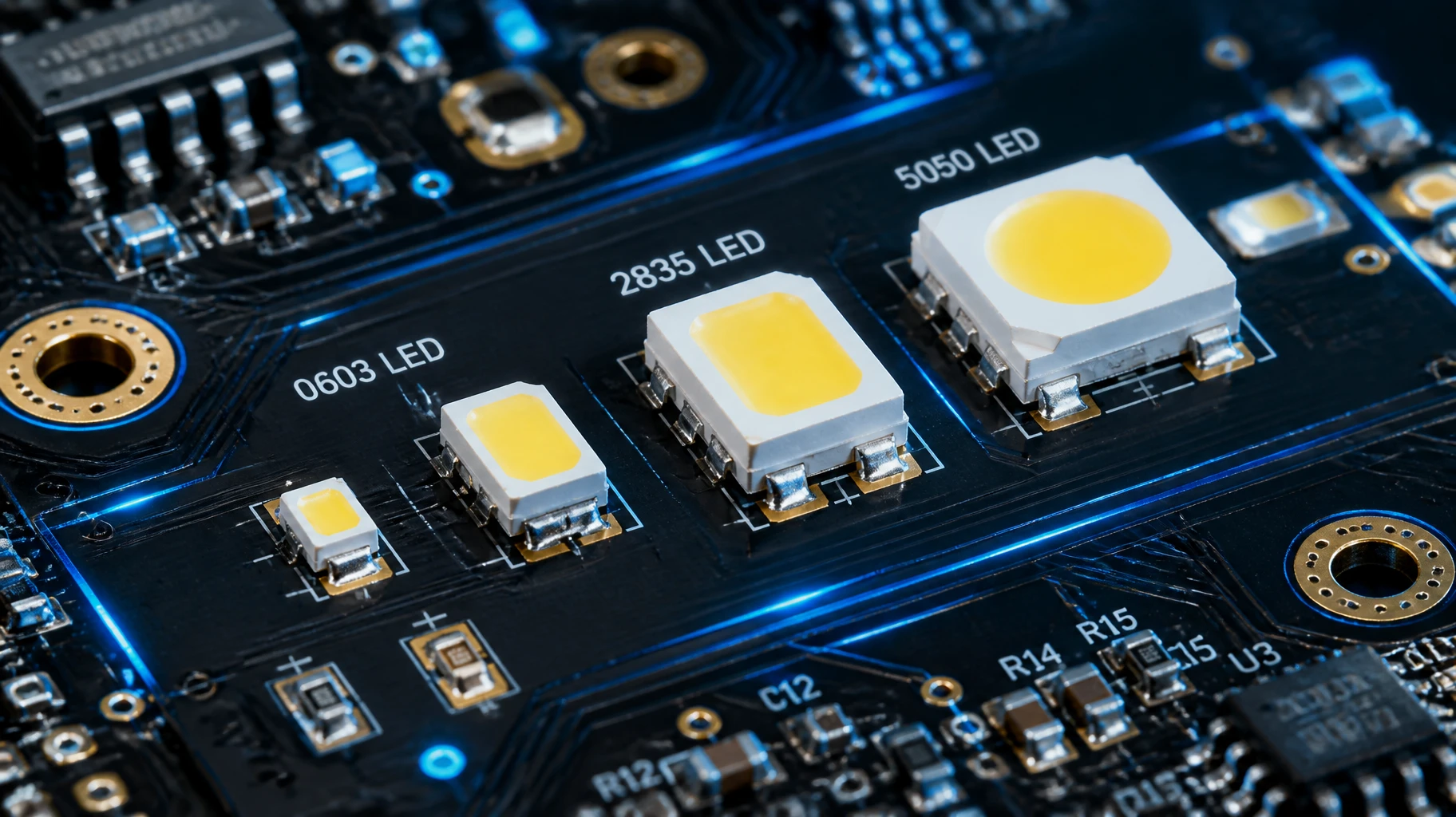
To simplify the component selection process for your design teams, the following markdown table consolidates common smd led sizes, physical footprint dimensions, typical operating currents, and typical industrial application environments.
| Package Designation Code | Primary Measurement Unit | Physical Dimensions (Length by Width in mm) | Typical Power Envelope (Watts) | Optimal Operational Current (mA) | Primary Industrial Application Targets |
| 0402 | Imperial | 1.0 mm by 0.5 mm | 0.03 W to 0.05 W | 5 mA to 10 mA | Ultra-compact consumer portables, micro status indicators |
| 0603 | Imperial | 1.6 mm by 0.8 mm | 0.05 W to 0.08 W | 15 mA to 20 mA | Industrial control interfaces, backlighting sub-panels |
| 0805 | Imperial | 2.0 mm by 1.25 mm | 0.08 W to 0.10 W | 15 mA to 20 mA | Commercial networking switches, medical diagnostic displays |
| 1206 | Imperial | 3.2 mm by 1.6 mm | 0.10 W to 0.15 W | 20 mA to 30 mA | Power rail diagnostic indicators, automotive switch clusters |
| 2835 | Metric | 2.8 mm by 3.5 mm | 0.20 W to 0.50 W | 30 mA to 60 mA | High-efficiency commercial T8 tubes, LED strip lighting |
| 3528 | Metric | 3.5 mm by 2.8 mm | 0.06 W to 0.10 W | 20 mA to 30 mA | Architectural decorative accents, retail display illumination |
| 5050 | Metric | 5.0 mm by 5.0 mm | 0.20 W to 1.50 W | 60 mA to 150 mA | High-output multi-color RGB smart strips, outdoor signage |
| 5630 / 5730 | Metric | 5.7 mm by 3.0 mm | 0.50 W to 1.00 W | 100 mA to 150 mA | Commercial downlights, high-lumen industrial bay fixtures |
Reviewing this smd led size chart demonstrates that as physical package volumes increase, the component's current-handling capability and power capacity grow substantially. This scaling behavior highlights the need to cross-reference an verified smd led sizes chart during early schematic development to balance electrical load demands with available circuit board area.
For an expanded reference table that includes niche package profiles, custom Z-axis component heights, and alternative pad geometries, engineering teams can access our
As circuit layouts pack components more tightly, managing thermal dissipation becomes a priority for optoelectronic hardware designs. Unlike traditional incandescent lamps that radiate heat through infrared energy, surface-mount diodes transfer thermal energy downward through their conductive metal pads into the underlying circuit board structure. If the thermal energy generated at the diode junction is trapped, the component's luminous efficiency drops, color outputs shift, and lifespan shortens considerably.
Implementing high-power package arrays like 2835 or 5050 requires strict adherence to Design for Manufacturability (DFM) layout practices:
Exposed Thermal Pad Footprints: High-power chip designs include a dedicated, non-electrical thermal pad underneath the component body. The corresponding footprint on the circuit board must feature an matching exposed copper pad coated with a highly conductive surface finish, such as Electroless Nickel Immersion Gold (ENIG), to establish an efficient thermal interface.
Thermal Via Matrices: To transfer thermal energy through rigid glass-epoxy substrates, engineers implement matrices of plated through-hole (PTH) thermal vias directly within the landing pads. These vias are typically filled with conductive epoxy and capped with copper plating to maximize vertical thermal conductivity and prevent solder migration during reflow.
Solder Mask and Stencil Registration: High component placement density requires high precision during solder paste deposition. Stencil apertures must be designed to deposit the exact volume of paste needed to achieve a uniform solder joint thickness without causing bridging between closely spaced electrical pads.
Transitioning a high-volume lighting array or sensitive control panel from early prototype designs to automated high-volume production requires an integrated, reliable contract manufacturing pipeline. When processing large arrays of fragile optoelectronic components, procurement leads must look past simple component brokers and align with a vertically integrated partner capable of validating manufacturing files before production begins.
Automated assembly environments require strict process controls across every phase of production:
Automated Reel and Feeder Profiling: High-speed pick-and-place lines use motorized tape feeders calibrated to the exact tape pitch of the component reels. Whether your bill of materials specifies small imperial indicators or large metric power diodes, the component packaging format must be fully validated to prevent machine jams or component feeding errors.
Vacuum Nozzle and Optical Center Calibration: Pick-and-place systems utilize specialized soft-tipped vacuum nozzles to lift components without scratching delicate silicone lenses or damaging ceramic encapsulation bodies. Automated alignment cameras scan each part in real time to verify dimensional tolerances against your placement files before mounting.
Multi-Zone Reflow and Atmospheric Controls: Lead-free solder alloys require precise, multi-zone convection reflow profiles. The thermal ramp-up and cooling phases must be carefully managed to ensure all joints melt uniformly without subjecting the internal diode junctions to thermal shock.
By utilizing the turnkey capabilities of our dedicated

To ensure long-term reliability in demanding industrial, automotive, and medical applications, finished circuit board assemblies must undergo comprehensive testing workflows. Optoelectronic components are sensitive to electrostatic discharge (ESD) and mechanical stresses, making strict quality control verification essential.
Our quality assurance departments process all volume production batches under strict adherence to IPC Class 3 (High-Reliability Electronic Products) standards:
Automated Optical Inspection (AOI): High-resolution multi-camera inspection arrays verify component presence, proper orientation, polarity alignment, and solder fillet shapes, instantly flagging any placement anomalies.
3D X-Ray Inspection (AXI): For high-power components with large central thermal pads, automated X-ray scanners check inside the solder layer to detect hidden voids or shorts that optical systems cannot see.
Functional Testing and Burn-In Verification: Populated boards pass through automated functional testing cells to confirm consistent current draw and luminous output across all channels under simulated field loads.
Certain package codes can be confusing because the same numbers designate different footprints depending on whether the metric or imperial system is applied. For example, an imperial 0603 package measures 1.6 mm by 0.8 mm, whereas a metric 0603 package measures 0.6 mm by 0.3 mm. ApolloPCB checks all incoming layout files against your component bills of materials during automated DFM reviews to ensure landing pads match your chosen component system perfectly.
Our high-speed SMT assembly lines utilize programmable pick-and-place systems fitted with custom, soft-component vacuum nozzles. These tools lift components safely without applying excessive mechanical pressure to fragile silicone lenses, preventing internal wire bond damage and structural housing fractures.
For high-density and high-power applications, ApolloPCB recommends Electroless Nickel Immersion Gold (ENIG) or OSP (Organic Sphericity Preservative) finishes. These treatments provide exceptionally flat pad surfaces, ensuring reliable component co-planarity, uniform solder paste deposition, and efficient thermal transfer across large component arrays.
As modern hardware systems pack more power into smaller physical volumes, selecting the correct component footprint is vital to ensuring long-term product reliability. Securing a strong position in competitive commercial markets requires moving past transactional brokers and partnering with an integrated manufacturer capable of executing advanced material science, complex mechanical processing, and high-precision automated assembly under one roof.
ApolloPCB provides a vertically integrated manufacturing ecosystem equipped with state-of-the-art pick-and-place lines, 3D SPI/AOI verification cells, automated X-ray inspection systems, and advanced multi-axis CNC drilling machinery. Whether your design requires high-density status-indicator matrices or high-power illumination arrays, our engineering cells ensure your hardware scales smoothly with maximum reliability.
Ready to optimize your product sourcing pipeline, eliminate field failures, and streamline your volume production runs? Please contact our international support team and

Got project ready to assembly? Contact us: info@apollopcb.com



 Whatsapp 0086 755 29438407
 Mail info@apollopcb.com
 Tel 0086 755 29438407


ABOUT US

PRODUCTS
TECHNOLOGY
KNOWLEDGE CENTRE
CULTURE
NEWS
We're not around but we still want to hear from you! Leave us a note:

Leave Message to APOLLOPCB
