




-
- PCB TYPE
- PRINTED CIRCUIT BOARD PROTOTYPE ALUMINUM PRINTED CIRCUIT BOARD R&F PCB FPC HIGH FREQUENCY PCB HIGH-TG PCB HEAVY COPPER PCB HDI PCB PCB FOR LIGHTING METAL CORE PCB


time:Jul 02. 2026, 14:03:18
In the highly competitive global electronics manufacturing sector, industrial hardware engineers, original equipment manufacturers (OEMs), and procurement directors face continuous pressure to design products with greater spatial density, lower structural mass, and absolute operational reliability. As advanced electronic systems integrate into increasingly confined or dynamic mechanical enclosures—such as automotive sensor arrays, aerospace avionics bays, multi-axis industrial robotic limbs, and high-density medical diagnostic equipment—the limits of traditional rigid circuit boards become clear. Under continuous vibration, high-frequency physical bending, or severe thermal expansion shifts, rigid laminates are prone to trace fracturing, solder joint fatigue, and early interconnect failure. To overcome these mechanical boundaries and ensure reliable product lifecycles, global hardware teams specify advanced fpc fabrication as their primary interconnect architecture.
Flexible Printed Circuits (FPCs) replace stiff glass-epoxy matrix boards with thin, highly ductile polyimide films clad with flexible copper foils. This design allows the electronic sub-assembly to bend, fold, twist, and contour smoothly within complex three-dimensional enclosures. However, transitioning a complex multi-layer flexible schematic from initial computer-aided design (CAD) validation into defect-free volume production requires an accurate, data-driven analysis of base polymer material properties, dielectric insulation performance, fine-line chemical etching tolerances, and automated assembly profiles. This comprehensive technical guide outlines the precise engineering frameworks, material stackups, and manufacturing process controls necessary to successfully execute high-reliability flexible circuit production runs.
The performance and operating life of a flexible circuit depend heavily on the raw material composition selected during initial product design. Unlike rigid boards that rely on standard FR4 glass-epoxy layups, flexible substrates utilize specialized polymer films and high-purity copper foils designed to withstand continuous mechanical flexing without experiencing structural delamination or trace cracking. When evaluating fpc fabrication services, engineering teams must review the specific characteristics of adhesiveless substrates, adhesive polymer formulations, and raw copper metallurgies.
Traditional flexible laminates use an acrylic or butyral adhesive layer to bond the conductive copper foil to the underlying polyimide base film. While adhesive-based boards offer a cost-effective choice for static or low-flex applications, the adhesive layers introduce significant thermal and mechanical risks for high-performance industrial electronics. Acrylic adhesives feature low thermal stability, a high coefficient of thermal expansion (CTE), and high moisture absorption rates. During high-temperature lead-free surface-mount technology (SMT) reflow cycles, these adhesive layers can soften, outgas, and swell, causing trace shifting or internal pad delamination.
For high-reliability, multi-layer applications, modern factories utilize adhesiveless base laminates. These premium substrates bond the copper foil directly to the polyimide base film via specialized casting or direct web-deposition processes. Eliminating the adhesive layer provides several clear design advantages:
Reduced Stackup Thickness: Adhesiveless laminates are significantly thinner, allowing for a tighter bend radius and better packaging efficiency within compact product housings.
Superior Thermal Performance: Without a low-temperature adhesive layer, adhesiveless boards exhibit excellent thermal stability, enabling them to survive multiple lead-free reflow cycles and continuous operation in harsh industrial environments.
Enhanced Electrical Integrity: Adhesiveless profiles provide lower dielectric loss and tighter impedance control, which are critical for high-speed signal transmission and high-frequency communication modules.
The crystalline structure of the conductive copper layer determines the circuit's resistance to mechanical fatigue under repetitive bending. FPC manufacturing utilizes two main types of copper foils:
Electrodeposited (ED) Copper: Manufactured by electroplating copper ions onto a rotating stainless steel drum, ED copper features a vertical, columnar grain structure. This grain orientation provides excellent vertical conductivity and fine-line etching precision, making it well-suited for high-density static applications where the board is bent once during initial product integration. However, its vertical grain structure makes it brittle under continuous physical movement, rendering it prone to micro-cracking during dynamic flex operation.
Rolled Annealed (RA) Copper: Produced by repeatedly rolling thick copper ingots through high-pressure mechanical mills followed by thermal annealing bakes, RA copper features an elongated, horizontal crystalline structure. This horizontal grain orientation allows the copper foil to stretch and compress smoothly along the flex axis, providing excellent resistance to repetitive mechanical stress. For dynamic flex applications, such as printhead cables or rotating camera joints, RA copper is mandatory to ensure millions of flex cycles without trace failure.
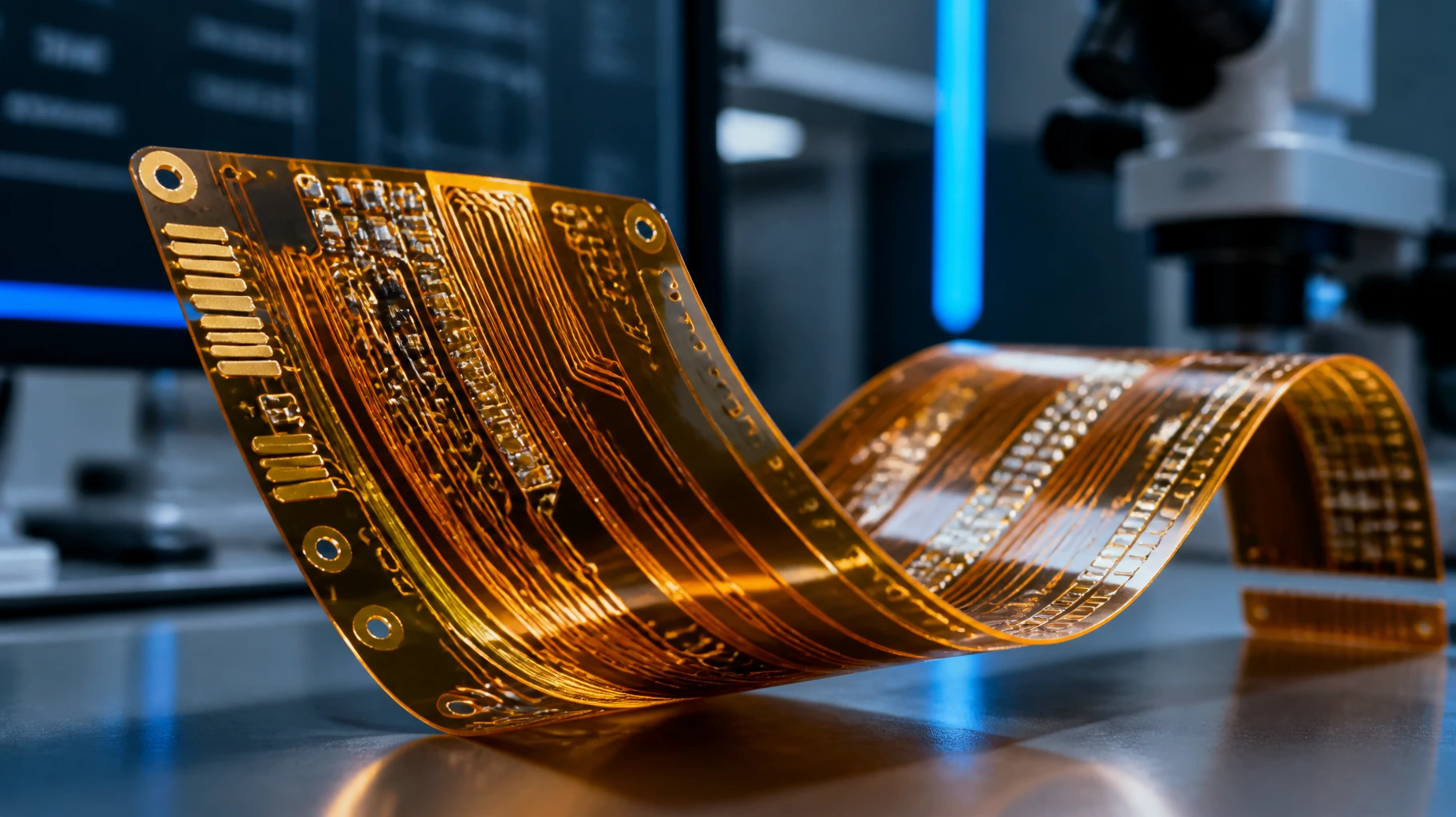
Transitioning raw polyimide rolls into fine-line, multi-layer flexible assemblies requires a highly controlled, automated sequence of chemical, thermal, and mechanical processing cells. Each phase of this workflow is managed by centralized Manufacturing Execution Systems (MES) to maintain tight dimensional tracking and material traceability across the factory floor.
Polyimide films are naturally hygroscopic and absorb ambient moisture from the factory cleanroom. To prevent internal outgassing, blistering, and dimensional shifting during subsequent high-temperature stages, the raw copper-clad laminates undergo a mandatory stabilization pre-bake in automated convection ovens. This baking process drives off residual moisture and relieves internal structural stresses within the polymer matrix, ensuring predictable panel registration during high-density circuit imaging.
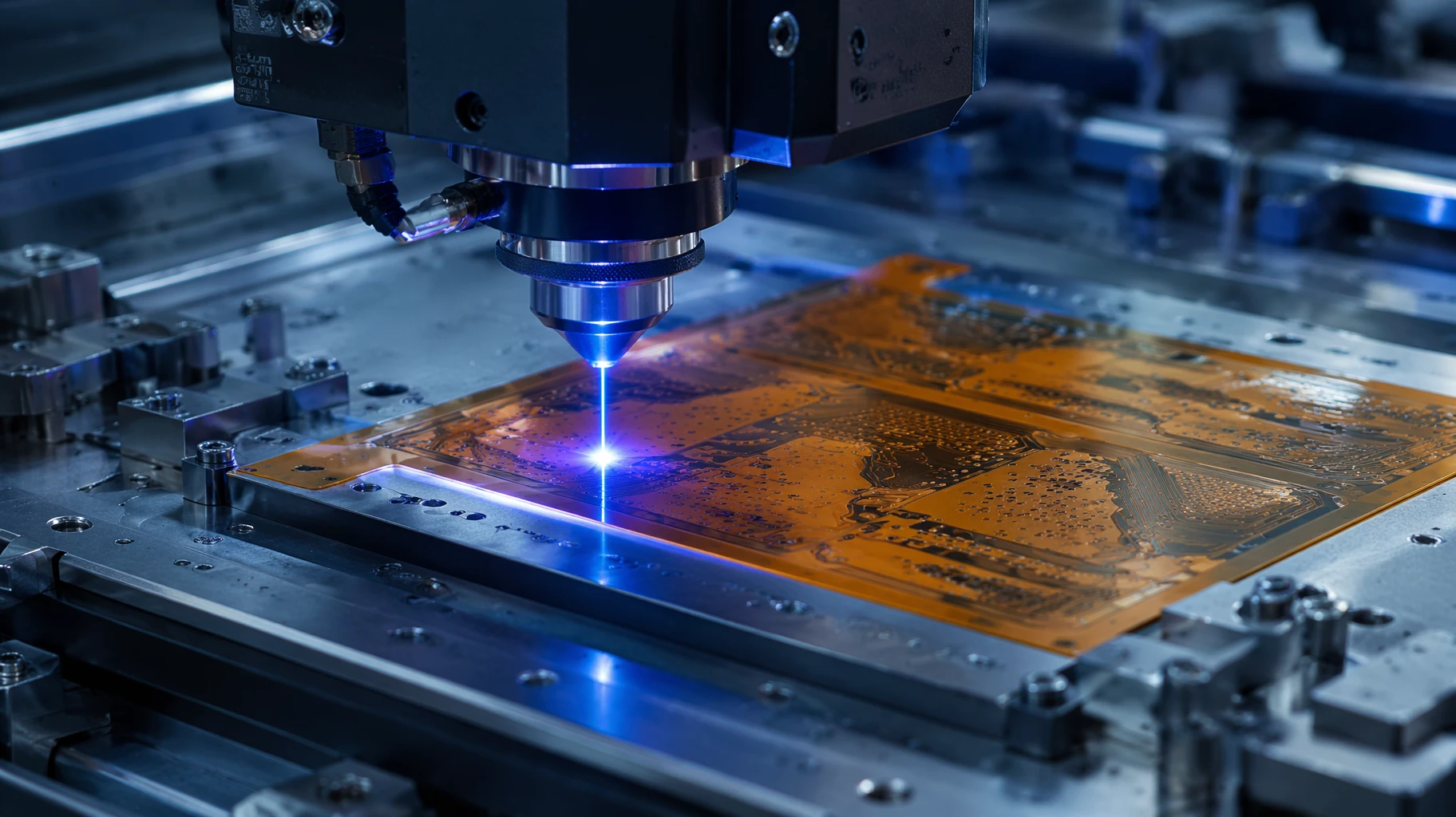
The stabilized panel is coated with a uniform layer of liquid or dry-film photosensitive polymer resist. To generate the fine-line trace geometries required by modern high-density designs, factories utilize advanced Laser Direct Imaging (LDI) systems. Instead of exposing the panel through traditional silver-halide photo-masks—which can stretch or distort under temperature variations—the LDI system uses a high-precision ultraviolet laser beam to write the circuit pattern directly from the digital CAD files onto the photoresist layer. This direct laser projection automatically compensates for any minor material shrinkage or distortion across the panel surface, ensuring exact pad alignment down to the micron level.
Following laser exposure, the panel passes through an automated chemical developer solution to strip away unexposed photoresist, leaving the target circuit pattern protected. The exposed background copper is then chemically removed in an acid etching chamber. Maintaining exact control over chemical concentrations, spray pressures, and conveyor speeds is essential during this stage to prevent under-cutting or over-etching of fine-pitch traces. Immediately after etching, the bare copper circuits pass through non-contact Automated Optical Inspection (AOI) systems. These high-resolution camera networks scan the traces from multiple angles to identify trace narrowing, open circuits, pinholes, or trace-to-trace shorts before the board is sealed.
To protect the delicate copper traces from oxidation, dust accumulation, and chemical corrosion, standard liquid solder masks are replaced with a flexible polyimide coverlay film pre-coated with a thermosetting acrylic adhesive layer. Access apertures for SMT components or termination pads are pre-cut into the coverlay using high-speed UV laser drilling systems.
The pre-machined coverlay is then precisely aligned over the etched copper traces by optical target registration systems and tacked into place using localized heating tools. The entire assembly is transferred to a high-pressure vacuum lamination press, where controlled thermal profiles cure the adhesive resin, forcing it to flow evenly around the copper trace profiles to establish a hermetically sealed, void-free structural bond.
The exposed copper pads within the coverlay apertures must receive a high-performance surface finish to ensure reliable solder joint formation and wire bonding. Depending on the specific application requirements, factories apply advanced plating finishes, including Electroless Nickel Immersion Gold (ENIG), Electroless Nickel Electroless Palladium Immersion Gold (ENEPIG), or direct Immersion Tin. For applications featuring integrated keypad contacts or sliding friction interfaces, a thick layer of hard electroplated gold is applied over an underlying nickel barrier to provide excellent mechanical wear resistance over long-term field operation.
The final step in the fabrication sequence is separating the individual flexible circuits from the larger panel array. Traditional mechanical die punching or routing can apply significant mechanical stress to the edges of flexible substrates, causing delamination along the coverlay bond line or micro-fissures in the outer copper traces.
To eliminate these processing stresses, modern factories utilize high-precision UV or CO2 laser cutting systems. The automated laser beam cuts complex perimeters, internal slots, and alignment notches with high accuracy, leaving a smooth, burr-free edge profile that prevents stress concentration and tearing during manual installation.
As electronic systems increase in complexity, single-sided flexible layouts are frequently insufficient to handle dense signal routing networks, complex differential impedance requirements, and shielding constraints. Designing multi-layer flexible stackups requires careful balance to ensure the assembly maintains sufficient mechanical flexibility while providing stable electrical performance across all signal layers. When engineering a complex system, technical design teams can consult our detailed manual on
Managing these multi-layered layouts requires implementing specific architectural rules to balance electrical performance with mechanical flexibility:
When a multi-layer flexible board is bent, the outer materials experience tensile stretching forces, while the materials along the inner radius experience compressive crushing forces. Between these two opposing stresses sits a theoretical zero-stress plane known as the neutral axis. To maximize the operational life of the assembly and prevent copper fractures, designers must structure the stackup so that the heaviest copper layers and critical high-speed signal traces sit as close to the neutral axis as possible. Thick, rigid components, such as solid plane layers or thick dielectric cores, should be kept away from the outer edges of the bending zone to minimize mechanical stress during movement.
In multi-layer flexible designs, routing traces directly on top of each other on adjacent layers creates an engineering defect known as the "I-Beam effect." This alignment significantly increases the structural stiffness of the board along the routing path, rendering it vulnerable to cracking during bending. To maintain high flexibility and reduce internal stresses, trace paths should be staggered across adjacent layers. This alternating layout spreads mechanical loads evenly across the substrate matrix and reduces capacitive cross-talk between parallel signal paths.
Flexible circuits used in telecom infrastructure, medical imaging, or digital aerospace modules require protection from electromagnetic interference (EMI) without significantly increasing the board's overall thickness or stiffness. Standard solid copper planes add excessive rigidity, making them unsuitable for high-flex zones.
Instead, modern designs incorporate specialized cross-hatched copper shielding patterns or ultra-thin silver conductive ink films. These alternative shielding treatments provide excellent EMI suppression while maintaining a thin, flexible profile that preserves the circuit's mechanical properties.
To select the ideal core substrate composition for your product's mechanical and electrical constraints, engineering teams must cross-reference mechanical limits, chemical thresholds, and thermal boundaries. The reference matrix below outlines the critical distinctions across common flexible core laminate configurations.
| Base Core Material Class | Adhesive Integration Type | Dielectric Constant (Dk at 1 GHz) | Dissipation Factor (Df at 1 GHz) | Moisture Absorption Rate | Maximum Operating Temperature | Optimal Industrial Sourcing Target |
| Standard Acrylic Base | Adhesive-Bonded | 3.4 to 3.6 | 0.020 to 0.025 | 2.5% to 3.0% | 105°C to 125°C | Static control interfaces, low-layer status panel links |
| Premium Epoxidized Base | Modified Epoxy Bond | 3.3 to 3.5 | 0.015 to 0.020 | 1.8% to 2.2% | 130°C to 150°C | Commercial instrumentation, mid-range robotic actuators |
| Advanced Polyimide Cast | Adhesiveless Cast | 3.1 to 3.3 | 0.003 to 0.005 | 0.8% to 1.1% | 220°C to 260°C | Aerospace avionics bays, medical diagnostic arrays |
| High-Frequency Fluoropolymer | Adhesiveless LCP | 2.9 to 3.0 | 0.001 to 0.002 | 0.04% to 0.1% | 200°C to 220°C | High-speed telecom modules, radar sensor matrices |
Analyzing this reference table shows that as material formulations move toward adhesiveless casting and liquid crystal polymer (LCP) technologies, moisture absorption drops significantly and dielectric loss performance improves. This variance highlights why volume engineering teams must balance available production budgets with the environmental operating thresholds needed for their specific application.
For international enterprise buyers operating in highly regulated automotive, medical, and aerospace markets, product compliance is a mandatory prerequisite for global market access. If an interconnect assembly fails prematurely due to hidden micro-voids, poor vertical copper plating, or chemical contamination, the entire system can fail, resulting in significant warranty claims and damage to brand reputation. To ensure continuous operation in harsh environments, engineering leads can review our
Implementing a reliable manufacturing workflow requires strict process controls across several testing and validation stages:
To verify the structural integrity of multi-layer flexible circuits, production facilities perform destructive micro-sectional analysis on sample coupons from each manufacturing batch. Technicians mount these coupons in specialized curing resins, polish the cross-sections, and examine them under high-powered electron microscopes to verify critical internal structures:
Through-Hole Plating Uniformity: The vertical copper plating inside micro-vias must maintain a uniform, continuous thickness along the barrel walls, preventing thin areas that could fracture under thermal expansion stress.
Coverlay Adhesive Bleed Control: The acrylic or epoxy adhesive layer must flow adequately to seal trace perimeters without bleeding excessively into open component pads, ensuring clean, solderable surfaces for automated assembly.
Inner-Layer Connection Registration: Internal pad-to-trace junctions must exhibit precise registration to prevent trace misalignments or open circuits under continuous mechanical flexing.
Because flexible circuits feature ultra-thin polyimide insulation barriers and operate in tight mechanical enclosures, all production runs must undergo 100% mandatory High-Potential (Hi-Pot) insulation validation checks. Automated testing equipment applies a precise high-voltage DC pulse between independent circuit lines and adjacent ground layers to verify the integrity of the dielectric layers. This step ensures the polyimide films and cured adhesive structures are entirely free of pinholes, micro-cracks, or conductive chemical contamination that could cause low-voltage leakage currents or short circuits during long-term field operation.
To confirm that a custom fpc fabrication batch can withstand the physical demands of its final operating environment, QA departments place sample assemblies into automated mechanical test fixtures. These systems simulate actual field movements by subjecting the circuits to repetitive bending, folding, and twisting actions at controlled speeds and angles.
Throughout this lifecycle simulation, automated data logging systems continuously monitor the loop resistance of the copper traces. Any micro-cracking or grain separation inside the copper foil causes an immediate spike in resistance, allowing engineers to identify potential fatigue failures and confirm the batch meets the million-cycle reliability standards required for demanding industrial applications.
When scaling an electronic product design from early engineering prototypes up to high-volume contract manufacturing, minimizing hidden overhead costs and optimizing material yield are essential to ensuring a strong return on investment (ROI). Experienced procurement heads understand that total flexible production costs are largely determined by design choices made during the early layout and panel design phases.
Hardware procurement teams can leverage three key optimization strategies to minimize total cost of ownership:
Because raw polyimide core substrates are supplied in continuous rolls or large rectangular sheets, material utilization is a primary driver of overall production costs. Designing an optimized layout allows engineers to nest irregular, L-shaped, or long flexible circuit profiles tightly within a single manufacturing frame. This practice maximizes material utilization, reduces wasted substrate area, and lowers the cost per individual circuit.
Procurement leads looking to optimize material utilization can explore our complete
Flexible circuits are inherently malleable, which can complicate standard SMT assembly components like large integrated circuits, dense microcontrollers, or heavy surface-mount connectors. Attempting to solder components onto an unsupported flexible base can lead to solder joint cracking or pad tearing when the board undergoes physical bending.
To provide structural support where needed without making the entire circuit rigid, designers integrate selective stiffeners. These localized materials—typically made of thick FR4 plates, polyimide panels, or stainless steel sheets—are laminated to the back of the flexible circuit directly underneath component landing zones or connector fields. This approach provides a rigid, stable platform for reliable SMT processing while keeping the rest of the board light and flexible.
Specifying ultra-narrow trace widths and spaces below standard capabilities requires low-speed processing controls and intensive optical inspection steps that increase overall manufacturing cost structures. By standardizing trace layouts around widely supported line-and-space dimensions, engineering teams can utilize standard high-speed etching lines, improve first-pass manufacturing yields, and reduce total production costs.
For a detailed breakdown of available material classes and thickness options, engineering leads can review our product specification matrix for

Executing an high precision fpc fabrication process requires utilizing advanced Laser Direct Imaging (LDI) infrastructure, non-contact optical inspection (AOI) setups, and automated UV laser drilling systems. These digital toolsets eliminate dimensional errors caused by traditional film stretch, allowing factories to maintain tight trace tolerances and precise coverlay alignment across large multi-layer production runs. ApolloPCB monitors these core stages through computer-integrated manufacturing lines to ensure high-density flexible circuits conform exactly to design specifications.
Adhesiveless polyimide material is highly preferred for an advanced fpc fabrication with high reliability because it eliminates the thick, thermally unstable acrylic adhesive layer found in traditional flexible laminates. This direct bond reduces overall stackup thickness, improves thermal resistance during lead-free SMT reflow, and lowers moisture absorption, providing a highly stable platform for mission-critical industrial, medical, and automotive applications. ApolloPCB integrates premium adhesiveless base laminates across our high-reliability manufacturing lines to ensure robust field survival.
ApolloPCB integrates selective FR4 or polyimide stiffeners directly onto the back of the flexible panels underneath component landing pads and connector fields. This engineering step establishes stable, non-yielding zones that prevent physical bending stress from transferring to delicate solder joints during automated picking and component reflow, ensuring high first-pass assembly yields and reliable long-term field operation.
Succeeding in the highly competitive global electronics market requires moving past transactional brokers and partnering with an integrated manufacturer capable of executing advanced material science, complex chemical etching, and high-precision automated assembly under one roof. Maintaining a reliable product supply chain requires a manufacturing partner that combines deep technical expertise, advanced production machinery, and strict quality control frameworks.
ApolloPCB provides a vertically integrated manufacturing ecosystem equipped with advanced LDI imaging arrays, high-speed UV laser drilling cells, 3D automated optical inspection setups, and high-pressure vacuum lamination systems. Whether your design requires complex multi-layer configurations with dynamic flex specifications or specialized rigid-stiffener integration certified to IPC Class 3 standards, our engineering cells ensure your hardware scales smoothly with maximum reliability.
Ready to optimize your product sourcing pipeline, eliminate field failures, and streamline your volume production runs? Please contact our international support department and

Got project ready to assembly? Contact us: info@apollopcb.com



 Whatsapp 0086 755 29438407
 Mail info@apollopcb.com
 Tel 0086 755 29438407


ABOUT US

PRODUCTS
TECHNOLOGY
KNOWLEDGE CENTRE
CULTURE
NEWS
We're not around but we still want to hear from you! Leave us a note:

Leave Message to APOLLOPCB
