




-
- PCB TYPE
- PRINTED CIRCUIT BOARD PROTOTYPE ALUMINUM PRINTED CIRCUIT BOARD R&F PCB FPC HIGH FREQUENCY PCB HIGH-TG PCB HEAVY COPPER PCB HDI PCB PCB FOR LIGHTING METAL CORE PCB


time:Mar 21. 2026, 19:11:25
As electronic designs relentlessly evolve toward extreme miniaturization and higher power densities, hardware engineers face a critical physical barrier: heat. When high-wattage components—such as power MOSFETs, IGBT modules, and ultra-bright surface-mount LEDs—operate in confined spaces, the thermal energy they generate must be evacuated instantly. If heat is trapped, the junction temperature of the semiconductor spikes, leading to thermal runaway, accelerated degradation, and catastrophic failure.
For factories and R&D teams developing mission-critical hardware, traditional substrates are simply no longer viable. The definitive engineering solution is the metal core PCB.
By leveraging advanced metal based laminates, these specialized circuit boards actively pull heat away from active components, multiplying thermal dissipation rates by up to 10 times compared to standard fiberglass boards. In this comprehensive technical guide, the ApolloPCB engineering team analyzes the performance metrics of metal core PCBs, compares multi-tier architectures, and explores how optimizing your thermal substrate is the key to unlocking peak electronic performance.
Before analyzing advanced thermal metrics, we must establish a baseline understanding of the hardware architecture. What is a metal core PCB? A metal core printed circuit board (MCPCB), also widely known as an insulated metal substrate (IMS), is a specialized thermal management board that incorporates a solid metallic base material as a built-in heat spreader.
Unlike standard boards that rely entirely on microscopic copper traces and plated through-holes to move heat, a metal core PCB utilizes its entire foundational footprint to draw thermal energy away from critical components.
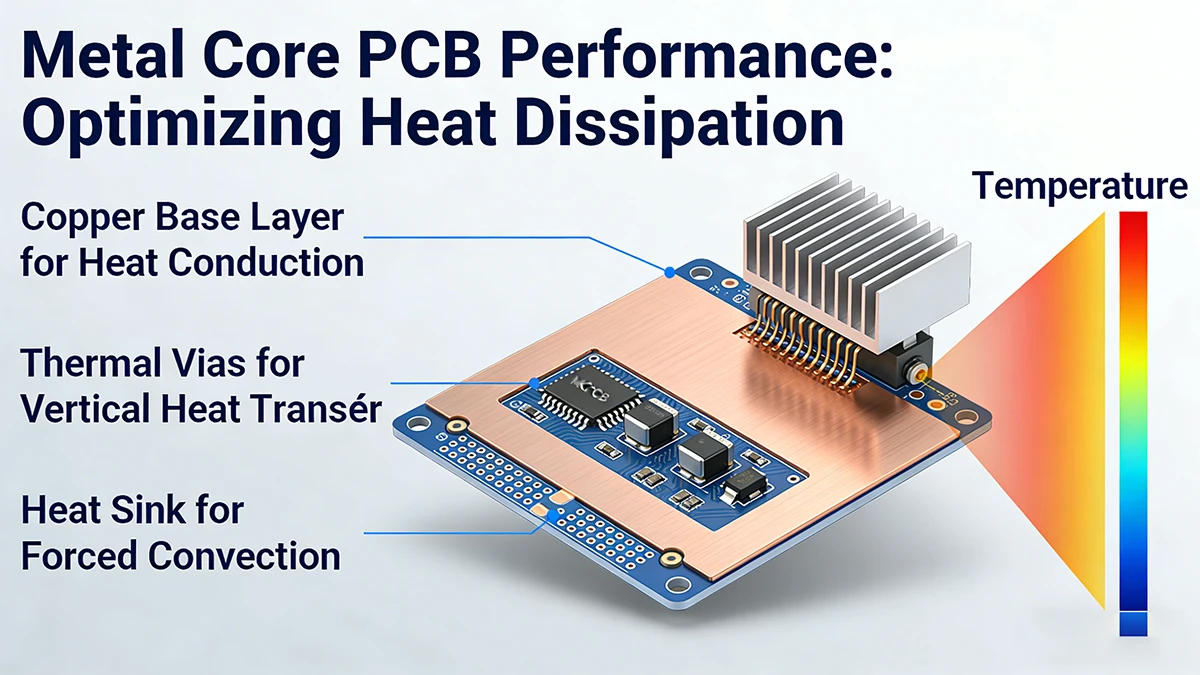
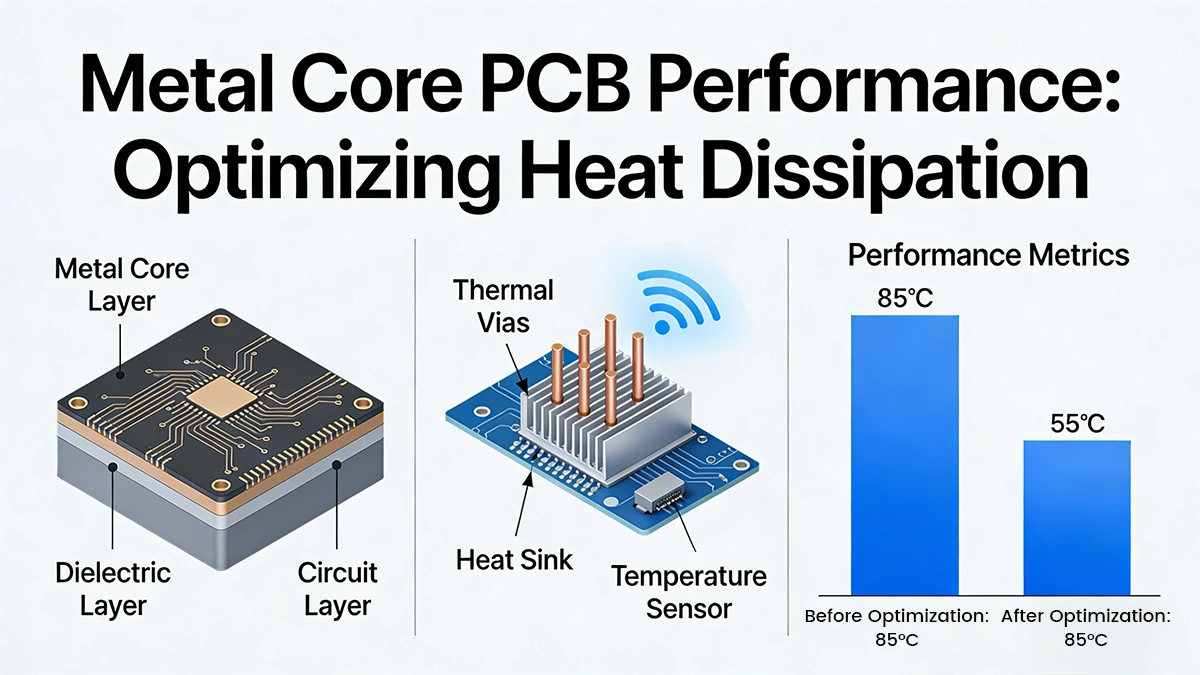
At the microscopic level, the performance of a metal core PCB relies on a highly engineered three-tier stack-up:
The Copper Circuit Layer: The uppermost layer, typically ranging from 1oz to an extreme 10oz heavy copper, responsible for carrying high electrical currents without voltage drops.
The Thermal Dielectric Layer: The ultimate performance bottleneck. This electrically insulating layer is infused with thermally conductive ceramics (like aluminum oxide or boron nitride). It provides crucial High-Potential (Hi-pot) electrical isolation while offering minimal thermal resistance.
The Metal Base: The foundational layer (usually aluminum or copper) that absorbs the heat from the dielectric and rapidly spreads it across a vast surface area before transferring it to an external heat sink or chassis.
Achieving these extreme thermal conductivity metrics is impossible without a strictly controlled
When hardware procurement teams transition from low-power logic boards to demanding power electronics, they frequently ask: What is the difference between metal core PCB and FR4? The distinction lies entirely in their thermomechanical properties.
Thermal Conductivity (W/m·K): FR4 is a composite of woven fiberglass and epoxy resin. By its very nature, epoxy is a thermal insulator. A standard FR4 board has a thermal conductivity of approximately 0.25 to 0.3 W/m·K. When high-power components are mounted on FR4, the heat becomes trapped at the solder junction. In stark contrast, an aluminum core PCB utilizes a thermally conductive dielectric that offers 1.0 to 8.0 W/m·K, paired with an aluminum base boasting roughly 237 W/m·K. This means a metal core PCB transfers heat exponentially faster than FR4.
Dimensional Stability and CTE: High temperatures cause materials to expand. The Coefficient of Thermal Expansion (CTE) measures this growth. FR4 expands significantly under high heat (high Z-axis expansion), which stresses plated through-holes and fractures delicate solder joints. Metal core PCBs offer vastly superior dimensional stability. The rigid metal base restricts extreme expansion, ensuring the board remains perfectly flat and your surface-mount device (SMD) solder joints remain intact during severe thermal cycling.
Component Density and Board Size: Because FR4 cannot dissipate heat efficiently, engineers must space out high-power components and rely on bulky, expensive bolt-on heat sinks to prevent overheating. A metal core PCB serves as its own integrated heat sink. This allows layout engineers to pack high-wattage components closer together, aggressively shrinking the overall footprint of the device.
Not all thermal challenges are identical. At ApolloPCB, we engineer different metal core architectures to match the specific power and routing density requirements of your application.
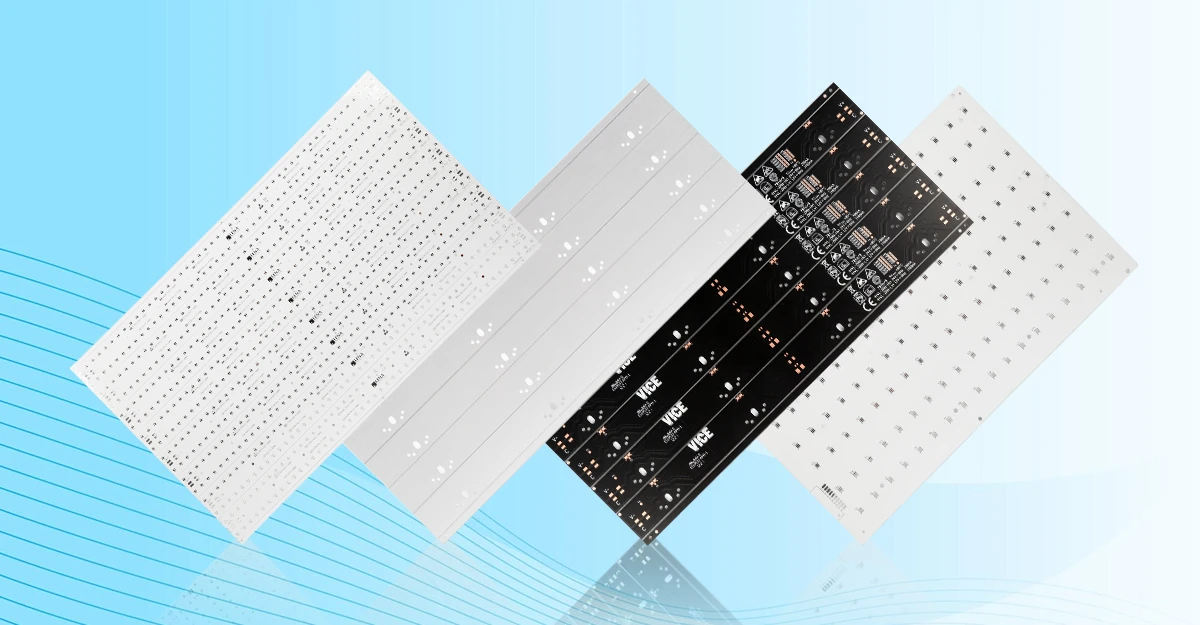
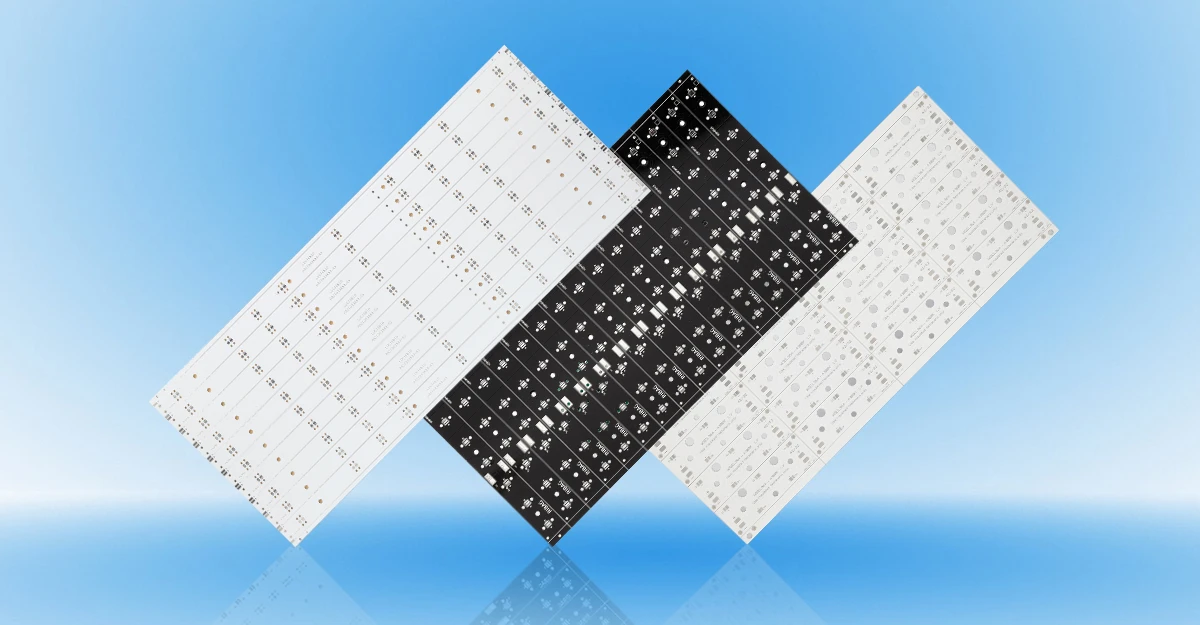
The Single Layer metal core pcb is the undisputed workhorse of the lighting and basic power conversion industry. It consists of a single copper circuit layer, one dielectric layer, and the metal base. Because heat only has to travel through one microscopic dielectric barrier before reaching the metal heat sink, it offers the lowest possible thermal resistance. It is highly cost-effective and is the absolute standard for linear LED strips, streetlights, and basic power supplies.
As circuit complexity increases, a single routing layer is often insufficient. A 2 layer metal core pcb features two layers of copper circuitry separated by a standard FR4 or high-Tg dielectric, completely bonded to a thermally conductive dielectric and the metal base. To connect the two copper layers, we utilize plated through-holes (PTH). Because the metal base is conductive, the holes drilled through the metal must be pre-filled with insulating resin and re-drilled to prevent the copper plating from short-circuiting against the aluminum base. This architecture is ideal for complex motor drives and high-density power supplies.
For the most extreme, space-constrained applications, we engineer the Multilayer metal core pcb. These boards can feature 4, 6, or even 8 layers of complex circuitry (often utilizing blind and buried vias) bonded to a heavy metal core. These are incredibly complex to manufacture but are strictly required for highly advanced military, aerospace, and electric vehicle (EV) traction inverters where logic routing and massive power switching must occur on the exact same compact board.
While thermal management is the primary goal of a metal core PCB, electrical performance and signal integrity cannot be ignored. In high-density power converters, high-speed switching signals (like PWM signals driving MOSFETs) are often routed right alongside high-current traces. This proximity leads to electromagnetic interference (EMI) and crosstalk.
To mitigate this, ApolloPCB engineers strictly advise clients to observe foundational routing principles during their layout phase. A common question from junior layout engineers is: What is the 3W rule in PCB?
The 3W rule is a fundamental layout guideline used to minimize crosstalk (electromagnetic coupling) between adjacent parallel traces. The rule states that the distance between the centers of two adjacent traces should be at least three times the width (3W) of a single trace.
For example, if you are routing a 10-mil wide PWM signal trace, the center-to-center distance to the next parallel trace should be at least 30 mils (leaving a 20-mil gap between the trace edges). By adhering to the 3W rule, the magnetic flux lines from the aggressive signal decay significantly before reaching the victim trace, reducing crosstalk by approximately 70%. When routing high-frequency switching nodes on an aluminum core pcb, combining the 3W rule with the natural EMI shielding properties of the solid metal base results in an incredibly quiet, high-performing circuit.
The superior performance of metal-backed boards has fundamentally transformed several critical tech industries.
High-brightness LEDs are notoriously sensitive to heat. For every 10°C increase in junction temperature, the lifespan of an LED is roughly cut in half, and its lumen output drops drastically (a process known as lumen depreciation).
When thermal management fails, lumen depreciation accelerates. This is why
In electric vehicles, On-Board Chargers (OBC) and DC-DC converters process massive amounts of kilowatts. Traditional FR4 cannot survive the thermal cycling. Heavy-copper Multilayer metal core PCBs provide the massive current-carrying capacity required for the power stage, combined with the extreme heat dissipation needed to keep the switching modules within safe operating limits.
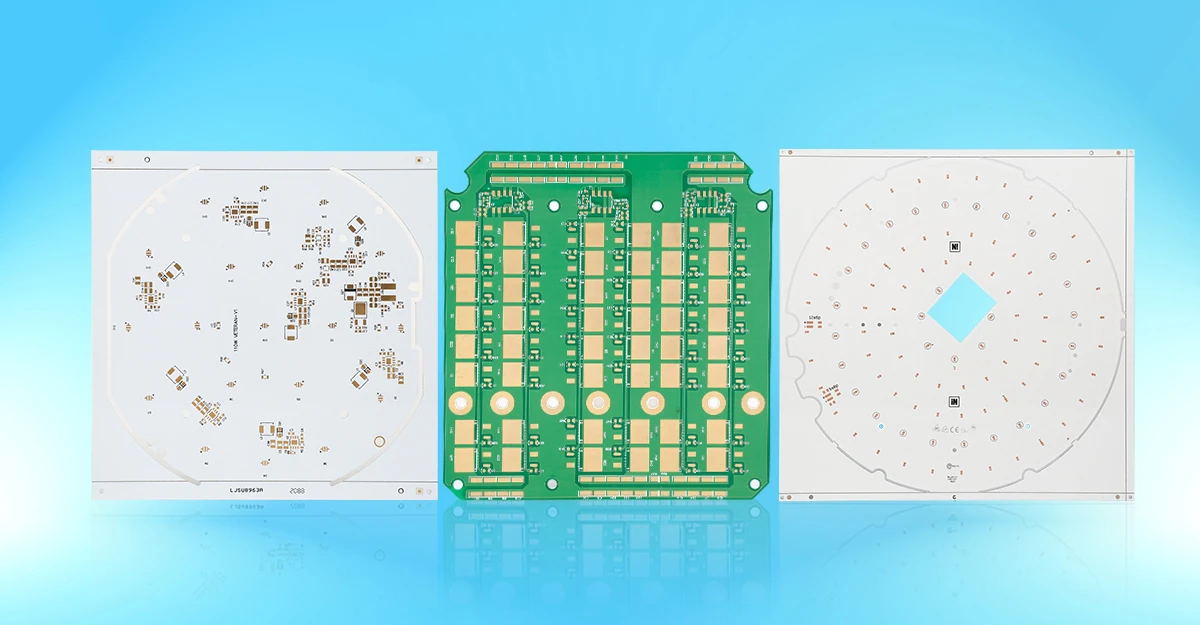
With so many substrates available on the market, procurement teams often ask: What is the best material for PCB?
The objective answer from our engineering team is that there is no single "best" material; the optimum material is entirely dictated by the application's operating environment:
For standard digital logic and low-power consumer electronics: High-Tg FR4 remains the most cost-effective and reliable choice.
For High-Frequency RF/Microwave applications (5G, Radar): PTFE (Teflon) or Rogers laminates are the best, as they offer the lowest dielectric loss (Df) and a highly stable dielectric constant (Dk) at gigahertz frequencies.
For High-Power, High-Heat Applications (LEDs, Power Supplies, Automotive): A metal core PCB (specifically an aluminum core PCB or Copper Core PCB) is undeniably the best material. It is the only substrate capable of actively preventing thermal destruction in power-dense designs.
Navigating the balance between thermal resistance and high-voltage insulation requires
Pushing your hardware to its absolute performance limits requires a manufacturing partner that understands the microscopic physics of heat transfer. At ApolloPCB, we do not just fabricate boards; we engineer thermal solutions.
From rapid prototyping of a Single Layer metal core pcb for a commercial lighting fixture to the mass production of a highly complex Multilayer metal core pcb for an aerospace contractor, our facility is equipped to handle the world's most demanding thermal requirements. We utilize industry-leading thermally conductive dielectrics and precision heavy-copper etching to ensure your power electronics run cooler, faster, and longer.
Do not let thermal bottlenecks throttle your product’s potential. Contact ApolloPCB today to submit your Gerber files for a comprehensive DFM review, and let our engineers optimize your heat dissipation strategy.
A: A metal core PCB (MCPCB) is an advanced thermal management board that uses a solid metal base—typically aluminum or copper—as a heat spreader. At ApolloPCB, we engineer these boards with specialized ceramic-filled dielectrics to rapidly draw heat away from high-power components, significantly improving your device's lifespan and preventing thermal throttling in mission-critical applications.
A: The primary difference lies in thermal conductivity and heat management. Standard FR4 acts as a thermal insulator (approx. 0.3 W/m·K), which traps heat at the component level. In contrast, ApolloPCB’s metal core PCBs utilize highly conductive dielectrics and solid metal bases to dissipate heat up to 10 times faster than standard FR4. Additionally, our MCPCBs provide superior dimensional stability, preventing the board from warping under extreme thermal stress.
A: The 3W rule is a crucial layout guideline used to minimize electromagnetic crosstalk between adjacent traces, stating that the center-to-center distance should be at least three times the trace width. When you submit your Gerber files to ApolloPCB, our expert DFM team reviews your layout to ensure rules like the 3W standard are optimized. Combined with the natural EMI shielding of our metal bases, we guarantee an exceptionally quiet, high-performing power circuit.
A: The "best" material depends entirely on your application's specific operating environment. For standard digital logic, high-Tg FR4 is cost-effective. However, for high-power LED lighting, EV inverters, and industrial power supplies requiring extreme heat dissipation, an aluminum or copper metal core PCB manufactured by ApolloPCB is undeniably the best material choice to prevent component destruction and ensure peak performance.
[Contact ApolloPCB Today for a Technical Consultation on Your Project]
Related Articles
Ultimate Metal Core PCB Guide: Boost Heat Efficiency in Power Tech
Metal Core PCB Manufacturing: High-Precision Aluminum & Copper Solutions
Metal Core PCB for LED & Automotive Cooling | ApolloPCB
Custom Metal Core PCB Solutions | Solve Heat & Reduce Costs | ApolloPCB

Got project ready to assembly? Contact us: info@apollopcb.com



 Whatsapp 0086 755 29438407
 Mail info@apollopcb.com
 Tel 0086 755 29438407


ABOUT US

PRODUCTS
TECHNOLOGY
KNOWLEDGE CENTRE
CULTURE
NEWS
We're not around but we still want to hear from you! Leave us a note:

Leave Message to APOLLOPCB
