




-
- PCB TYPE
- PRINTED CIRCUIT BOARD PROTOTYPE ALUMINUM PRINTED CIRCUIT BOARD R&F PCB FPC HIGH FREQUENCY PCB HIGH-TG PCB HEAVY COPPER PCB HDI PCB PCB FOR LIGHTING METAL CORE PCB


time:Mar 24. 2026, 16:13:19
In the high-stakes world of power electronics, "standard" is often synonymous with "insufficient." Every day, hardware procurement managers and engineering leads face a brutal reality: as components shrink and power requirements surge, the risk of catastrophic thermal failure skyrockets. For a factory-level client, a single thermal bottleneck isn't just a technical glitch—it is a cascade of expensive RMAs, brand-damaging field failures, and a direct hit to the bottom line.
At ApolloPCB, we have found that the most successful hardware teams have moved beyond simply buying boards. They are sourcing integrated thermal solutions. The metal core PCB (MCPCB) is no longer a luxury; it is a strategic requirement. However, the true value lies in customization. By tailoring the substrate, dielectric, and copper weight to your specific thermal load, the ApolloPCB engineering team helps you do more than just solve a heat problem—we help you optimize your entire Bill of Materials (BOM) and drastically reduce long-term operational costs.
In high-volume manufacturing, the true cost of a component isn't found on the purchase order—it’s found in the warranty claims department. For many factories, the initial reflex to combat rising heat is to stick with standard FR4 fiberglass boards and attempt to "bandage" the problem with external fans, bulky cast-aluminum heat sinks, or expensive active liquid cooling systems. From a strategic procurement perspective, this is a "hidden cost" trap that leads to bloated Bill of Materials (BOM) and increased points of failure.
Standard FR4 is essentially a thermal insulator with a pathetic thermal conductivity of approximately $0.25 W/m \cdot K$. When heat is trapped at the component junction, the resulting thermal stress creates a "death spiral" for electronics. ApolloPCB is engineered specifically to break this cycle. By integrating thermal management directly into the structural substrate of the circuit board, our
This integration does more than just move heat; it eliminates the need for secondary cooling components, which in turn reduces the mechanical complexity of your assembly, slashes labor time on the production line, and shrinks the physical footprint—and the total housing cost—of your final product.
When you switch from generic substrates to an ApolloPCB custom solution, you are essentially buying an insurance policy for your brand's reputation. Our "Protection Plan" focuses on the three most common causes of field failure:
Eliminating Solder Joint Fatigue: One of the most common "silent killers" in power electronics is the mismatch in the Coefficient of Thermal Expansion (CTE). Traditional boards flex and expand at different rates than the components they carry, causing microscopic cracks in solder joints over time. ApolloPCB’s rigid metal cores provide superior dimensional stability, drastically reducing the expansion stress that leads to these expensive intermittent failures.
Preventing Lumen Depreciation & Color Shift: In the lighting industry, heat doesn't just kill LEDs; it makes them ugly before they die. Excessive heat causes "lumen depreciation" (dimming) and chromaticity shifts (turning white light into a sickly yellow or purple). We keep your LEDs operating within their optimal thermal window, ensuring your fixtures maintain their advertised brightness and color temperature for their entire 50,000-hour rated life.
Stopping Component "De-rating" & Unlocking Power: Many engineers are forced to "de-rate" their power ICs—essentially running a $10.00 chip at only 60% of its rated capacity just to keep it from melting. This is a waste of capital. With an ApolloPCB thermal substrate, you can run your power components at 100% rated capacity with zero fear of thermal shutdown. This allows you to use smaller, more affordable components to achieve the same power output, further driving down your BOM.
Hardware engineers at our client factories are perpetually caught in a high-stakes tug-of-war between two conflicting market demands: "Make it more powerful" and "Make it smaller." This is especially brutal in the world of high-density power conversion. In a compact, often hermetically sealed enclosure—such as an EV charging module, a slim-line architectural LED fixture, or a ruggedized industrial sensor—airflow is a luxury that simply doesn't exist. There is no room for fans, and passive air convection is insufficient to move the "thermal wall" generated by modern power semiconductors.
The secret to solving this "impossible" design challenge lies in the dielectric layer of the ApolloPCB metal core board. This layer is the silent mediator of your entire circuit; it must perform the contradictory task of being a perfect electrical insulator (to prevent shorting to the metal base) while acting as a high-speed highway for thermal energy.
In our decade of factory-direct experience, we’ve seen many procurement teams fall into the Over-Engineering Trap. Many specialized manufacturers only offer a single, "ultra-high-performance" dielectric material that is unnecessarily expensive for 70% of mid-range applications. Forcing an 8.0 W/m.K material into a design that only requires 2.0 W/m.K is like paying for a Ferrari to run a grocery errand—it’s a waste of your capital and bloats your per-unit cost.
At ApolloPCB, we take a granular, data-driven approach to material science. We provide a comprehensive range of thermal conductivities, from a cost-effective 1.0 W/m.K to an industry-leading 8.0 W/m.K. Our engineering team works with you during the DFM phase to "right-size" your substrate.
By precisely matching the dielectric’s thermal impedance to your specific component wattage and expected ambient temperature, our team ensures you aren't over-paying for performance you don't need. This tailored approach allows you to achieve peak reliability by
Precision Thickness Control: We offer dielectric thicknesses from 50μm to 150μm, allowing you to find the "sweet spot" where thermal resistance is minimized but High-Potential (Hi-pot) breakdown voltage remains safely within your certification requirements.
Material Compatibility: Whether your design requires specialized ceramic-filled epoxies or high-bond-strength polymers for high-vibration environments, ApolloPCB has the factory-direct supply chain to deliver the right material at a factory-direct price.

In the competitive landscape of global manufacturing, looking only at the unit price of a circuit board is a classic procurement error. It is a persistent and common misconception that a metal core PCB is always a more expensive line item that will inflate your project's budget. However, when you shift your perspective to the "Total Cost of Ownership" (TCO), an ApolloPCB custom-engineered board delivers a massive and measurable Return on Investment (ROI).
By integrating thermal management into the substrate itself, we don't just add a component; we re-engineer the economics of your entire assembly. Here is the mathematical reality of how ApolloPCB drives down your costs:
The most immediate financial impact of an ApolloPCB custom-designed aluminum board is the drastic simplification of your Bill of Materials (BOM). Traditional cooling strategies require a "stack" of secondary components: thermal interface materials (TIMs), gap fillers, specialized mounting brackets, and bulky cast-aluminum heat sinks.
In several high-power LED and industrial power projects, switching to an ApolloPCB aluminum core allowed our customers to reduce their mechanical component count by over 30%.
Material Savings: You stop paying for external heat sinks and expensive thermal greases.
Assembly Labor Savings: Fewer parts mean fewer steps on the assembly line. We’ve seen clients reduce their "Touch Time" per unit by 15-20%, directly lowering their factory labor costs and increasing their daily production throughput.
For high-volume factories, the "hidden enemy" is board warping. During the high-temperature reflow soldering process, standard FR4 boards often flex and bow, leading to "tombstoning" components or open solder joints. This results in expensive manual rework or, worse, scrapped panels.
Because our metal core PCBs offer vastly superior dimensional stability, they remain perfectly flat throughout the thermal profile of a standard SMT line. This structural rigidity ensures:
Higher First-Pass Yields (FPY): You get more functional boards off the line on the first try.
Reduced Inspection Time: Consistent board flatness allows your Automated Optical Inspection (AOI) machines to run at higher speeds with fewer false rejects.
Zero Warping: Our boards act as a rigid spine for your entire product, protecting delicate ceramic LED packages from mechanical stress during and after assembly.
Field failures and RMAs (Return Merchandise Authorizations) are the single most expensive costs a manufacturer can face—not only in shipping and repair costs but in irreparable damage to your brand’s reputation.
By keeping component junction temperatures consistently 10°C to 15°C cooler than the competition, ApolloPCB boards drastically extend the Mean Time Between Failures (MTBF). In the world of power electronics, every 10-degree drop in temperature can effectively double the lifespan of a semiconductor. This industry-leading reliability is exactly why our custom boards provide the
This expanded section focuses on the strategic decision-making process behind material selection, reinforcing ApolloPCB’s role as a consultant that helps procurement teams balance high-performance physics with strict budgetary constraints.
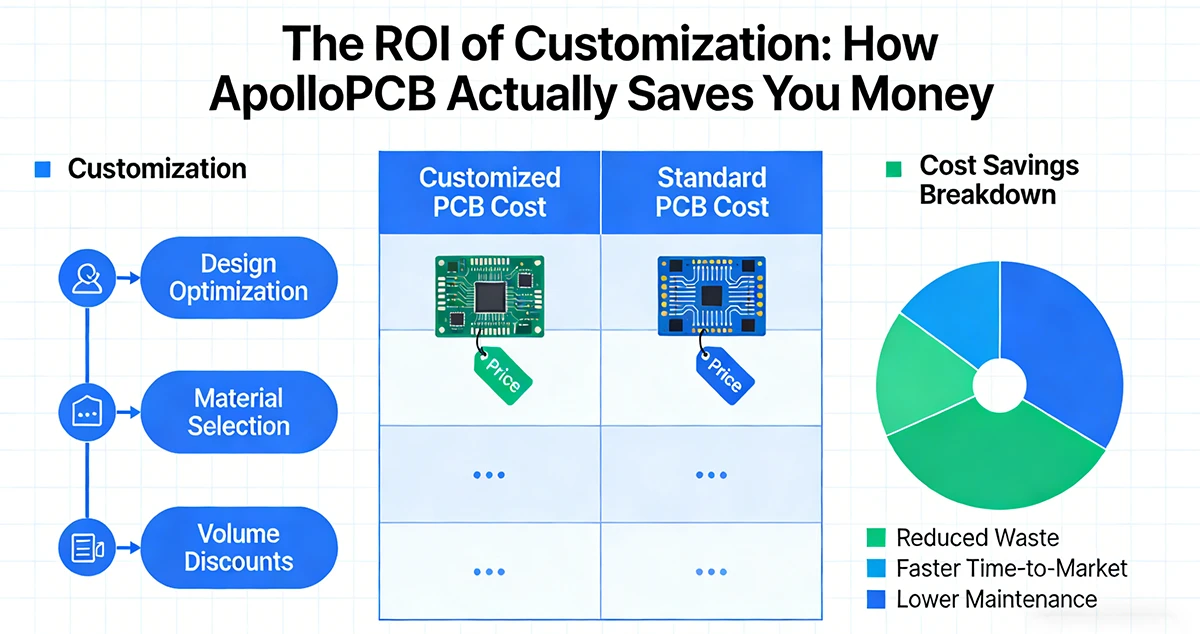
A cornerstone of the ApolloPCB technical partnership is our commitment to guiding your procurement and engineering teams through the "Material Gap." In the high-stakes world of factory-scale production, selecting the wrong substrate can lead to either an over-budget project or a product that fails under thermal stress. We don't just take orders; we act as a strategic consultant to ensure your substrate choice perfectly balances real-world thermal performance with your bottom-line requirements.
At ApolloPCB, we categorize our metal core solutions into three distinct performance tiers, allowing you to select the precise foundation for your specific power density and environmental conditions:
Statistically, 90% of all industrial thermal challenges are successfully and economically solved using our high-grade aluminum alloys. For high-volume consumer electronics, architectural lighting, and standard power converters, ApolloPCB’s aluminum boards are the undisputed market leader.
The Physics: Aluminum offers a thermal conductivity of approximately $237 W/m \cdot K$, which is more than enough to evacuate heat from standard surface-mount devices (SMDs).
The ROI: It is lightweight (critical for shipping costs and EV range), extremely cost-effective, and easy to machine. Our automated CNC routing and V-scoring lines are optimized for aluminum, allowing us to pass those manufacturing efficiencies directly to your per-unit price.
For ultra-high-density applications—such as 200W+ COB LEDs, EV traction inverters, or high-frequency RF modules—heat is often concentrated into a tiny "hot spot" that would overwhelm aluminum's ability to spread energy. In these "thermal emergency" scenarios, ApolloPCB utilizes C1100 pure copper bases.
The Physics: With a thermal conductivity of approximately $398 W/m \cdot K$, our copper cores provide nearly double the heat-moving power of aluminum.
The ROI: While copper commands a higher material premium, it eliminates the need for expensive active cooling systems. It is the uncompromised choice for mission-critical hardware where a single degree of cooling translates into years of additional component life.
For industrial sensors, down-hole oil & gas tools, or surgical medical devices, thermal management is only half of the requirement. These boards must also survive corrosive chemicals and extreme mechanical pressure. ApolloPCB provides specialized stainless steel core solutions for these niche, high-value sectors.
The Physics: While stainless steel has lower thermal conductivity than aluminum, it offers unparalleled mechanical rigidity and chemical inertness.
The ROI: By utilizing a stainless steel base, we provide a board that acts as its own structural chassis. This allows you to eliminate external protective enclosures, reducing the total weight and complexity of your specialized industrial hardware.
In the world of high-volume electronics procurement, there is a massive hidden gap between a "broker" and a "manufacturer." When you send a Gerber file to a broker or a generic PCB house, they simply print exactly what they see—even if the design contains thermal bottlenecks or material waste. At ApolloPCB, we take a fundamentally different approach. Every project that enters our facility undergoes a rigorous Design for Manufacturing (DFM) review by our senior engineering team. We don't just build your board; we analyze your layout for both thermal physics and financial efficiency before the first sheet of aluminum is cut.
Many hardware engineers overlook the fact that the copper traces themselves can become heat sources if they are too thin for the intended current. Our DFM team performs a "Current-to-Width" calculation on every power rail.
The ApolloPCB Value-Add: We may suggest wider traces or transitioning to heavy copper weights (up to 10oz). By reducing the DC resistance of your circuit, we minimize "I²R" resistive heating. This doesn't just keep the board cooler; it improves the overall power efficiency of your device, which is a critical selling point for your end customers.
For high-voltage power supplies and EV charging systems, the "Metal Core" presents a unique safety challenge. Because the conductive metal base is separated from high-voltage circuits by only a thin dielectric layer, the risk of "arcing" or dielectric breakdown is real.
The ApolloPCB Value-Add: We ensure your layout meets strict international safety standards (like UL 60950 or IEC 60601) for creepage and clearance distances. If our engineers spot a potential short-circuit risk near the board edge or a mounting hole, we proactively suggest layout adjustments before you spend money on a production run that might fail safety certification.
Raw material cost is the largest component of a metal core PCB’s price. Standard "off-the-shelf" panel sizes often lead to significant material waste—waste that you, the customer, usually pay for.
The ApolloPCB Value-Add: We help you design the most efficient Panelization Strategy specifically tailored to our factory’s automated production lines. By optimizing the "breakaway" tabs and reducing the spacing between boards on a panel, we maximize material utilization. Minimizing this "scrap rate" is the most direct and transparent way for ApolloPCB to lower your per-unit price, especially on orders of 10,000 units or more.
In the high-pressure world of factory-scale production, time isn't just a metric—it is a currency. A delay in the prototyping phase is a direct delay in your revenue stream and a missed window in a hyper-competitive market. Whether you are racing to beat a competitor to a new EV charging platform or meeting a strict construction deadline for a municipal lighting project, your supply chain must move at the speed of your business.
ApolloPCB specializes in breaking the typical weeks-long lead times of standard manufacturers. We offer quick-turn metal core PCB prototypes delivered in as little as 24 to 48 hours from the moment your Gerber files are approved. This high-velocity response allows your R&D and procurement teams to move from a digital model to a physical reality in a single weekend.
By utilizing ApolloPCB’s rapid prototyping service, your engineering team gains three massive strategic advantages that directly impact your project’s success:
Validate Complex Thermal Models in Real-Time: Even the most advanced thermal simulation software has its limits. The only way to truly confirm that your heat dissipation calculations ($W/m \cdot K$) translate into a safe operating temperature in a sealed enclosure is through physical testing. A 24-hour ApolloPCB prototype allows you to conduct empirical temperature-rise tests immediately, ensuring your design is robust before you commit your budget to mass production.
Pass Safety & Compliance Certifications Early: Regulatory hurdles like UL, RoHS, and Hi-pot certifications are often the final bottleneck in a product launch. By getting a physical, factory-quality MCPCB into your hands within 48 hours, you can begin your safety and isolation testing weeks ahead of schedule. Identifying a dielectric breakdown issue or a clearance flaw during the early prototyping phase—rather than during a massive production run—can save your factory tens of thousands of dollars in scrapped material.
Win Competitive Bids with Physical Proof: In the B2B world, seeing is believing. When you are bidding for a major contract, having a physical, high-performance ApolloPCB prototype to show your clients—rather than just a 3D rendering—gives you an immediate edge. It demonstrates that your design is mature, your thermal management is solved, and your manufacturing partner has the capacity to deliver. It transforms you from a "potential bidder" into a "proven solution provider."
The real beauty of the ApolloPCB rapid prototyping service is that it happens on the same production lines as our mass-production runs. This means that the thermal performance and material quality you validate during the 24-hour prototype phase will be exactly what you receive when you scale up to 100,000 units. We eliminate the "Prototype Gap" where a prototype works, but the mass-produced version fails.

Thermal management is no longer a "back-of-the-envelope" calculation. It is a sophisticated engineering discipline that dictates whether your product succeeds in the market or fails in the field.
At ApolloPCB, we pride ourselves on being more than just a manufacturer. We are your technical partner. Whether you are looking to shave cents off a high-volume LED project or solve a massive heat issue in a new EV charging platform, we have the material science and the factory capacity to make it happen.
Don't let heat be the bottleneck of your innovation. Contact the ApolloPCB engineering team today to submit your Gerber files for a free DFM thermal review and an instant, factory-direct quote.
[Contact ApolloPCB Today for a Technical Consultation on Your Project]
Related Articles
Ultimate Metal Core PCB Guide: Boost Heat Efficiency in Power Tech
Metal Core PCB Manufacturing: High-Precision Aluminum & Copper Solutions

Got project ready to assembly? Contact us: info@apollopcb.com



 Whatsapp 0086 755 29438407
 Mail info@apollopcb.com
 Tel 0086 755 29438407


ABOUT US

PRODUCTS
TECHNOLOGY
KNOWLEDGE CENTRE
CULTURE
NEWS
We're not around but we still want to hear from you! Leave us a note:

Leave Message to APOLLOPCB
