




-
- PCB TYPE
- PRINTED CIRCUIT BOARD PROTOTYPE ALUMINUM PRINTED CIRCUIT BOARD R&F PCB FPC HIGH FREQUENCY PCB HIGH-TG PCB HEAVY COPPER PCB HDI PCB PCB FOR LIGHTING METAL CORE PCB


time:Mar 23. 2026, 10:20:23
In the modern landscape of high-performance illumination, the "Light Emitting Diode" (LED) has completely disrupted traditional lighting technologies. However, the move to high-wattage LEDs has introduced a relentless invisible enemy: concentrated thermal stress. Unlike incandescent bulbs that radiate heat through infrared light, LEDs dissipate heat through conduction into their substrate. Without a robust thermal path, an LED’s junction temperature will spike, causing lumen depreciation, color shifting, and eventual premature failure.
For industrial lighting manufacturers and automotive Tier-1 suppliers, the solution is no longer found in standard FR4 boards. The industry has standardized on the Metal Core PCB (MCPCB) as the essential cooling backbone for high-intensity applications. At ApolloPCB, we don't just manufacture boards; we engineer the thermal heart of your lighting system. In this guide, we explore the deep-dive applications of MCPCBs in the lighting and automotive sectors, illustrating how ApolloPCB’s advanced thermal solutions ensure reliability in the world’s most demanding environments.
The global lighting industry has undergone a radical transformation, shifting from simple decorative applications to massive, industrial-grade illumination projects. This evolution has pushed LED wattage and power density to unprecedented levels. In high-output environments—such as 1000W stadium floodlights, municipal smart streetlamps, and high-bay warehouse lighting—a single COB (Chip on Board) LED can generate a staggering amount of thermal energy.
When you realize that this heat is concentrated within a footprint no larger than a postage stamp, the "thermal wall" becomes a physical reality. Standard FR4 boards simply act as insulators in these scenarios, trapping heat and leading to immediate component failure. To ensure long-term reliability and structural integrity in these harsh, often outdoor environments, these high-wattage modules rely on
In the world of semiconductor physics, Junction Temperature (Tj) is the single most important metric for LED health. The performance, efficiency, and color consistency of an LED are all inversely proportional to its $T_j$. As the temperature at the chip’s junction rises, a chain reaction of degradation begins:
Luminous Efficacy Collapse: For every degree increase above the optimal operating temperature, the LED produces fewer lumens per watt. This means your "high-efficiency" fixture suddenly begins drawing more power for less light.
Chromaticity Shift & Yellowing: Excessive heat causes the encapsulating phosphor to degrade. This is why many low-quality streetlights eventually shift from a "Cool White" to an ugly, dim yellow or purple hue.
The Lifespan Myth: While LED technology promises 50,000+ hours of operation, this is only achievable if heat is managed. Without a proper thermal path, that 50,000-hour rating is quickly slashed to fewer than 5,000 hours, leading to expensive maintenance and brand-damaging field failures.
By utilizing a high-performance ApolloPCB metal core PCB, engineers can actively lower the junction temperature by as much as 10°C to 15°C compared to conventional substrates.
In the high-stakes world of industrial lighting, this 15-degree margin is the difference between success and failure. This massive thermal headroom allows our clients to drive their LEDs at significantly higher currents, achieving maximum rated brightness (Lumen output) without crossing the thermal threshold that triggers a product’s warranty. By partnering with ApolloPCB, factories can guarantee their customers a product that remains bright, color-accurate, and operational for its entire intended lifecycle.
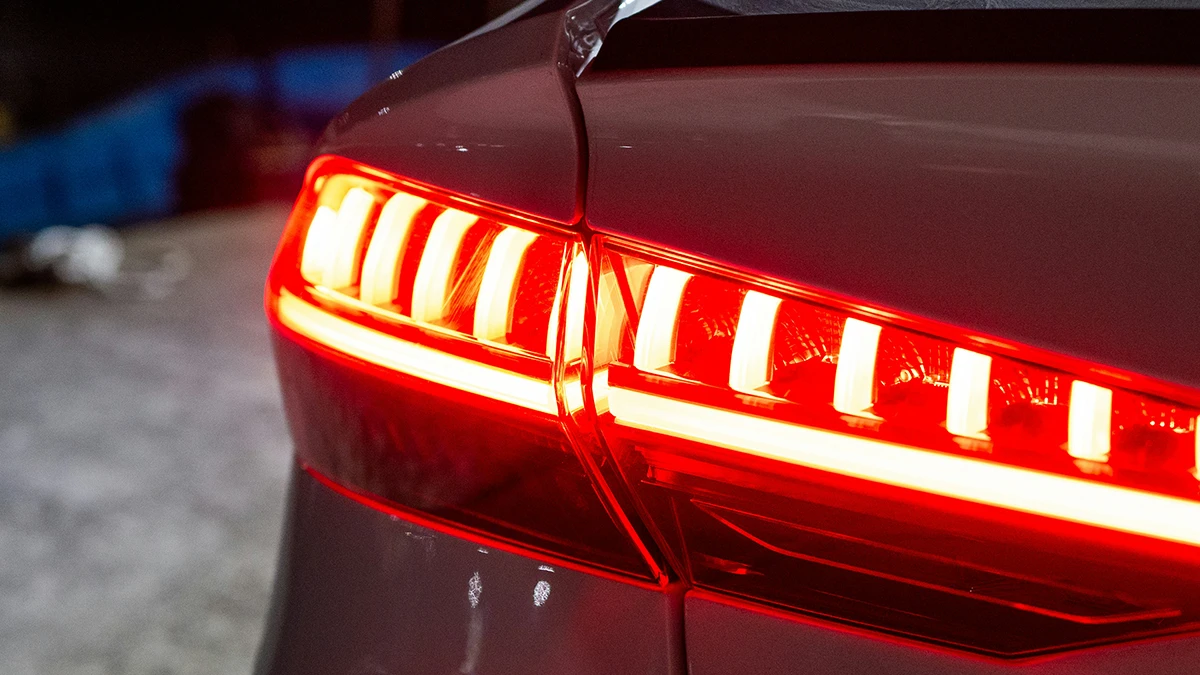
The automotive industry has emerged as the most aggressive growth driver for advanced Metal Core PCB technology. In the current "Software-Defined Vehicle" era, cars are no longer mere transportation; they are sophisticated, mobile lighting ecosystems. From high-intensity adaptive headlights to complex, multi-zone interior ambient lighting, the thermal challenges within a vehicle are immense. Unlike stationary lighting, automotive components must survive constant vibration, high humidity, and extreme temperature fluctuations—all while maintaining a zero-failure rate for safety-critical systems.
Modern automotive headlamps are marvels of optical engineering, utilizing Matrix LED or Adaptive Driving Beam (ADB) technology to selectively dim pixels and prevent glaring oncoming drivers. However, these systems demand massive electrical current concentrated into incredibly tight, non-ventilated, and hermetically sealed enclosures. This high-density power creates a "thermal oven" effect, making the underlying substrate the critical factor in
At ApolloPCB, we recognize that headlamps are life-safety components. They must operate flawlessly in environments ranging from -40°C in arctic winters to +85°C (with internal housing temperatures reaching much higher) in desert summers. To meet these brutal requirements, ApolloPCB’s automotive-grade MCPCBs are manufactured on dedicated, state-of-the-art production lines certified to the IATF 16949 quality management system. This ensures that every board can withstand thousands of thermal cycles without the risk of delamination, dielectric breakdown, or solder joint fatigue.
Day-time Running Lights (DRLs) represent a unique thermal challenge: they are required to stay illuminated for the entire duration of a vehicle's operation. This "constant-on" state creates a continuous thermal load that can degrade standard FR4 materials over time, leading to yellowing of the optics or board carbonization.
For global Tier-1 suppliers, ApolloPCB’s aluminum-core PCBs are the preferred choice for DRL and signal lighting modules. Our aluminum substrates offer a triple-advantage:
High Thermal Stability: Our proprietary dielectrics maintain a consistent thermal path even after years of continuous operation.
Lightweight Profile: In the world of Electric Vehicles (EVs), every gram matters. Reducing the weight of the lighting assembly directly contributes to better battery efficiency and extended vehicle range—a key KPI for modern EV manufacturers.
Predictable Cooling: By providing a linear thermal path, we allow engineers to simplify their housing designs, often eliminating the need for heavy, expensive external cooling fans or oversized cast-aluminum heat sinks.
Beyond the headlights, ApolloPCB is at the forefront of interior "Smart Surface" lighting. As dashboards and door panels become interactive, we provide ultra-thin metal core solutions that allow for high-brightness LEDs to be integrated directly into leather or polymer trim. Our manufacturing process ensures that these boards are not only thermally efficient but also mechanically robust enough to meet the stringent IPC Class 3 standards required for high-reliability automotive electronics.
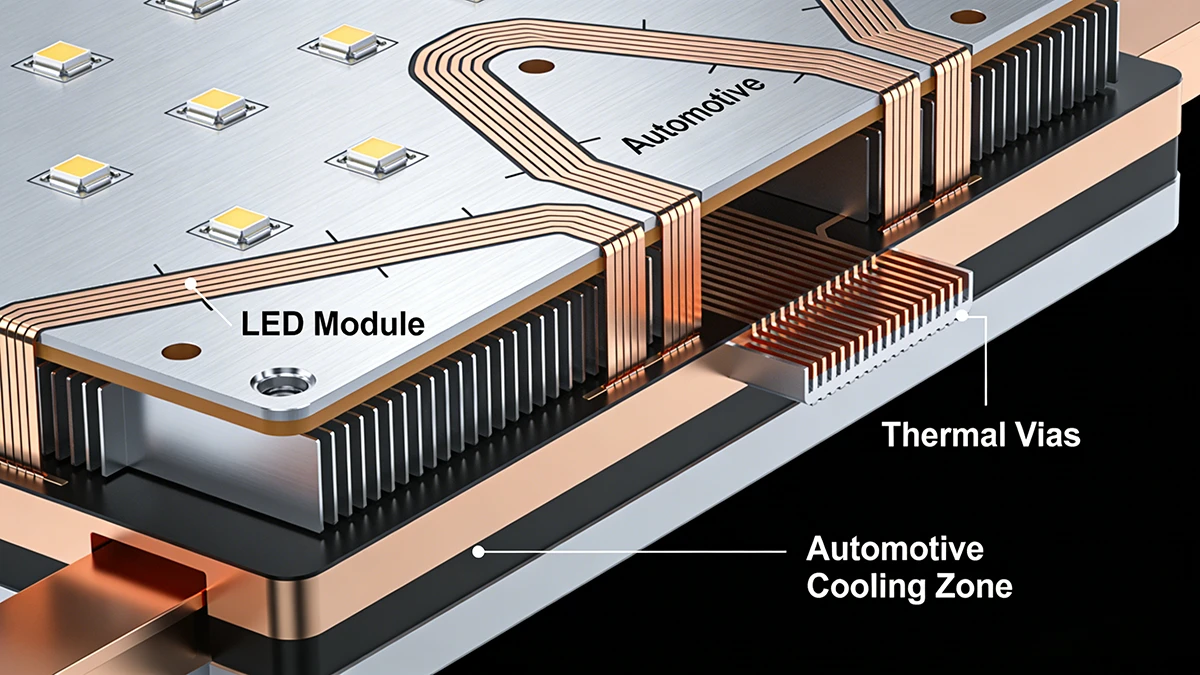
While standard aluminum-backed boards dominate the general commercial market due to their cost-effectiveness, ApolloPCB thrives in the "extreme" tier of the industry. We manufacture specialized versions of Metal Core PCBs for mission-critical applications that demand more aggressive thermal management than aluminum can provide. When your design pushes past the limits of conventional air-cooling, our advanced substrate engineering becomes the definitive solution.
In high-end architectural "Wall Washers," stadium floodlights, or laser-based automotive high-beams, the heat density—measured in Watts per square millimeter—can easily exceed the physical capabilities of aluminum. In these "thermal emergency" scenarios, ApolloPCB utilizes C1100 pure Copper-based MCPCBs.
The physics behind this choice is undeniable: Pure Copper possesses an intrinsic thermal conductivity of approximately 398 W/m·K, nearly double that of the highest-grade Aluminum (~237 W/m·K).
Instantaneous Thermal Spreading: Aluminum is excellent at holding heat, but Copper is superior at moving it. Our copper-core solutions allow for near-instantaneous lateral heat spreading across the board’s foundation.
Eliminating "Thermal Hot Spots": Under an ultra-bright LED chip, heat tends to "pool" directly under the die. Copper pulls this energy away so fast that it prevents the formation of catastrophic hot spots that lead to localized phosphor burning and chip cracking.
Direct Dielectric Bonding: At ApolloPCB, we offer specialized "pedestal" designs (Thermo-path) where the copper core is raised to touch the thermal pad of the LED directly, bypassing the dielectric layer entirely for the lowest possible thermal resistance in the industry (Rth).
In modern automotive interiors and high-end consumer wearables, lighting is no longer restricted to flat, rectangular surfaces. It is now integrated into complex, curved surfaces like wrap-around dashboards, door panel contours, and ergonomic medical devices.
ApolloPCB’s Rigid-Flex Metal Core PCB solutions represent a creative and mechanical leap for lighting designers. This technology allows us to combine the 3D-folding flexibility of a polyimide (Flex) circuit with the localized, heavy-duty heat sinking of a solid metal base.
Smart & Aesthetic Integration: Designers can now place high-brightness LEDs exactly where they are needed on a curved surface without the bulk of external cooling fans or heavy cast-aluminum housings.
Weight and Connector Reduction: By integrating the thermal path into a flexible circuit, we eliminate the need for extra wires and connectors, which are common failure points in high-vibration automotive environments.
ApolloPCB Precision: Manufacturing these requires extreme precision in our CNC depth-routing and multi-stage lamination processes to ensure the transition between the "Rigid Metal" and "Flex" zones is structurally sound and thermally optimized.
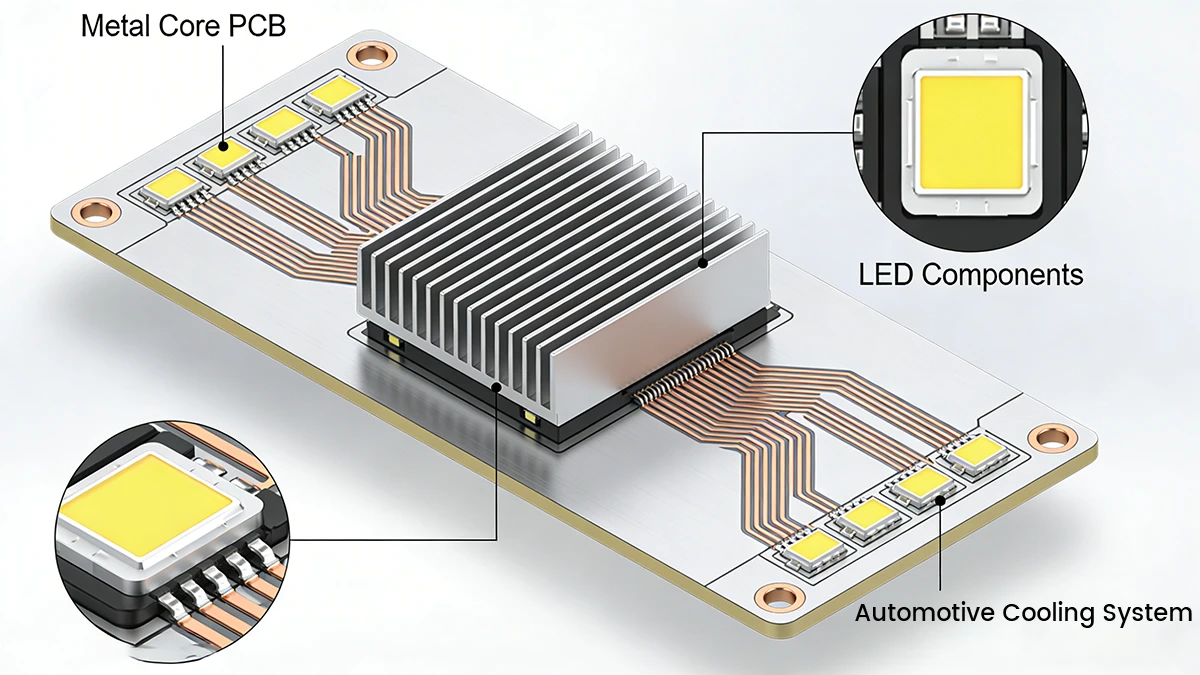
In the high-stakes world of Tier-1 automotive and industrial lighting, the difference between a prototype and a market-ready product lies in the engineering details. Factories that choose ApolloPCB for their mission-critical projects gain more than just a printed circuit board; they gain a comprehensive technical partnership.
Our engineers engage in deep Design for Manufacturing (DFM) reviews to ensure that every substrate is optimized for its specific thermal environment. Rather than over-engineering standard commercial fixtures with unnecessarily expensive materials, lighting designers can drastically
For manufacturers targeting international markets, regulatory compliance is the ultimate gatekeeper. All ApolloPCB metal core solutions are built from the ground up to pass the most stringent safety and environmental inspections required for global export.
UL Certification: Our materials and processes are UL-certified, ensuring flame retardancy and electrical safety that meet North American standards.
RoHS & REACH: We utilize lead-free finishes and eco-friendly chemistries, ensuring your products are fully compliant with European environmental directives. This "compliance-first" manufacturing approach streamlines your certification process and reduces time-to-market.
In automotive headlamps and municipal street lighting, electrical insulation is not just a technical spec—it is a matter of public safety. Because a metal core PCB features a conductive metal base separated from a high-voltage circuit by only a few microns of dielectric material, the risk of "arcing" or dielectric breakdown is real.
Unlike budget manufacturers that only perform sample testing, ApolloPCB conducts 100% Hi-Pot (High Potential) testing on every single board. We subject the dielectric layer to high-voltage stress (often up to 3000V or higher depending on the spec) to ensure zero leakage current between the circuit and the metal base. This rigorous screening process guarantees that your products will never suffer from insulation failure, even in high-humidity outdoor environments.
The automotive environment is a symphony of mechanical stress. Constant engine vibration, road shock, and high-speed turbulence can cause standard, flexible PCBs to flex excessively, leading to solder joint fatigue—the #1 cause of LED field failures in vehicles.
The rigid metal base (Aluminum or Copper) of an ApolloPCB board provides an inherent structural integrity that flexible or FR4-based boards simply cannot match. By acting as a rigid spine, the metal base:
Prevents Micro-Cracking: It minimizes board flexing, protecting delicate ceramic LED packages from mechanical stress.
Optimizes CTE Mismatch: Our engineers select dielectrics that help bridge the gap between the expansion rates of the metal base and the silicon components, ensuring that solder joints remain intact through thousands of thermal expansion and contraction cycles.
A rapidly growing and highly demanding application for ApolloPCB's metal core PCB technology is the solar-powered LED security camera. These devices represent the pinnacle of off-grid engineering, often installed in remote, unmonitored locations such as oil pipelines, border crossings, and high-altitude weather stations. In these environments, the electronics are subjected to a dual-thermal assault: intense, direct solar radiation during the day and high-current internal heat generation at night.
These sophisticated systems integrate high-power Infrared (IR) LEDs for long-range night vision alongside high-speed, high-resolution 4K image sensors. This creates a significant engineering conflict. IR LEDs, particularly those designed for 30-meter to 100-meter range, generate substantial amounts of thermal energy during night operation.
If this heat is not managed, it conducts directly through the housing and into the CMOS image sensor. For image sensors, heat is the enemy of clarity. Excessive thermal energy increases "dark current" within the silicon, which manifests as digital noise—the grainy, snowy interference that ruins image quality.
By utilizing a high-conductivity ApolloPCB aluminum substrate, manufacturers can achieve what was previously impossible in a compact, uncooled enclosure: Thermal Isolation.
Lateral Heat Spreading: Our aluminum base rapidly pulls heat away from the IR LED cluster and spreads it toward the outer edges of the camera’s aluminum housing, which acts as a secondary heat sink.
Maintaining CMOS Integrity: By lowering the ambient temperature inside the camera housing by up to 12°C, our MCPCB ensures the image sensor operates within its optimal temperature range.
Desert Reliability: This thermal management allows for crystal-clear 4K video capture even in the middle of a desert summer, where ambient temperatures can exceed 50°C. ApolloPCB’s specialized white solder masks also provide an additional layer of UV protection, ensuring the board does not degrade or discolor after years of exposure to the sun.
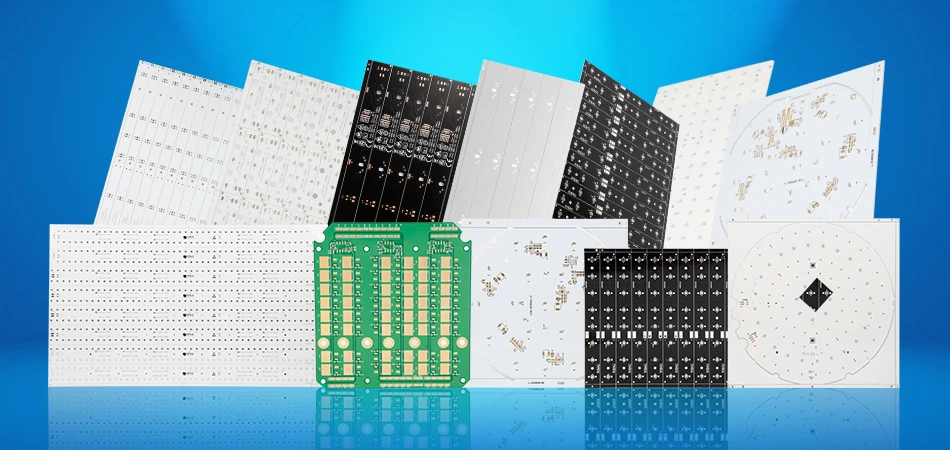
When sourcing for factory-scale projects, procurement teams need a partner that understands the microscopic nuances of the metal core PCB manufacturing process. At ApolloPCB, we have spent decades refining our facility to cater specifically to the high-reliability sectors of LED lighting and automotive electronics.
Expert DFM (Design for Manufacturing): Our engineering team performs a deep-dive review of every automotive and LED project. We optimize trace spacing for high-voltage creepage, select the perfect solder mask reflectivity for maximum lumen output, and ensure metal edge clearances are perfect for your automated assembly lines.
Speed to Market: In the fast-moving automotive R&D world, waiting weeks for a prototype is not an option. ApolloPCB offers quick-turn metal core prototypes in as little as 24-48 hours, allowing your team to complete validation testing and secure your market window ahead of the competition.
Scalability and Global Consistency: Whether you need 100 boards for a niche high-end project or 1,000,000 boards for a global automotive platform, our automated production lines deliver the same IATF 16949-certified quality. The 1,000,000th board is guaranteed to be as thermally efficient and structurally sound as the first prototype.
From the city streets illuminated by smart, energy-efficient LED lamps to the adaptive, matrix headlights of the next generation of Electric Vehicles, the Metal Core PCB is the unsung hero of the technology. It is the silent, efficient thermal engine that makes modern high-brightness lighting possible.
ApolloPCB remains at the forefront of this technology, providing factory-level customers with the precision, speed, and technical expertise required to solve the most difficult thermal challenges. We invite you to leverage our technical partnership to push your products to the next level of performance and reliability.
Ready to upgrade your lighting or automotive project? Contact the ApolloPCB engineering team today for a free DFM review and a factory-direct quote on your advanced Metal Core PCB designs.
[Contact ApolloPCB Today for a Technical Consultation on Your Project]
Related Articles
Ultimate Metal Core PCB Guide: Boost Heat Efficiency in Power Tech
Metal Core PCB Manufacturing: High-Precision Aluminum & Copper Solutions
Metal Core PCB Performance: Optimizing Heat Dissipation
Custom Metal Core PCB Solutions | Solve Heat & Reduce Costs | ApolloPCB

Got project ready to assembly? Contact us: info@apollopcb.com



 Whatsapp 0086 755 29438407
 Mail info@apollopcb.com
 Tel 0086 755 29438407


ABOUT US

PRODUCTS
TECHNOLOGY
KNOWLEDGE CENTRE
CULTURE
NEWS
We're not around but we still want to hear from you! Leave us a note:

Leave Message to APOLLOPCB
