




-
- PCB TYPE
- PRINTED CIRCUIT BOARD PROTOTYPE ALUMINUM PRINTED CIRCUIT BOARD R&F PCB FPC HIGH FREQUENCY PCB HIGH-TG PCB HEAVY COPPER PCB HDI PCB PCB FOR LIGHTING METAL CORE PCB


time:Jun 22. 2026, 19:39:07
In the highly competitive landscape of global industrial manufacturing, original equipment manufacturers (OEMs), enterprise hardware architects, and engineering directors face continuous pressure to balance technical innovation with absolute supply chain stability. As electronic systems integrate into increasingly complex mechanical housings—ranging from heavy machinery controllers and automotive sensor matrices to high-reliability telecom infrastructure—the foundation of system reliability always relies on the execution of the printed circuit board assembly. Moving a complex hardware prototype from initial design validation files into thousands of defect-free, field-ready units requires more than just standard contract manufacturing; it demands an integrated, highly engineered production strategy.
For enterprise buyers managing high-volume electronic product lines, evaluating a manufacturing partner requires reviewing their precise engineering capabilities, material sourcing networks, and mechanical processing tolerances. A minor mismatch in thermal profiling, component placement tolerances, or mechanical drilling depth can cause catastrophic line errors, structural defects, and costly product field recalls. This comprehensive reference manual provides an in-depth look at the industrial frameworks, mechanical features, and quality controls necessary to successfully scale your electronic hardware designs through a world-class manufacturing center.
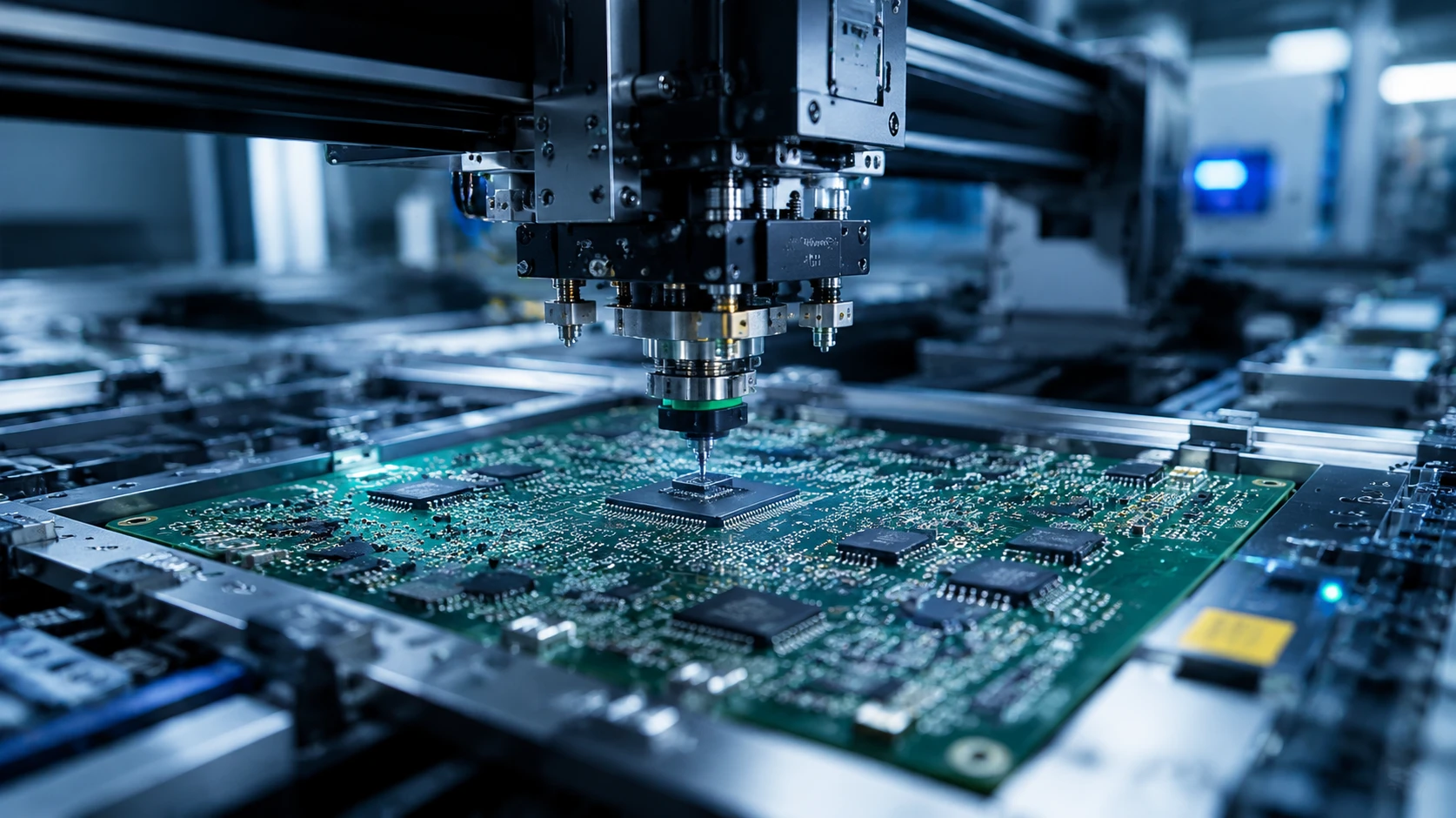
Modern electronics manufacturing lines are highly automated environments where precision scheduling software coordinates high-speed machinery to assemble intricate circuit patterns. To successfully process dense, multi-layered electronic systems, factories rely on advanced pcb assembly equipment that can consistently place sub-millimeter surface-mount technology (SMT) components while securely anchoring heavy through-hole technology (THT) power devices. Industrial-grade production setups must run concurrent, optimized assembly lines to accommodate diverse component shapes and processing configurations.
Surface-mount assembly handles the overwhelming majority of modern component placements. High-speed pick-and-place lines feature multi-gantry systems and advanced vision alignment cameras capable of mounting thousands of components per hour, ranging from microscopic 01005 passives to dense, fine-pitch Ball Grid Arrays (BGAs). To prevent internal circuit shorting or structural solder voids beneath fine-pitch BGAs, the raw paste deposition phase must be continuously monitored via inline 3D Solder Paste Inspection (SPI) machines before entering the component placement phase. For a complete look at these multi-stage production setups, technical design teams can review our
While surface-mount components excel at high-density signal routing, heavy-duty industrial components—such as large terminal blocks, power transformers, high-voltage electrolytic capacitors, and ruggedized system connectors—require the mechanical strength provided by tht pcb assembly. Inserting component leads directly through plated through-holes establishes a robust mechanical anchor that resists continuous vibrational stress, heavy physical impacts, and severe thermal expansion shifts.
Modern factories optimize this process by pairing automated dual-wave soldering systems with precise selective wave soldering machinery, protecting delicate surface-mount components on the bottom layer while ensuring complete vertical solder fill around through-hole pins. By integrating these specialized production lines under one roof, an experienced manufacturing facility can execute complex, high-reliability pcb assembly smt and through-hole processing workflows simultaneously on a single board, maximizing structural stability and signal integrity.
Industrial electronics rarely sit isolated in gentle environments; they are typically mounted securely inside cast-aluminum housings, heavy steel NEMA enclosures, or high-vibration vehicle chassis systems. Sourcing circuit hardware from an established partner offers massive advantages in cost optimization, ecosystem responsiveness, and scale. The electronics manufacturing clusters host a deeply integrated network of material suppliers, specialized chemical processing lines, automated optical inspection developers, and precision laser-drilling equipment manufacturers.
Direct factory access to premium raw components enables a modern facility to maintain an uninterrupted production flow, insulate clients from raw material market fluctuations, and offer highly competitive lead times. Consequently, the mechanical fabrication of the raw circuit board substrate is just as critical as the placement of the electrical components. Securing a multi-layered circuit board inside a heavy industrial housing requires advanced mechanical modifications, including countersunk and counterbored mounting holes, to allow high-torque fastening hardware to sit flush with or below the laminate surface.
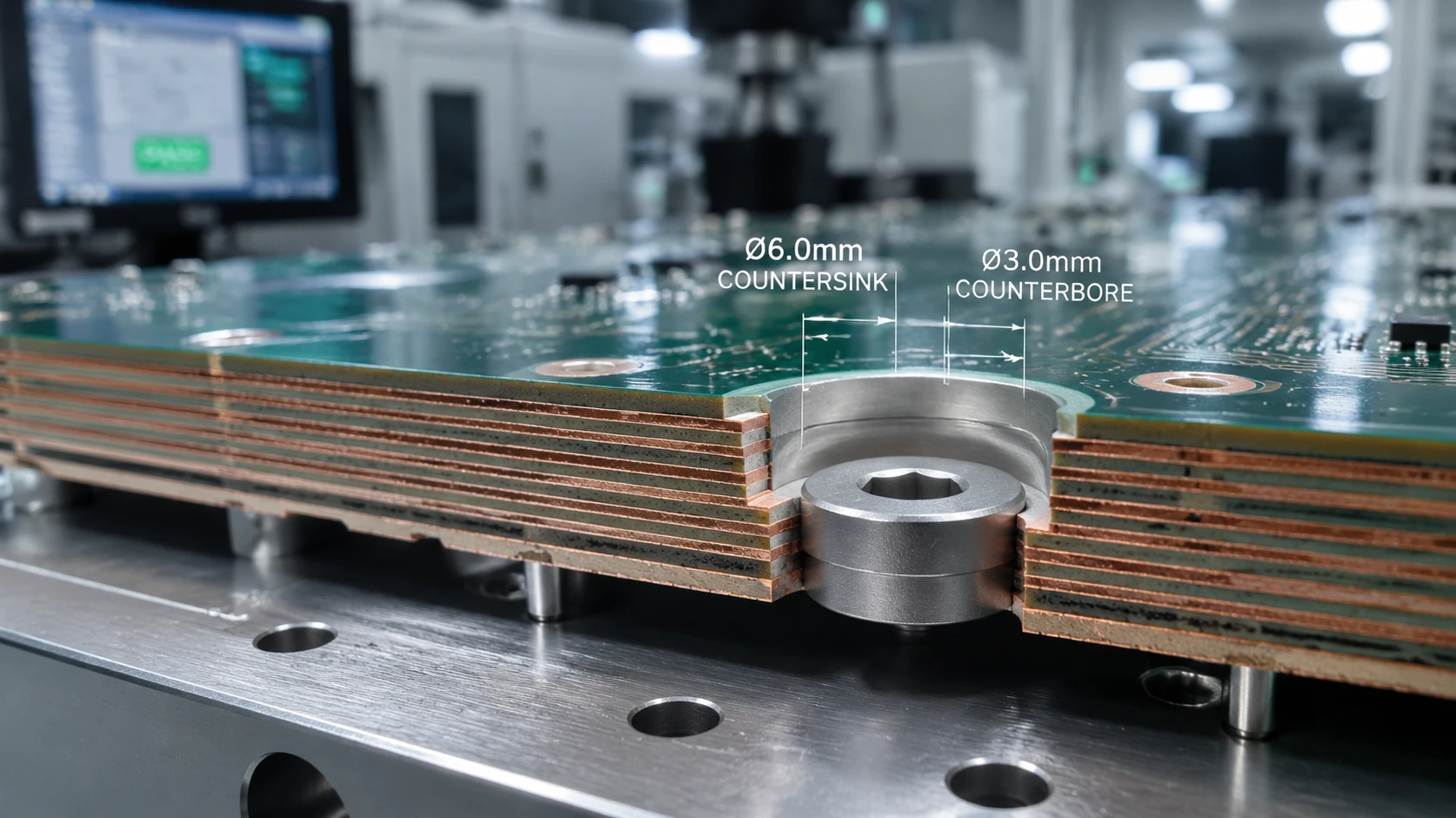
When a product housing requires flat-head or oval mechanical screws to achieve a perfectly smooth surface finish, engineers specify precise countersink holes in pcb assembly. This process uses a specialized conical drilling tool to create a precisely angled bevel around the perimeter of a standard mounting hole. Achieving a secure, vibration-resistant fit requires maintaining tight manufacturing tolerances during precision countersink in pcb assembly operations. The depth and angle of the bevel, which typically covers standard configurations like 82, 90, or 120 degrees, must match the screw head geometry perfectly. Any depth variation can lead to uneven pressure across the laminate layers, causing copper cracking, trace delamination, or board warping when tightened down on the factory floor.
For designs that use heavy-duty socket head cap screws or hex bolts to withstand extreme mechanical loads, hardware engineers rely on counterbore holes in pcb assembly. Unlike an angled countersink, a counterbore is a flat-bottomed, cylindrical enlargement of an existing hole that allows the fastener head and matching lock washers to sit entirely below the outer laminate layer. This processing requires strict depth-control software on automated CNC milling systems to cut through the glass-epoxy matrix without encroaching on internal voltage planes or signal routing traces.
As industrial systems shrink, mechanical spaces become increasingly tight. In complex industrial products, engineers often implement a specialized tapped counterbore in pcb assembly to allow mounting hardware to thread directly into structural internal metal cores or heavy-duty copper backplanes without requiring bulky nuts on the opposite side of the board. Furthermore, a standardized 3mm counterbore pcb assembly work profile is widely used across multi-tier automated industrial brackets. This specific sizing allows standard M3 industrial bolts to sit completely flush, preventing physical interference with surrounding component housings or adjacent shield enclosures. Enterprise sourcing teams looking to optimize these mechanical properties can access our
To transition an enterprise hardware design smoothly from an initial digital schematic into a defect-free physical assembly, the manufacturing facility must execute a highly controlled, multi-stage pcb assembly process. Each phase of this workflow is carefully tracked by computerized Manufacturing Execution Systems (MES) to maintain complete transparency and material traceability.
The assembly lifecycle begins with a clean, bare panel loaded onto an automated stencil printing system. A precise squeegee blade applies lead-free solder paste through a laser-cut stainless steel stencil, depositing exact volumes of paste onto the exposed surface pads. Immediately following paste application, the panels pass through a 3D Solder Paste Inspection (SPI) system. This step uses laser triangulation to verify the exact height, area, volume, and alignment of every single paste deposit, automatically alerting operators to any print deviations before components are placed.
Once verified by the SPI system, the panel moves to the high-speed SMT placement cells. These machines feature dual-gantry positioning systems and optical centering cameras that verify component dimensions in real time. The pick-and-place systems handle everything from ultra-fine-pitch microcontrollers to large surface-mount connectors, placing them onto the solder paste with absolute precision.
After component placement, the populated panels are conveyed into a multi-zone forced-convection reflow oven. The internal atmosphere is strictly controlled using pure nitrogen gas to eliminate oxidation during heating. The assembly passes through multiple carefully tuned heating zones—including preheat, soak, liquidus reflow, and cooling stages. The oven's thermal profile is calibrated based on the board's overall copper density and laminate thickness, ensuring that all solder joints melt uniformly and solidify without overheating delicate internal silicon structures.
Once the panels emerge from the reflow oven, they undergo rigorous, automated inspection. Automated Optical Inspection (AOI) systems scan the board from multiple angles using high-resolution cameras and multi-color LED illumination arrays to verify component presence, correct orientation, polarity markings, and solder fillet geometries. For complex designs that feature hidden connections—such as bottom-termination components, land grid arrays (LGAs), or quad-flat no-lead (QFN) packages—the boards are routed to automated 3D X-ray inspection (AXI) chambers. This advanced imaging system penetrates the dense component packages to verify that no hidden shorts, solder bridges, or internal voids exist within the solder matrix.
After passing electrical and optical inspections, the panelized boards move to the mechanical modification cells. Here, heavy-duty CNC routing systems execute precision drilling and milling operations, creating required structural features such as countersunk or counterbored mounting apertures. Concurrently, manufacturing engineers will thoroughly review the time-to-delamination parameters of the material, specifically the T260 and T288 metrics. These values precisely define the safe operational minutes a multi-layer panel can survive continuous exposure to extreme temperatures of 260 degrees Celsius or 288 degrees Celsius before its internal interlayer structures begin to separate. Performing these mechanical milling steps after reflow prevents the board from experiencing stress-induced warping during high-temperature cycles and ensures that dust or particulate matter cannot compromise raw solder joints during printing.
Before leaving the cleanroom facility, completed boards are subjected to comprehensive functional testing (FCT) and custom in-circuit testing (ICT) to confirm that the entire circuit responds perfectly to simulated operational loads. Once validated, the assemblies receive an optional application of precision conformal coating to protect the circuits from moisture ingress, corrosive chemical vapors, and fine industrial dust. Finally, the finished products are vacuum-packed in anti-static ESD shielding bags and boxed with desiccant packs to ensure safe transport to the client’s final integration facilities.
For international enterprise buyers operating in highly regulated consumer, medical, and industrial automation markets, product compliance is a mandatory prerequisite for market access. If a circuit board assembly contains prohibited hazardous substances or fails to meet international electrical safety standards, the entire product line risks border rejections, costly legal penalties, and significant damage to brand reputation. To maintain continuous access to premium global markets, high-volume production lines must implement rigorous regulatory verification workflows.
A core standard in modern electronic product sourcing is a guaranteed rohs compliant pcb assembly workflow. The Restriction of Hazardous Substances (RoHS) directive strictly limits the use of specific hazardous materials—including lead, mercury, cadmium, and hexavalent chromium—in electronic components and solder alloys. Achieving certified lead-free production requires an integrated quality control network that extends across the entire factory supply chain.
Every batch of raw components, laminates, and prepreg materials must be verified with certified documentation and scanned using X-ray Fluorescence (XRF) spectrometers to confirm the complete absence of restricted substances before warehouse entry. To prevent cross-contamination, lead-free solder pastes, flux formulations, and cleaning chemicals are segregated on dedicated production lines with isolated stencils, squeegees, and wave soldering pots. Because lead-free SAC305 solder alloys require a higher melting point than traditional leaded solders, reflow ovens must maintain highly stable, elevated temperature profiles to ensure clean solder wetting without inducing thermal stress or delamination in the laminate layers.
For extreme industrial applications where equipment failure could disrupt critical factory infrastructure, standard commercial manufacturing standards are insufficient. Enterprise buyers must specify IPC Class 3 manufacturing guidelines, which dictate exceptionally tight assembly tolerances, thicker vertical copper plating in through-hole via barrels, and strict internal cleanliness standards to prevent chemical corrosion over years of continuous field service. Partnering with a certified pcb assembly manufacturing facility ensures that your production runs are backed by rigorous quality control systems, providing maximum field reliability and predictable performance across the entire lifecycle.
When scaling an industrial hardware product line from early engineering prototypes to high-volume manufacturing, minimizing hidden overhead costs and reducing component scrap rates are essential to ensuring a strong return on investment (ROI). Experienced procurement heads understand that total production costs are determined by choices made during the early layout and panel design phases. To maximize material utilization and lower overall production costs, hardware engineering teams rely on three key optimization strategies:
During automated processing, individual boards are kept in larger panel arrays to navigate high-speed conveyor lines safely. Designing an optimized panel array allows engineers to arrange multiple individual circuit boards into a single, standardized manufacturing frame. This practice maximizes raw material utilization, minimizes wasted laminate space along the tooling rails, and significantly speeds up overall pick-and-place times. To learn how optimized layouts improve material yield and lower processing costs, procurement leads can download our
Custom mechanical details—such as non-standard countersink angles or highly complex stepped counterbores—require specialized, low-speed CNC tooling interventions that increase overall machine cycle times. By standardizing mechanical features around widely used industrial sizes, such as a 3mm counterbore pcb assembly work profile, design teams can use standard factory cutting tools, reduce setup overhead, and lower total manufacturing costs.
Reviewing component clearances, trace widths, thermal reliefs, and via structural layouts before releasing final fabrication files allows hardware teams to resolve production issues before automated assembly begins. This proactive approach prevents costly line stoppages, eliminates manual rework, and ensures high first-pass yields across volume production runs. For a detailed guide on structuring raw panels and optimizing high-volume production flows, engineering teams can access our technical article on

Executing a precision countersink in pcb assembly requires advanced CNC drilling systems configured with precise depth-control sensors. This precision ensures that the conical bevel is drilled to the exact depth and angle specified in the design files without cutting into internal trace networks or compromising the structural integrity of the surrounding multi-layer laminate. ApolloPCB monitors these mechanical machining processes under strict quality controls to ensure high-vibration fastening hardware always sits perfectly flush.
A 3mm counterbore pcb assembly work configuration is highly preferred across global industrial supply chains because it integrates perfectly with standard metric M3 mechanical fasteners. This standardization allows high-torque socket head cap screws to sit completely flush with or below the board surface, eliminating physical clearance issues with adjacent shielding housings or tightly spaced internal product enclosures. ApolloPCB offers standardized mechanical milling lines to support efficient processing for these standard mounting requirements.
ApolloPCB operates dedicated lead-free processing zones and carries full certification for rohs compliant pcb assembly workflows. We subject all incoming raw component stocks, laminates, and solder alloys to strict material inspections and continuous X-ray Fluorescence (XRF) chemical screening checks. This rigorous process guarantees that zero restricted hazardous substances enter the automated production environment, ensuring full regulatory compliance for your products in global markets.
Succeeding in the global industrial electronics market requires moving past simple transitional brokers and partnering with an integrated manufacturer capable of executing advanced material science, complex mechanical processing, and high-precision automated assembly under one roof. Maintaining a reliable product supply chain requires a manufacturing partner that combines technical expertise, advanced machinery, and rigorous quality control systems.
ApolloPCB provides a vertically integrated manufacturing ecosystem equipped with state-of-the-art pick-and-place lines, 3D SPI/AOI verification cells, automated X-ray inspection systems, and advanced multi-axis CNC drilling machinery. Whether your design requires complex mechanical processing like precision countersink in pcb assembly work or high-density surface-mount processing certified to IPC Class 3 standards, our engineering cells ensure your hardware scales smoothly with maximum reliability.
Ready to optimize your product sourcing pipeline, eliminate field failures, and streamline your volume production runs? Please contact our international support team and

Got project ready to assembly? Contact us: info@apollopcb.com



 Whatsapp 0086 755 29438407
 Mail info@apollopcb.com
 Tel 0086 755 29438407


ABOUT US

PRODUCTS
TECHNOLOGY
KNOWLEDGE CENTRE
CULTURE
NEWS
We're not around but we still want to hear from you! Leave us a note:

Leave Message to APOLLOPCB
