




-
- PCB TYPE
- PRINTED CIRCUIT BOARD PROTOTYPE ALUMINUM PRINTED CIRCUIT BOARD R&F PCB FPC HIGH FREQUENCY PCB HIGH-TG PCB HEAVY COPPER PCB HDI PCB PCB FOR LIGHTING METAL CORE PCB


time:Jun 06. 2026, 11:11:46
The industrial electronics sector is currently managing an unprecedented architectural shift. As hardware designers, electrical engineers, and original equipment manufacturers (OEMs) look to maximize functional density within increasingly tight physical footprints, traditional unboard routing methods are hitting a wall. High-pin-count microprocessors, multi-gigabit data buses, and dense sensor arrays require reliable interconnections that can navigate complex 3D form factors. Traditional wire harnesses and ribbon cables, while pliable, introduce manual assembly errors, high point-of-contact resistance, parasitic inductance, and significant weight penalties—vulnerabilities that modern high-reliability applications cannot tolerate.
To overcome these physical constraints, next-generation industrial systems rely on the integration of the advanced rigid flex pcb. By combining standard rigid FR4 board sections with thin, dynamic polyimide flexible substrates into a single, cohesive, multi-layered hardware platform, engineers can design complex, highly custom three-dimensional circuits. This integration eliminates the need for failure-prone plug-in connectors and discrete cables, turning a multi-board hardware architecture into a single continuous electronic platform.
Sourcing these complex structures requires moving away from general-purpose board shops. Successfully executing a rigid flex rigid pcb design demands a highly specialized rigid flex pcb manufacturer capable of managing different material thermal expansions, precise multi-stage vacuum laminations, and tight registration tolerances.
ApolloPCB stands at the forefront of this manufacturing space, providing advanced rigid-flex PCB solutions configured to minimize total cost of ownership (TCO) while securing zero-defect field reliability across the most demanding operational environments.
Understanding the engineering value of a pcb flex rigid layout requires looking at how it changes system-level integration. In an industrial or medical environment, a circuit board is regularly exposed to mechanical vibrations, sudden thermal shocks, and spatial restrictions. Here is an analytical look at the core advantages of rigid flex pcb architectures when compared to traditional multi-board connector assemblies:
In automated factory equipment, automotive powertrains, or aerospace avionics, constant high-frequency vibration is a leading cause of hardware failure. Traditional crimped wire terminals and board-to-board plastic connectors are highly vulnerable to fretting corrosion, terminal backed-out anomalies, and micro-disconnections. A custom-engineered rigid-flex board replaces these mechanical friction points with a continuous chemical and metallurgical bond. Traces run continuously from the rigid section, through the flexible polyimide core, and into the opposing rigid terminal zone without interruption, eliminating connector wear and ensuring reliable field operation.
Eliminating bulky vertical connectors and hand-wired cables allows hardware teams to compress their mechanical enclosures by up to 60% in volume and shed up to 70% of packaging weight. This space-saving capability is highly beneficial for high-density applications like implantable medical devices, defense tracking modules, and compact down-hole drilling instrumentation, where every cubic millimeter is at a premium.
Every mechanical connector junction behaves like an impedance discontinuity in high-speed digital systems, introducing parasitic capacitance, trace reflections, and potential electromagnetic interference (EMI). Running signal lines across a continuous, un-jointed copper plane allows a certified flex rigid pcb manufacturer to maintain strict characteristic impedance matching across the entire board. This layout significantly reduces insertion losses and signal cross-talk, which is critical when routing multi-gigabit interfaces like PCIe, USB 4.0, or high-speed LVDS camera buses.
To balance structural flexibility with robust electrical performance, our engineering cells leverage the advanced material data sets detailed in our industry spectrum review on aluminum and flexible PCB thermal properties.
The primary challenge in rigid flex pcb fabrication lies in material science. A rigid-flex assembly bonds inherently mismatched materials: rigid glass-epoxy FR4 laminates, which are stiff and thick, and ultra-thin polyimide films, which are pliable and hygroscopic. These layers must remain perfectly bonded across thousands of thermal cycles and structural stresses without delaminating or fracturing inner-layer copper traces.
Early-generation rigid-flex fabrication often used acrylic or butyral adhesives to bond the copper foil to the polyimide core layer. However, these organic adhesives feature an exceptionally high Coefficient of Thermal Expansion (CTE) along the Z-axis. When subjected to the high temperatures of lead-free reflow assembly (peaking around 260°C), the adhesive expands aggressively, placing severe upward stress on plated through-holes (PTH) and microvias, which frequently leads to hidden inner-layer track breaks.
To eliminate this failure mode, ApolloPCB builds high-reliability assemblies exclusively with 2-layer adhesiveless Flexible Copper Clad Laminates (FCCL). By bonding the copper directly to the polyimide core on a molecular level, we achieve a thinner profile, maximize thermal cycling endurance, and eliminate the risk of adhesive-driven via fractures during automated SMT reflow.
The metallurgical grain structure of the copper layer specified in your design determines its fatigue life in the field:
Electro-Deposited (ED) Copper: Formed via an electrolytic plating process, ED copper features a vertical, columnar grain structure. While suitable for rigid boards and static, bend-and-stay flex circuits, it is brittle. Under dynamic bending or heavy chassis vibrations, these vertical grain boundaries act as fracture paths, leading to rapid trace failure.
Rolled Annealed (RA) Copper: Fabricated by running heavy copper ingots through high-pressure mechanical rollers, RA copper possesses a smooth, horizontal grain structure oriented parallel to the board surface. This grain structure makes RA copper exceptionally ductile, enabling it to handle continuous flexing and vibration over millions of cycles without work-hardening.
Standard rigid PCBs use standard "flow" prepregs that liquefy during lamination to fill void spaces. In rigid-flex processing, however, standard prepreg would bleed outward onto the exposed flexible zones, rendering them stiff and unusable. As an experienced rigid flex pcb supplier, ApolloPCB uses specialized "no-flow" or "low-flow" acrylic and epoxy prepregs. Our lamination presses use custom thermal profiles to ensure the bonding agent cures perfectly at the rigid-to-flex boundary line without weeping onto the active flexible segments.
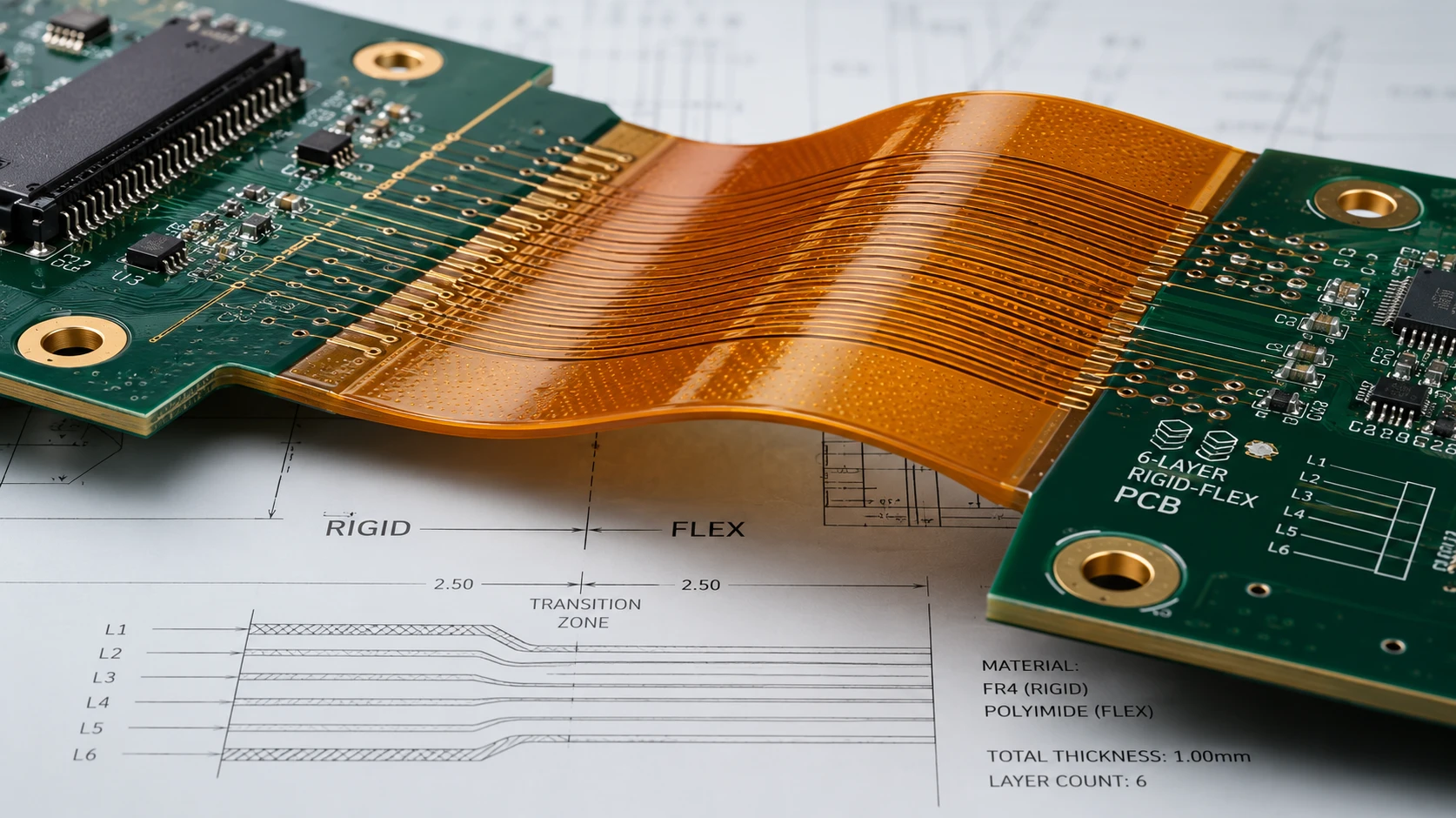
Fabricating an integrated rigid flex rigid pcb requires specialized, highly automated production lines and deep process engineering. The material stackup must pass through multiple processing steps, alternating between chemical wet lines, precise laser ablation chambers, and high-pressure lamination presses.
Here is a detailed breakdown of the advanced rigid flex pcb manufacturing process executed inside our IATF 16949 compliant facilities:
Raw polyimide film absorbs ambient moisture from the air. Before processing, all material batches undergo a multi-hour vacuum dehydration bake. This process completely drives out moisture, locking down the material's dimensions and preventing delamination or blistering when the boards encounter high lamination or reflow temperatures later in the pipeline.
The adhesiveless flexible core is coated with a liquid photoresist and imaged using high-resolution Laser Direct Imaging (LDI) systems. LDI writes the trace path directly onto the panel via a computer-controlled UV laser beam, automatically compensating for micro-scale material expansion or contraction. The unexposed copper is removed in a chemical etching chamber to form the fine-line flexible circuits.
To protect the delicate copper traces within the flexible sections from oxidation and ambient moisture, a polyimide coverlay film is pre-cut using high-speed UV laser cutters. Technicians align the coverlay over the etched traces using high-magnification optical systems before loading the panels into a vacuum hydraulic press. This press bonds the coverlay firmly to the core, preventing any air pockets or voids along the trace borders.
The rigid FR4 external layers and no-flow prepreg bonding sheets are pre-routed using precision CNC milling machines to remove material directly over the intended flexible flex zones. This selective material removal creates internal "windows" that allow the flexible sections to bend freely once final profiling is complete.
The prepared rigid layers, no-flow prepreg sheets, and internal flexible layers are stacked using optical pinned fixtures. The entire assembly is loaded into an automated vacuum press. The press applies a carefully managed temperature and pressure ramp-up, activating the no-flow prepreg to bond the rigid and flexible sections into a single, integrated multi-layer board.
Electrical connections between the rigid and flexible layers are formed using advanced dual-source (UV/CO2) laser drilling systems. These lasers form microvias down to 50 microns in diameter through the mixed material stackup. The drilled panels then pass through a specialized low-temperature gas plasma desmear chamber to clean resin smear out of the via holes, ensuring solid electrical contact for subsequent plating steps.
The panels pass through automated plating lines where periodic-reverse pulse electroplating deposits a uniform copper layer inside the microvias and through-holes without over-plating the outer pads. Exposed component pads are then plated with Electroless Nickel Electroless Palladium Immersion Gold (ENEPIG) to provide an ultra-flat surface profile that prevents brittle solder joints and supports high-precision wire bonding.
The external rigid material covering the flexible zones is removed using controlled-depth CNC milling and UV laser scoring. This step separates the rigid outer pieces from the active polyimide layers, allowing the flexible sections of the finished board to bend and flex as intended. Every finished batch then undergoes 100% automated optical inspection (AOI) and high-voltage electrical testing before final packaging.
Procurement leads and engineering directors must ensure their manufacturing partner possesses the technical capabilities required to build complex multi-layer designs. A high-tier rigid-flex pcb manufacturer must maintain tight process controls to prevent layer-to-layer misregistration as complexity and layer counts scale up.
ApolloPCB supports an extensive range of advanced rigid flex pcb fabrication capabilities designed to help technology factories bring complex hardware to market:
Multi-Layer Stackups: We offer full volume production for complex configurations, functioning as a reliable 6 layer rigid-flex pcb manufacturer up to dense 12-layer boards, allowing complex ground planes and high-speed signal lines to be routed across distinct layers.
High-Density Interconnect (HDI) Microvias: We support advanced via-in-pad layouts featuring stacked or staggered blind and buried microvias down to 50 microns, maximizing routing density in compact designs.
Fine-Line Feature Execution: Our LDI photolithography and fluid-dynamic etching lines reliably process fine trace configurations down to 25-micron line and space widths, preventing trace undercutting and short circuits.
Integrated Rigid Stiffeners: We integrate localized FR4, polyimide, or aluminum stiffeners directly beneath high-pin-count components or heavy SMT connectors, ensuring the board can withstand heavy insertion forces during final manual assembly.
To review our complete list of manufacturing parameters and material stackups, view our engineering directory for advanced rigid-flex PCB fabrication.
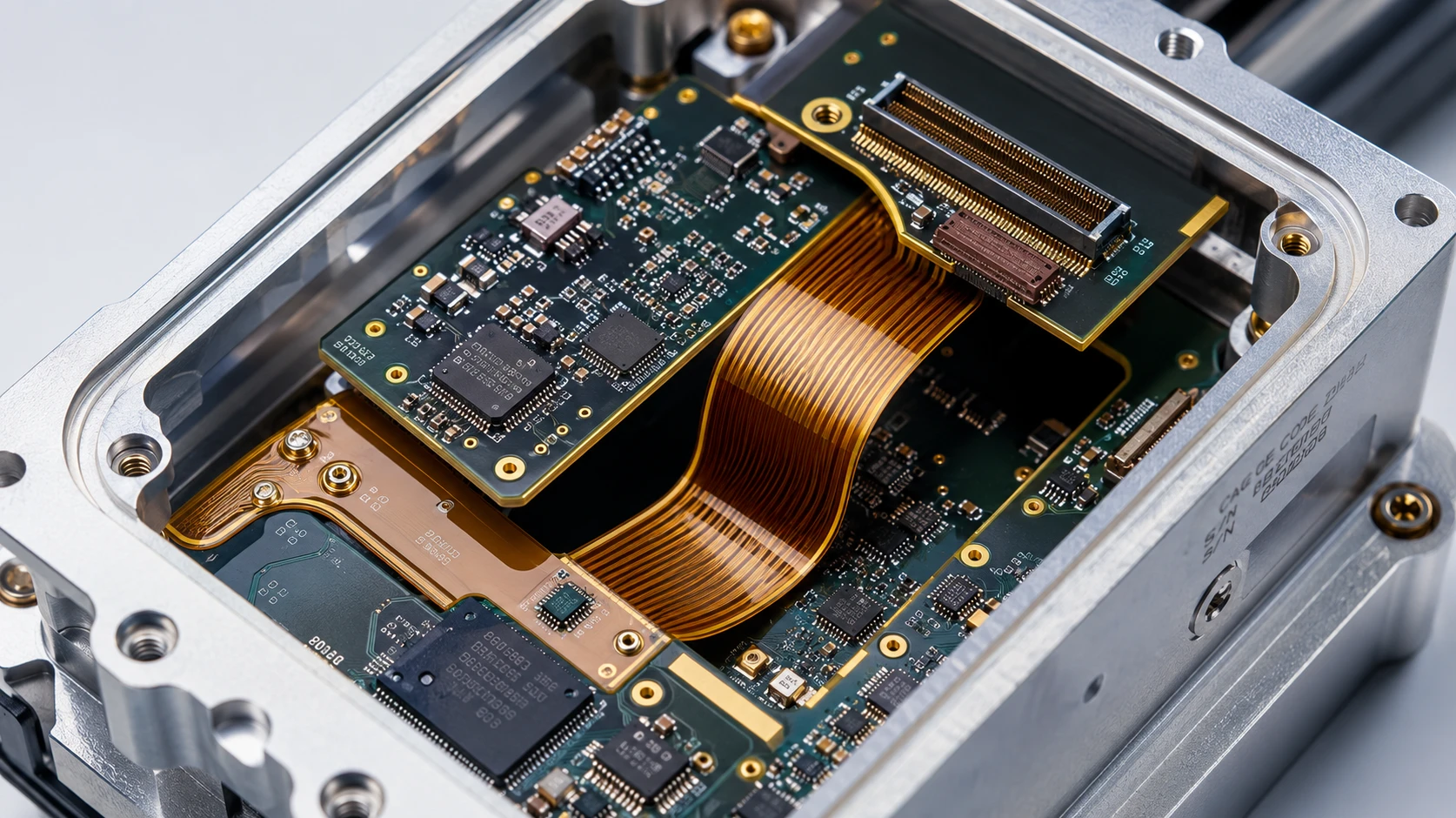
Achieving a high-yielding, cost-optimized production run requires close alignment between the initial layout files and the physical constraints of the manufacturing floor. Following verified rigid flex pcb design guidelines during the layout phase reduces NPI engineering loops and protects against early mechanical failures.
To help your team optimize their designs, our engineering cells recommend following these core layout principles during the CAD design phase:
To prevent copper work-hardening and trace fractures within the flexible sections, designers must maintain a safe bend radius based on the material thickness. For standard double-sided flexible sections, the minimum bend radius should be at least 10 times the total thickness of the flexible layer stack. For dynamic applications that experience continuous flexing, this parameter should be increased to 20 times the layer thickness to ensure long-term mechanical survival.
Standard sharp, 90-degree trace corners create stress-concentration points that can crack under repetitive bending forces. All trace transitions inside the flexible zone and across the rigid-to-flex boundary must use smooth, radiused corners or 45-degree angles. Furthermore, traces should run perpendicular to the primary bend axis to distribute mechanical stress evenly across the copper grain structure.
Copper pads located near the rigid-to-flex boundary line are highly vulnerable to peeling off due to mechanical shear forces. Designers should extend the coverlay film at least 1 millimeter inside the rigid section to lock the edge pads firmly down. Additionally, adding "teardrop" pad connections where traces meet component pads helps distribute mechanical stress and prevents track breaks at the junction point.
When designing multi-layer flexible sections, traces on opposing layers should not be routed directly on top of each other. Staggering the traces in an alternating "I-beam" layout reduces overall board stiffness, improves flexibility, and prevents internal layer-to-layer shear failures during bending cycles.
In industries like medical equipment, aerospace tracking, and industrial automation, component failure can compromise passenger safety, disrupt production infrastructure, or cause millions of dollars in warranty liability. Therefore, an elite rigid flex pcb supplier must back its hardware with transparent, data-driven quality metrics. ApolloPCB operates under a strict quality management system certified to IPC Class 3 (Advanced High-Reliability Electronic Products) and IATF 16949 (Automotive Quality Management Systems) baselines.
[100% Netlist Electrical Check] ──> [Dynamic Flex Stress Rig] ──> [Micro-Sectioning Void Check]
Our quality assurance department subjects every production batch to a strict testing regimen before final shipment to ensure long-term performance:
Automated Optical Inspection (AOI): Advanced 3D AOI scanners check the trace geometry of both inner and outer layers against the original digital CAD netlist, catching any micro-shorts or neckdowns before lamination.
Destructive Micro-Sectioning Analysis: Specialized micro-section coupons are processed alongside every manufacturing panel. Our laboratory cuts and polishes these coupons to verify exact copper plating thicknesses inside microvias and through-holes under high-magnification microscopes, ensuring the complete absence of inner-layer separation or resin voids.
Real-Time Dynamic Flex Strain Testing: Completed boards are mounted in motorized testing jigs that flex the polyimide sections through specified angles and speeds. Automated multi-meters monitor trace resistance in real time, verifying that the copper grain structure survives the mechanical demands of the application.
100% Netlist Electrical Validation: Automated flying probe testers or custom test fixtures check every independent circuit path on every board against the original schematic, ensuring zero open circuits, micro-shorts, or insulation breakdowns.
This comprehensive quality control infrastructure provides international procurement departments and quality directors with an authoritative layer of operational confidence. By maintaining clear material lot traceability, automated optical inspection records, and environmental test documentation for every production run, ApolloPCB delivers reliable pipelines that easily pass the most stringent corporate supplier audits.

The primary cause of layer delamination is trapped moisture within the hygroscopic polyimide core or the mismatch in Coefficient of Thermal Expansion (CTE) caused by high-flow acrylic adhesive layers. ApolloPCB mitigates this risk by using premium adhesiveless copper-clad laminates and applying a strict multi-hour vacuum dehydration pre-bake immediately before lamination and SMT assembly to completely remove trapped moisture.
Yes. ApolloPCB operates an advanced engineering matrix capable of processing asymmetric and custom multi-layer stackups, including uneven layer distributions across rigid and flexible zones. Our engineering team conducts a thorough pre-production DFM review to ensure the custom layout remains balanced during pressing, preventing any panel warping or registration errors.
Standard ENIG can develop micro-fissures, known as "black pad" brittle fractures, when exposed to continuous mechanical vibration or thermal shock. ENEPIG adds an intermediate layer of electroless palladium between the nickel and immersion gold layers. This palladium layer stabilizes the nickel matrix, completely eliminates intermetallic failures, provides an ultra-flat surface for fine-pitch SMT assembly, and supports high-reliability thermosonic wire bonding.
As industrial electronics incorporate more advanced sensors, denser computing modules, and tighter mechanical enclosures, the demand for highly reliable rigid-flex circuitry will continue to grow. Securing your market position requires moving past transactional part-brokers and partnering with an integrated manufacturer capable of executing advanced material science, complex multi-layer fabrication, and automated high-density SMT assembly.
ApolloPCB blends engineering expertise, advanced manufacturing infrastructure, and strict quality validation to eliminate supply chain fragmentation and protect your hardware investment from prototype to full-scale OEM deployment. To optimize your hardware architecture and reduce your total cost of ownership, view our detailed directory for integrated flexible printed circuit systems or access our full spectrum of specialized turnkey flex-rigid processing cell guides.
Ready to eliminate field failures, reduce hidden logistical overhead, and compress your product development timeline? Request an instant custom FPC technical quote from the ApolloPCB engineering team today, and discover how our integrated prototype-to-production solutions can drive value for your business platform.

Got project ready to assembly? Contact us: info@apollopcb.com



 Whatsapp 0086 755 29438407
 Mail info@apollopcb.com
 Tel 0086 755 29438407


ABOUT US

PRODUCTS
TECHNOLOGY
KNOWLEDGE CENTRE
CULTURE
NEWS
We're not around but we still want to hear from you! Leave us a note:

Leave Message to APOLLOPCB
