




-
- PCB TYPE
- PRINTED CIRCUIT BOARD PROTOTYPE ALUMINUM PRINTED CIRCUIT BOARD R&F PCB FPC HIGH FREQUENCY PCB HIGH-TG PCB HEAVY COPPER PCB HDI PCB PCB FOR LIGHTING METAL CORE PCB


time:Feb 22. 2026, 10:40:48
In the rapidly evolving landscape of solid-state lighting, selecting the correct SMD LED package size is a foundational decision that impacts everything from thermal management to the final footprint of the pcb board manufacturing process. For industrial factories, understanding these specifications is not just about aesthetics; it is about optimizing the assembly line and ensuring long-term product reliability.
At ApolloPCB, we integrate these technical standards into our pcb fabrication and assembly services to ensure that your LED arrays are built to international quality benchmarks.
| Package (Imperial) | Metric (mm) | Dimensions (L x W mm) | Common Application |
| 0402 | 1005 | 1.0 x 0.5 mm | Ultra-compact indicators, Smartphones |
| 0603 | 1608 | 1.6 x 0.8 mm | Standard status indicators, Backlighting |
| 0805 | 2012 | 2.0 x 1.25 mm | General lighting, Consumer electronics |
| 1206 | 3216 | 3.2 x 1.6 mm | Automotive dashboards, Power indicators |
| 2835 | - | 2.8 x 3.5 mm | High-brightness LED strips, Lighting |
| 3528 | - | 3.5 x 2.8 mm | Architectural lighting, Signage |
| 5050 | - | 5.0 x 5.0 mm | RGB LEDs, High-power modules |
The naming of SMD (Surface Mount Device) LEDs—such as 2835, 3030, or 5050—refers to the physical dimensions of the component in millimeters. For instance, a 2835 LED measures 2.8mm X 3.5mm.
Power Consumption: Smaller packages like 0603 are typically for indicator lights, while larger packages like 5050 are designed for high-lumen illumination.
Thermal Pad Design: High-power LEDs (e.g., 3030) often feature a dedicated thermal pad on the bottom to facilitate heat transfer to an aluminum pcb board.
Luminous Efficiency: Larger surface areas often allow for multiple chips within one package, increasing the total light output.
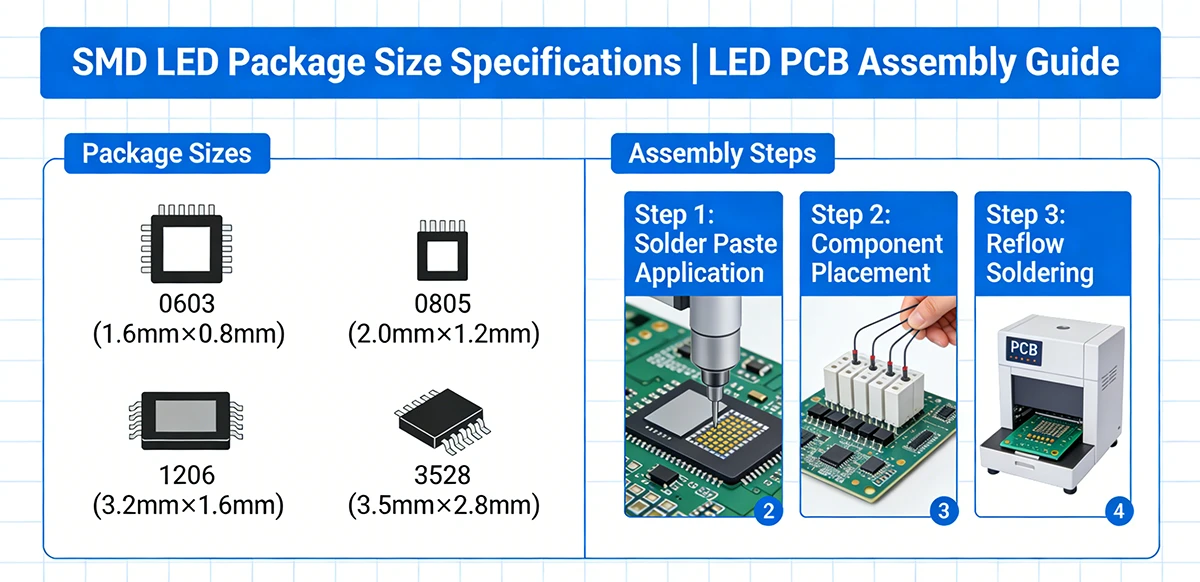
Choosing the right package depends on your target application and the capabilities of your pcb smt assembly line.
| Package Style | Dimensions (mm) | Common Power | Primary Application |
| 0603 | 1.6X0.8 | 0.05W | Indicator lights, small displays |
| 0805 | 2.0X1.25 | 0.1W | Backlighting, signal status |
| 2835 | 2.8X3.5 | 0.2 - 0.5W | LED strips, bulbs, tube lights |
| 3030 | 3.0X3.0 | 1.0W | High-power street lights, floodlights |
| 5050 | 5.0X5.0 | 0.2 - 1.5W | RGB lighting, decorative modules |
| 5730 | 5.7X3.0 | 0.5W | High-brightness panels, downlights |
For factory procurement teams and hardware engineers, an LED is not just a light source—it is a thermal and mechanical component that dictates the entire metal core pcb design guidelines. The physical footprint of the LED package (SMD) influences the choice of substrate, the precision of the manufacturing equipment, and the overall efficiency of the assembly line.
Understanding this synergy is the key to reducing field failures and optimizing pcb assembly & manufacturing costs.
The smaller the LED package, the higher the "heat density" at the solder point. High-power LEDs, such as the 3030 or 5730, are engineered to push the limits of brightness, but this comes at the cost of significant localized heat generation.
Substrate Selection: Attempting to run high-power SMD LEDs on a standard FR4 board is a recipe for rapid lumen depreciation and premature failure. At ApolloPCB, we recommend an aluminium core pcb for these specific package sizes. The metal base acts as an integrated heat sink, pulling thermal energy away from the LED junction instantly.
Thermal Pad Optimization: Large packages often feature a neutral thermal pad. Our pcb fabrication manufacturer process ensures that the copper "pour" under these pads is optimized with maximum surface area contact to the dielectric layer, ensuring a low-resistance thermal path.
As package sizes shrink to indicator-level dimensions like 0603 or 0805, the margin for error in fabrication disappears. The "Solder Mask Dam"—the tiny strip of mask between two solder pads—becomes the primary defense against production defects.
Preventing Solder Bridging: If the solder mask is not aligned with micron-level accuracy, solder paste can bleed across pads during reflow, causing shorts. At ApolloPCB, our high-resolution pcb board manufacturing machine (utilizing LDI technology) ensures these dams are maintained even on the most densely populated boards.
High-Reflectivity Finishes: For LED applications, the precision of the mask opening also affects the light output. Our surface mount pcb assembly lines are calibrated to work with "Super White" masks that offer >90% reflectivity, ensuring that light isn't lost to absorption by the board substrate.
From a factory throughput perspective, choosing your LED package size is a financial decision. Standardized sizes like the 2835 and 5050 are the "global languages" of the SMT world.
High-Speed Compatibility: These common sizes are highly compatible with universal high-speed pick-and-place machines. Choosing standard footprints means your project can be loaded onto our machines without specialized feeders or custom nozzle configurations, which directly lowers your pcb manufacturing assembly setup fees.
Reduced Rework: Standardized packages have well-documented "solder fillet" behaviors. This predictability allows our AOI (Automated Optical Inspection) systems to more accurately identify genuine defects, reducing the time spent on manual inspection and ensuring a faster transition from prototype pcb manufacturing to full-scale production.
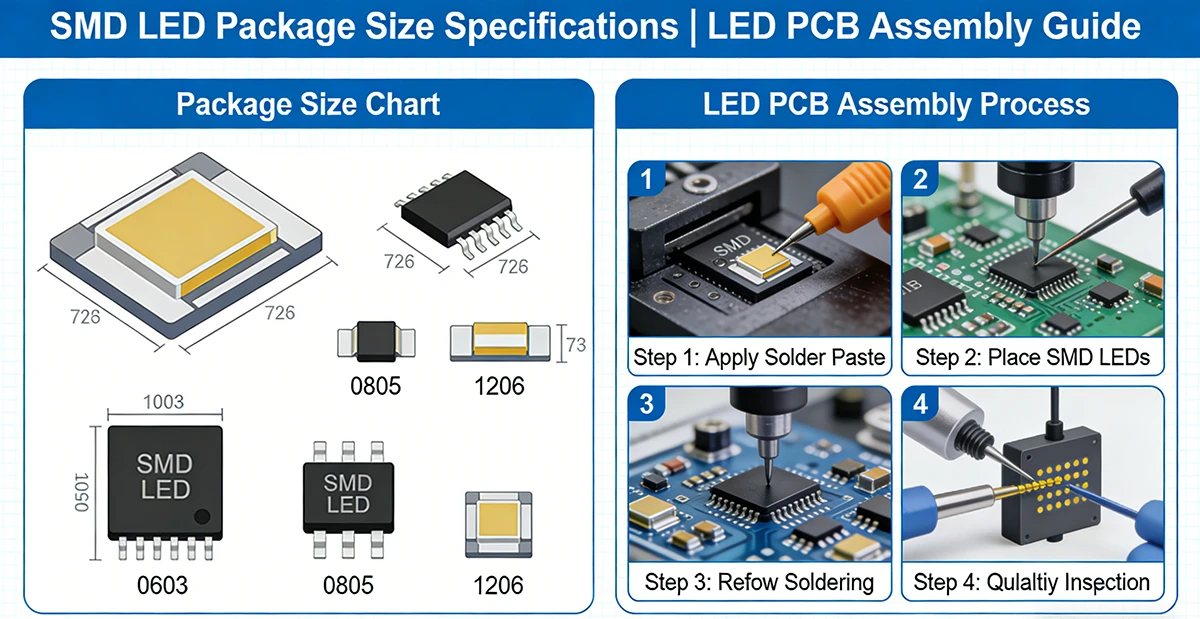
While standard aluminum substrates are the workhorse of the lighting industry, they have physical limits. For ultra-high-density LED arrays—such as those used in industrial UV curing, medical surgical lighting, or 5G-integrated smart systems—standard thermal management can fail. In these high-stakes factory environments, we turn to advanced materials like Aluminum Nitride (AlN) and Rogers PCB Hybrids.
In applications like UV curing or high-intensity laser diodes, the LED power density is so concentrated that the heat cannot be moved fast enough by a traditional dielectric layer. This is where Aluminum Nitride ceramic PCB technology becomes essential.
Extreme Thermal Conductivity: While a high-end aluminum board might offer $3.0\text{ W/m·K}$, Aluminum Nitride provides a staggering $>170\text{ W/m·K}$. Because the material itself is an electrical insulator, there is no need for a "bottleneck" dielectric layer between the circuit and the base.
Coefficient of Thermal Expansion (CTE): AlN has a CTE that closely matches that of silicon and ceramic LED chips. This reduces the mechanical stress on solder joints during rapid power cycling, preventing the "micro-cracking" that often plagues high-power industrial LEDs.
Industrial Use Cases: Medical sterilization equipment, high-power UV lithography, and concentrated photovoltaic (CPV) systems.
The modern lighting factory is no longer just producing "bulbs"; it is producing IoT-enabled smart nodes. When RF (Radio Frequency) control circuitry—such as Zigbee, Wi-Fi, or Bluetooth—must be integrated directly onto the same board as the high-power LEDs, a standard substrate is insufficient.
Signal Integrity Meets Power: High-frequency signals require materials with a low dielectric constant and low dissipation factor. We utilize Rogers FR4 PCB hybrids, where the RF signals travel on a specialized Rogers layer (like RO4350B), while the power and LED components sit on more cost-effective FR4 or metal-backed sections.
Space and Interference Management: By using a hybrid stackup, we eliminate the need for separate control modules. This reduces the device's overall footprint and minimizes EMI (Electromagnetic Interference) between the high-current LED drivers and the sensitive wireless antennas.
Industrial Use Cases: Smart city street lighting, wireless-controlled horticultural lighting, and adaptive automotive headlamps.
Manufacturing with AlN or Rogers requires a different caliber of pcb board manufacturing machine.
Ceramic Handling: AlN is brittle and requires specialized laser cutting or diamond-coated CNC bits to prevent shattering.
Hybrid Lamination: Bonding Rogers to FR4 or Metal requires precise "press cycles" to ensure that the different materials don't delaminate under the thermal stress of SMT reflow.
At ApolloPCB, we specialize in these complex stackups, providing the technical depth required to move your high-density lighting project from a concept to a high-yield industrial reality.
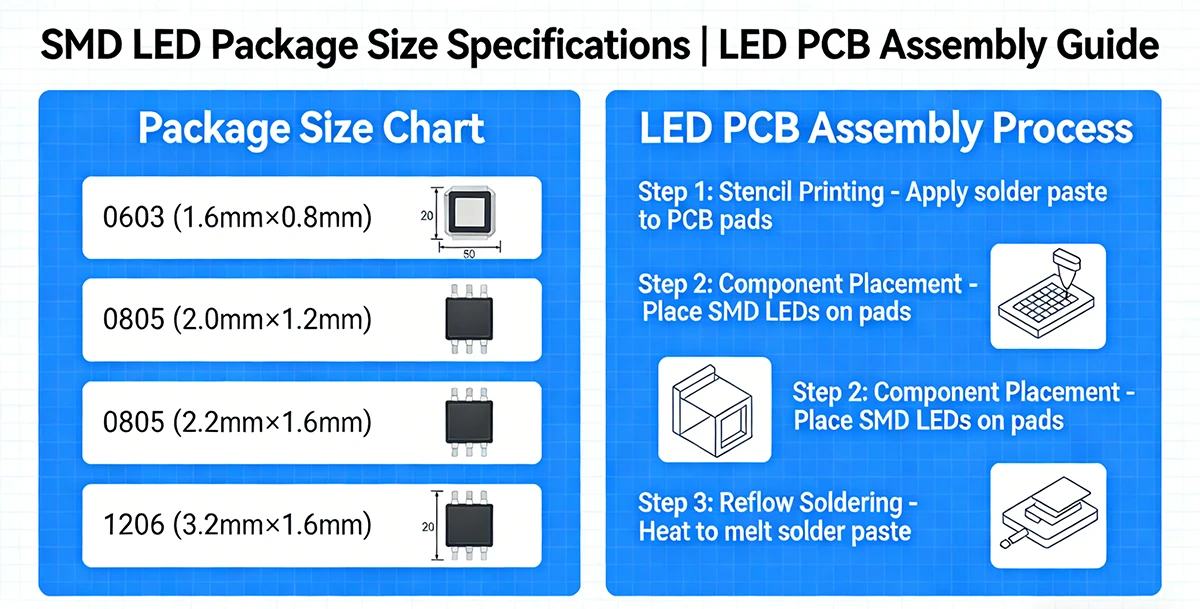
The 2835 is more efficient and has better heat dissipation due to its larger thermal pad relative to its size. The 5050 is often preferred for RGB (Multi-color) applications because its larger footprint can accommodate three separate chips (Red, Green, and Blue) easily.
Smaller LEDs allow for higher component density but require more expensive high-resolution inspection tools (like 3D AOI). Larger LEDs are easier to assemble but require more robust metal core pcb thermal management.
Yes. As a full turnkey pcb assembly expert, we source LEDs directly from top-tier manufacturers like Osram, Cree, and Lumileds, ensuring that the components perfectly match your footprint design.
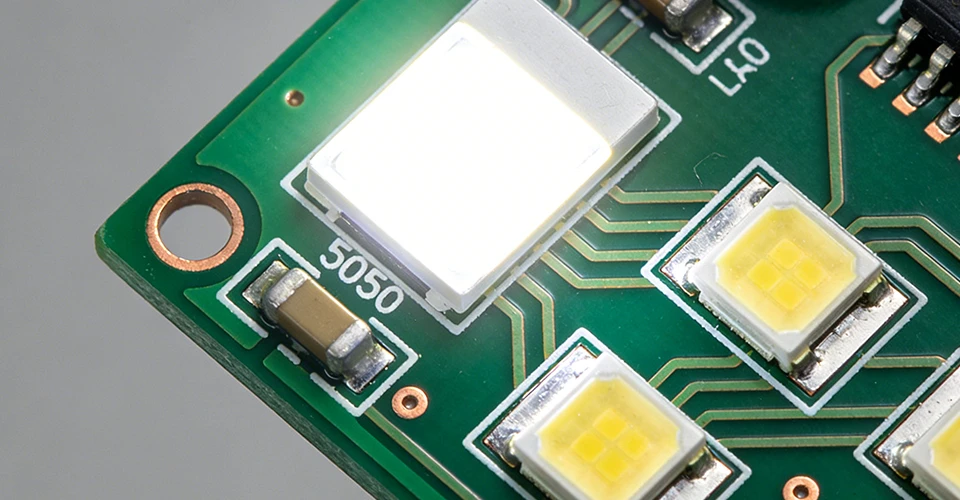
When planning a high-volume LED product, always verify the availability of the package size. While custom sizes exist, sticking to the standards in our Common SMD LED package size specification table ensures faster lead times and lower costs for your pcb manufacturing assembly.
[Contact ApolloPCB Today for a Free DFM Review and Precision Quote]
Related Articles:
SMD LED Sizes: Complete Specification Chart for OEM Layouts
LED Lighting Sinkpad PCB: Tailored Thermal Solutions for Next-Gen Illumination
CEM3 PCB Material Guide: ST210G Thermal Conductivity & LED Solutions
LED Lighting Aluminum PCB: Unveiling the Key to Illumination Innovation
Waterproof LED FPC Manufacturer: Core Waterproof Tech & Custom Solutions for LED Lighting Innovation

Got project ready to assembly? Contact us: info@apollopcb.com



 Whatsapp 0086 755 29438407
 Mail info@apollopcb.com
 Tel 0086 755 29438407


ABOUT US

PRODUCTS
TECHNOLOGY
KNOWLEDGE CENTRE
CULTURE
NEWS
We're not around but we still want to hear from you! Leave us a note:

Leave Message to APOLLOPCB
